



Pak PM Sharif appears before Panama Papers probe panel

Agencies
June 15, 2017

Islamabad, Jun 15: Prime Minister Nawaz Sharif today appeared before a Supreme Court-appointed team probing the Panamagate graft case, becoming Pakistan's first sitting premier to depose before such a panel.
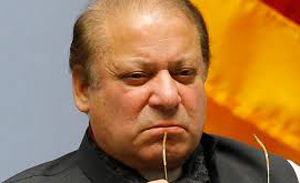
nawazA seemingly-relaxed Sharif arrived at the Judicial Academy - which has been temporarily turned into the Joint Investigation Team (JIT) secretariat - amid tight security.

According to official sources, more than 2,500 security personnel have been deployed.

The 67-year-old PML-N leader, who was accompanied by his eldest son Hussain Nawaz, brother Punjab Chief Minister Shehbaz Sharif and son-in-law Muhammad Safdar, waved at party workers and responded to their chants before entering the building.

A large number of PML-N supporters had assembled near the JIT secretariat, waiving their party flags and chanting pro- Nawaz slogans.

"The day that creates history & sets a much required & welcome precedent for others to emulate," Sharif's daughter Maryam Nawaz tweeted along with pictures of the PML-N leader and his top aides just before leaving for the JIT.

Dawn reported that the prime minister will face the 6- member JIT panel alone. It was not known for how long the JIT will question him.

The JIT chief Wajid Zia had summoned the prime minister to appear before the probe team on June 15 with all documents relevant to the case.

The summons was issued to Sharif, 67, after he returned last Saturday from Kazakhstan where he had attended the Shanghai Cooperation Organisation (SCO) Summit.

In its judgement of April 20 in the Panama Papers case, the Supreme Court had constituted a JIT and empowered it to summon the prime minister, his sons and any other person necessary, to investigate allegations of money-laundering, through which the four apartments in London's posh Park Lane area were purchased.

Sharif has denied any wrongdoing.

The Joint Investigation Team had questioned Sharif's sons -- Hussain and Hasan -- last month over the family's alleged improper business dealings.

His eldest son Hussain was questioned five times while Hasan, the youngerson, was summoned twice.

The court last year took up the case and issued a split decision over allegations of money laundering when Sharif was prime minister in 1990s.

On May 5, the Supreme Court set up a high-level six- member JIT to probe Sharif and his sons' alleged corruption in the Panama Papers case.

The JIT is bound to complete the probe in 60 days unless it is granted additional time.

It is for the first time that a sitting prime minister is appearing before a high-level probe team traditionally constituted to investigate high-profile criminal cases.

The JIT probing the offshore holdings of Prime Minister Sharif and his children has also summoned his younger brother and Punjab Chief Minister Shahbaz Sharif, to appear before it on June 17.

Comments

Add new comment

  • Coastaldigest.com reserves the right to delete or block any comments.
  • Coastaldigset.com is not responsible for its readers’ comments.
  • Comments that are abusive, incendiary or irrelevant are strictly prohibited.
  • Please use a genuine email ID and provide your name to avoid reject.
News Network
July 11,2020

Singapore, Jul 11: Singapore Prime Minister Lee Hsien Loong has secured a “clear mandate” with his ruling People’s Action Party (PAP) winning 83 of the 93 contested parliamentary seats in the general election held amidst the Covid-19 pandemic, with the Opposition gaining ground by winning a record 10 seats.

The ruling party, in power since independence in 1965, secured 61.24 percent of the total votes cast in the election, down from 69.9 percent in 2015. About 2.6 million Singaporeans voted on Friday.

“We have a clear mandate, but the percentage of the popular vote is not as high as I had hoped for,” 68-year old Lee told a PAP’s post-results press conference on Saturday morning.

The opposition Workers’ Party secured 10 seats and defeated a team in the Group Representation Constituency of Sengkang led by former Minister in the Prime Minister’s Office Ng Chee Meng who is also the Secretary-General of the power National Trades Union Congress (NTUC).

The Prime Minister assured it is “only right” that Workers’ Party’s Indian-origin secretary-general Pritam Singh be “formally designated” as the Leader of the Opposition, and that he will be provided with “appropriate staff support and resources to perform his duties”.

Lee took the results in “these circumstances” as an “endorsement” of the party’s policies and plans as he had called the elections amidst Covid-19 pandemic.

For latest updates and live news on coronavirus, click here

“We’ll take this forward and work with Singapore to realise those plans and solve the problems which we have,” Channel News Asia quoted the premier as saying.

Lee, who leads the PAP as secretary-general, said, “Singaporeans understand what’s at stake and why we must come together to uphold our national interests.”

He pledged to use this mandate “responsibly” to deal with the Covid-19 situation and economic downturn, to take Singapore “safely through the crisis and beyond”.

“The results reflect the pain and uncertainty that Singaporeans feel in this crisis, the loss of income, the anxiety about jobs, the disruption caused by the circuit breaker and the safe distancing restrictions,” he said.

This was not a “feel-good” election, said Lee, Singapore’s third prime minister who faces the city state’s worst recession with the economy projected to shrink between 7 and 4 per cent.

Lee acknowledged that the result also showed a “clear desire” for a diversity of voices in Parliament.

“Singaporeans want the PAP to form the government, but they, and especially the younger voters, also want to see more opposition presence in parliament,” he noted.

Lee added that he looks forward to the participation and contribution of the Opposition in parliament.

Singh, whose Workers’ Party team retained Aljunied Group Representation Constituency (GRC), will have 10 elected MPs now, up from six previously. His fellow member also retained the Hougang single-member constituency seat.

“Whether it works out… and whether it’s seen as a strengthening of Singapore will depend not only on what the PAP does but also on what the Opposition does because the Opposition now has 10 MPs elected from constituencies,” said Lee.

He assured that the ruling party will listen to Singaporeans and do its best to address their concerns, and “try to win” their support, whether or not they voted for the PAP.

When asked by the media if the party had lost the youth vote, he noted that different generations have different life experiences, and the young have significantly different life aspirations and priorities compared to the older generations.

“That’ll have to be reflected in our political process and in the government’s policies because, in the end, the government’s policies must be to achieve the aspirations of every generation of Singaporeans,” Lee said, assuring Singaporeans.

He hoped that the new generations of Singaporeans “look critically, but with an open mind” at what previous generations have done, “examine what’s relevant and what continues to make sense to them in a new environment” and “learn from these experiences hard-won by their parents and grandparents”.

This is so that they do not have to “learn them all over again and pay a high price which has already been paid”.

Lee added that he was, naturally, disappointed at the loss of the newly formed Sengkang GRC, which the Workers’ Party won with 52.13 percent of the valid votes.

“Ng Chee Meng and his team -- Lam Pin Min, Amrin Amin and Raymond Lye -- always knew it was going to be a tough fight,” he said.

“They gave it their all, but Sengkang voters have spoken, and we respect their decision.”

Lee described it as a “major loss to my team” and to the fourth-generation leaders, especially as Ng is the secretary-general of the Labour Movement, the NTUC.

Singh, 43, told a press conference following the results that his team would “continue to endeavour for good outcomes on the ground” and to represent voters “faithfully in parliament”.

“Today’s results are positive, but we have to hit the ground running. We should not get over our head with the results. There’s much work to do. And I can assure you this Workers’ Party team is committed to serve Singapore,” he stressed.

The PAP contested all 93 seats and the Workers’ Party 21 seats. Nine other political parties also contested the elections.

A total of 192 candidates contested for seats through 17 Group Representation Constituencies (GRCs).

Comments

Add new comment

  • Coastaldigest.com reserves the right to delete or block any comments.
  • Coastaldigset.com is not responsible for its readers’ comments.
  • Comments that are abusive, incendiary or irrelevant are strictly prohibited.
  • Please use a genuine email ID and provide your name to avoid reject.
Agencies
April 28,2020

United Nations, Apr 28: UN chief Antonio Guterres has warned that extremist groups are taking advantage of the COVID-19 lockdowns and intensifying efforts on social media to recruit youths online by exploiting their anger and despair, asserting that the world cannot afford a lost generation due to the unprecedented global health crisis.

The UN Secretary-General made the remarks on Monday during a video conference to review the five years since its adoption of a landmark resolution on youth, peace and security.

We can already see such groups taking advantage of the COVID-19 lockdowns, intensifying their efforts on social media to spread hatred and to recruit young people who may be spending more time at home and online, he said.

Guterres told the Security Council that even before the current crisis, young people were facing enormous challenges.

Listing startling numbers, he said one of every five young people was already not in education, training or employment and one of every four is affected by violence or conflict. Every year, 12 million girls become mothers while they themselves are still children.

These frustrations and, frankly, failures to address them by those in power today, fuel declining confidence in political establishments and institutions. And when such a cycle takes hold, it is all too easy for extremist groups to exploit the anger and despair, and the risk of radicalisation climbs, he said.

Issuing a call to action on youth, peace and security, Guterres said the world cannot afford a lost generation of youth, their lives set back by COVID-19 and their voices stifled by a lack of participation. Let us do far more to tap their talents as we tackle the pandemic and chart a recovery that leads to a more peaceful, sustainable and equitable future for all.

With over 1.54 billion children and youth out-of-school and young people acutely feeling the impact of the COVID-19 crisis, Guterres said countries must do more to harness the talents of young people to address the crisis and its aftermath.

In presenting his first report on the Security Council resolution, the UN chief said youth were already confronting numerous challenges even before the pandemic, including in accessing education, or through being affected by violence and conflict. Those pressing for peace or upholding human rights have been threatened.

Despite these obstacles, young people across the world have joined the common fight against the coronavirus disease, supporting both frontline workers and people in need. And they continue to push for change.

UN Youth Envoy Jayathma Wickramanayake spoke of the need for more meaningful partnerships between young people and the civil society organisations and government institutions that work on the youth, peace and security (YPS) agenda.

To date, there are no national action plans on YPS but I'm pleased to note that in some countries, these are in the process of development, she said.

For a national roadmap to be successful, a participatory, transparent and youth-led process with adequate resources are needed, she said.

Issuing his four-point call to action for the Council, Guterres urged members to do more to address the various challenges facing young people.

He also called for investment in youth participation, but also in their organisations and initiatives.

We must strengthen human rights protections and protect the civic space on which youth participation depends, he said. And fourth, we must emerge from the COVID-19 crisis with a determination to recover better - massively increasing our investment in young people's capacities as we deliver the Sustainable Development Goals.

Comments

Add new comment

  • Coastaldigest.com reserves the right to delete or block any comments.
  • Coastaldigset.com is not responsible for its readers’ comments.
  • Comments that are abusive, incendiary or irrelevant are strictly prohibited.
  • Please use a genuine email ID and provide your name to avoid reject.
News Network
April 26,2020

Apr 26: The remarkable story of an airman who overcame prejudice to become one of only a handful of Indian fighter pilots in the First World War has emerged in newly-released archive files by the UK's Commonwealth War Graves Commission (CWGC).

Lieutenant Shri Krishna Chanda Welinkar is one of the thousands of moving stories from the war preserved in family correspondence and being brought alive as part of a digitisation project.

The never-before-published files contain thousands of letters, pictures and other papers sent between the Commission and the next of the kin of First World War dead.

Among them is the story of Welinkar, who hailed from Bombay in colonial India. After much hardship and discrimination, he eventually became a pilot and went missing while on patrol over the skies above the Western Front in June 1918.

His family had to wait nearly three years before they finally knew for certain that he had died, and his grave was located.

“For everyone who died in the First World War, there was inevitably a partner, parent or child back home who had questions. The heartbreaking letters in CWGC's archive give us an insight into what it was like for those families trying to come to terms with their loss,” said Andrew Fetherston, chief archivist for CWGC.

“They are stories that show desperate searches for closure, former enemies uniting and, on many occasions, the sad realisation that a missing loved one would always remain so. We are pleased to be able to make this invaluable piece of World War history accessible to a new generation and help deepen our understanding of how the First World War impacted those who were left behind,” he said.

Welinkar was one of the 1.3 million Indians who answered the call to fight for the British Empire. Nearly 74,000 never saw their homeland again and are remembered today in cemeteries and memorials throughout the world, including France, Belgium, the Middle East and Africa.

Welinkar was a well-educated man studying at Cambridge University. He trained to become an aviator in Middlesex and wished to join the Royal Flying Corps, later known as the Royal Air Force.

Upon attempting to enlist, Welinkar encountered the same prejudices as his other fellow Indian airmen and was encouraged to become an air mechanic instead.

He was eventually given a commission in the Royal Flying Corps as an Officer. In 1918, he was posted to France and patrolled the skies above the Western Front.

In June 1918, Lieutenant Welinkar embarked on what would be his final patrol; he did not return and was reported missing. His fate remained unknown for many months afterwards.

The newly-released e-files chronicle the remarkable discovery of Welinkar and his final resting place long after the war had ended. Colonel Barton, who knew Welinkar, acted on behalf of his mother and helped find her missing son. They spoke to former enemies and honed their search to the grave of an unidentified man, buried by the Germans as “Oberleutnant S.C. Wumkar” in a grave in Rouvroy, Belgium.

The body was later moved and reinterred in Hangard Communal Cemetery Extension but it wasn't until the vital clue, found in the original German burial records in February 1921, that it was confirmed beyond doubt this grave was of Welinkar's.

In May 1921, Colonel Barton, on behalf of Welinkar's mother, requested that a Commission headstone be placed on the grave with the following personal inscription: “To the Honoured Memory of One of the Empire's Bravest Sons”.

This records – known as Enquiry Files – are part of a collection of nearly 3,000 files which have never been made available to the public before. Nearly half have been digitised so far, alongside a previously unreleased collection of more than 16,000 photographs held in negatives in the Commission's archive.

The files, internally referred to simply as E-Files, contain correspondence between the CWGC and the next of kin of the war dead. They often contain letters, typed memos between Commission staff and on occasion photos, maps and diagrams.

CWGC only holds an enquiry file for a small proportion of the 1.7 million people it commemorates from the Commonwealth. Today it is only possible to release those surviving records from the First World War because correspondence with families of Second World War casualties often involves people still alive today and cannot be made public for many years, due to the UK's data protection rules.

To date, more than 1,300 of the surviving 3,000 First World War enquiry files have been digitised.

The CWGC commemorates the 1.7 million Commonwealth servicemen and women who died during the two World Wars. It also holds and updates an extensive and accessible records archive, while operating over 23,000 locations in more than 150 countries and territories.

Comments

Add new comment

  • Coastaldigest.com reserves the right to delete or block any comments.
  • Coastaldigset.com is not responsible for its readers’ comments.
  • Comments that are abusive, incendiary or irrelevant are strictly prohibited.
  • Please use a genuine email ID and provide your name to avoid reject.