



Pak seeks bigger SAARC to counter India's influence

October 12, 2016

Islamabad, Oct 12: Pakistan is exploring the possibility of creating a greater South Asian economic alliance to include China, Iran and neighbouring Central Asian republics as part of its bid counter India's influence in SAARC, a media report said today.pak
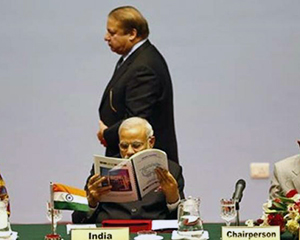
Dawn News, citing diplomatic observers, said Pakistan is exploring the possibility of creating a greater South Asian economic alliance to counter India's "controlling hold" on the eight-member South Asian Association for Regional Cooperation (SAARC).

A parliamentary delegation from Pakistan, which is now in New York, pitched this idea during its five-day visit to Washington last week, the report said.

"A greater South Asia is already emerging," Senator Mushahid Hussain Syed was quoted as saying in one of his interactions with the media.

"This greater South Asia includes China, Iran and the neighbouring Central Asian republics," he said.

He described the China-Pakistan Economic Corridor as the key economic route linking South Asia with Central Asia.

The Gwadar port, Syed said, would be the nearest warm water port, not only for China but also for the land-locked Central Asian states. "We want India to join this arrangement as well," said Syed.

Indians are "unlikely to accept" the offer as they are comfortable with the advantage that SAARC provides them, the report said.

"India used its influence in SAARC to isolate Pakistan when it announced that it would not attend the regional group's 19th summit, scheduled in Islamabad," the report said.

Citing continuous cross border terrorism by Pakistan, India had announced last month that "in the prevailing circumstances, the Indian government is unable to participate in the proposed Summit in Islamabad."

Besides India, four other SAARC members -- Bangladesh, Bhutan, Sri Lanka and Afghanistan -- had also pulled out of the summit.

"Among the eight SAARC nations, Afghanistan and Bangladesh are India's strong allies while Bhutan, surrounded by India from all sides, is too small to resist any move from New Delhi. The Maldives, Nepal and Sri Lanka have good ties with Pakistan, but they are not large enough to take on India," the report said.

The report cited that a senior diplomat had confirmed reports that Pakistan is actively seeking a new regional arrangement.

"Apparently, the showdown forced Pakistan to conclude that in its present shape, SAARC will always be dominated by India. That's why they are now talking about a greater South Asia," the diplomat was quoted as saying.

"Pakistan hopes that this new arrangement will give it more room to manoeuvre when India tries to force a decision on it," another diplomat said.

The report quoted diplomatic observers in Washington as saying that the proposed arrangement also suits China as it is also worried about India's rapidly growing influence in the region.

"They argue that China can play an important role in persuading Central Asian republics and Iran to join the new arrangement. But the observers warn that SAARC members will have little interest in supporting the idea," the report said.

"There is not much benefit for Bangladesh, Nepal and Sri Lanka in joining a land route far from their borders and Bangladesh and Sri Lanka have their own ports," it said.

The report stated thatt he member that is likely to get the most benefits from a greater South Asian alliance is Afghanistan, which is technically a land-locked Central Asian nation.

Any trade route that links South and Central Asian regions is good for Afghanistan, it noted.

"But observers believe that Afghanistan is too closely linked to India to join any arrangement that hurts India's interests. Afghanistan's presence in SAARC, however, justifies Pakistan's argument that Central Asian nations can be included in a greater South Asia.

Afghanistan applied for SAARC membership in 2006 and joined a year later, generating an interesting debate on the definition of South Asian identity because Afghanistan is a Central Asian country, the report said.

"But, as a South Asian diplomat pointed out, even if a greater South Asia became reality, there's no guarantee that its members would support Pakistan in its disputes with India," it said.

"Many Central Asian states have strong ties with India and Iran too has problems with Pakistan," the diplomat was quoted as saying.

Comments

Rikaz
 - 
Wednesday, 12 Oct 2016

India should not have cancelled this conference....

Add new comment

  • Coastaldigest.com reserves the right to delete or block any comments.
  • Coastaldigset.com is not responsible for its readers’ comments.
  • Comments that are abusive, incendiary or irrelevant are strictly prohibited.
  • Please use a genuine email ID and provide your name to avoid reject.
News Network
May 2,2020

Balochistan, May 1: Sajid Hussain, Editor-in-Chief of Balochistan Times, has been found dead in a Swedish town, the police have confirmed.

The Swedish police informed his family on Thursday night that they discovered his body from a river in Uppsala, The Times reported.
The Baloch journalist had been missing from the Swedish city since March 2 this year.

Sajid, 39, left Pakistan in 2012 and had been living as a refugee in Sweden since 2017. He wrote extensively on the suffering of the Balochis at the hands of the Pakistani military establishment.

His work often got him into trouble as the authorities did not like his reporting of Balochistan's forbidden stories, the reason he had to leave and live in exile.

The Baloch journalist was found dead two months after he went missing in Sweden.
Sajid left Pakistan because of security threats from Pakistan Army and its intelligence service ISI.

The spokesperson of the Baloch National Movement, Hammal Haider told news agency: "We are deeply saddened by the demise of prominent Baloch intellectual and writer Sajid Hussain."
"His death is indeed a loss of a great mind for the people of Balochistan. Due to his straightforwardness, he was loved among all journalistic, literary and political circles," added Haider.

"After this incident, we have serious concerns about our members and other Baloch refugees living in the West," he said.

Comments

Add new comment

  • Coastaldigest.com reserves the right to delete or block any comments.
  • Coastaldigset.com is not responsible for its readers’ comments.
  • Comments that are abusive, incendiary or irrelevant are strictly prohibited.
  • Please use a genuine email ID and provide your name to avoid reject.
Agencies
June 13,2020

Washington, Jun 13: America's first-ever Hindu lawmaker Tulsi Gabbard has said that in this chaotic time, one can find certainty, strength, and peace in Bhagavad Gita.

In her message during a virtual commencement address, the 39-year-old Congresswoman from Hawaii said that it is a chaotic time and no one can say with certainty what tomorrow looks like.

"... but we find certainty, strength, and peace in the practice of Bhakti Yoga and Karma Yoga taught to us by Krishna in the Bhagavad Gita," Tulsi Gabbard told the 'Class of 2020 for Hindu students''.

Her address came amidst protests in the US against the killing of African-American George Floyd by a white police officer in Minneapolis.

The country has been swept by protests since George Floyd's custodial death on May 25 with thousands of people mounting pressure for changes to the law enforcement practices.

The first-ever virtual Hindu commencement was organised by the Hindu Students Council on June 7, which drew thousands of viewers on Facebook and YouTube Live, all coming together in solidarity during the ongoing COVID-19 crisis.

According to Johns Hopkins Coronavirus Resource Center, the contagion has infected over 76,00,000 people and killed more than 4,25,000 across the world. The US is the worst affected country with over 2.04 million cases and more than 1,14,000 deaths.

The COVID-19, which originated in China''s Wuhan city in December last year, has also battered the world economy with the International Monetary Fund saying that the global economy is bound to suffer a "severe recession".

Scientists are racing against time to find a vaccine or medicine for its treatment.

Hundreds of graduates from the US, Canada, the UK, India and Australia attended to commemorate their graduation in a unique way - by celebrating their shared Hindu values.

Professor Subhash Kak served as the ceremony's Grand Marshall.

"As you think about this new chapter in your lives, ask yourself what is my purpose in life? It is a deep question that if you can recognise now that your purpose is to serve God and God''s children, practicing Karma Yoga, then you can lead a truly successful life," Tulsi Gabbard said.

"Success is not defined by temporary material things, trinkets, glittery objects or accomplishments - but a deeply successful and happy life centered around service," she added.

The Iraq war veteran ended her presidential campaign in March and offered her full support to former vice president Joe Biden, 77, who is all set to challenge Republican incumbent Donald Trump, 73, in November elections.

The commencement address focused heavily on themes from the Bhagavad Gita, a timeless historical text that many Hindus consider their moral framework.

Professor Kak, Regent Professor at Oklahoma State University and 2019 Padma Shri recipient, read out the names of the graduating students.

"I exhort you - the graduating students - to be the leaders of the new world where education is less of the mind of a vessel to be filled with information (usually forgotten after the semester is over), and more of a flame that is lit as envisioned by our Vedic sages," he said.

The student speakers were from many university campuses, including the Massachusetts Institute of Technology, Princeton, and Stanford.

Listen to the latest songs, only on JioSaavn.com

The programme included offerings of Hindu prayers, recitation of a traditional graduation message from the Upanishads, and a symbolic conferral of degrees to high school and college graduate.

Founded in 1990, Hindu Students Council is North America''s largest pan-Hindu youth organisation. 

Comments

Add new comment

  • Coastaldigest.com reserves the right to delete or block any comments.
  • Coastaldigset.com is not responsible for its readers’ comments.
  • Comments that are abusive, incendiary or irrelevant are strictly prohibited.
  • Please use a genuine email ID and provide your name to avoid reject.
Agencies
August 7,2020

Russia boasts that it's about to become the first country to approve a Covid-19 vaccine, with mass vaccinations planned as early as October using shots that are yet to complete clinical trials -- and scientists worldwide are sounding the alarm that the headlong rush could backfire.

Moscow sees a Sputnik-like propaganda victory, recalling the Soviet Union's launch of the world's first satellite in 1957.

But the experimental Covid-19 shots began first-in-human testing on a few dozen people less than two months ago, and there's no published scientific evidence yet backing Russia's late entry to the global vaccine race, much less explaining why it should be considered a front-runner.

“I'm worried that Russia is cutting corners so that the vaccine that will come out may be not just ineffective, but also unsafe,” said Lawrence Gostin, a global public health law expert at Georgetown University. “It doesn't work that way... Trials come first. That's really important.”

According to Kirill Dmitriev, head of Russia's Direct Investment Fund that bankrolled the effort, a vaccine developed by the Gamaleya research institute in Moscow may be approved in days, before scientists complete what's called a Phase 3 study.

That final-stage study, usually involving tens of thousands of people, is the only way to prove if an experimental vaccine is safe and really works.

Health Minister Mikhail Murashko said members of “risk groups,” such as medical workers, may be offered the vaccine this month.

He didn't clarify whether they would be part of the Phase 3 study that is said to be completed after the vaccine receives “conditional approval.”

Deputy Prime Minister Tatyana Golikova promised to start “industrial production” in September, and Murashko said mass vaccination may begin as early as October.

Dr Anthony Fauci, the top US infectious disease specialist, questioned the fast-track approach last week.

“I do hope that the Chinese and the Russians are actually testing a vaccine before they are administering the vaccine to anyone, because claims of having a vaccine ready to distribute before you do testing I think is problematic at best," he said.

Questions about this vaccine candidate come after the US, Britain and Canada last month accused Russia of using hackers to steal vaccine research from Western labs.

Delivering a vaccine first is a matter of national prestige for the Kremlin as it tries to assert the image of Russia as a global power capable of competing with the US and China.

The notion of being “the first in the world” dominated state news coverage of the effort, with government officials praising reports of the first-step testing.

In April, President Vladimir Putin ordered state officials to shorten the time of clinical trials for a variety of drugs, including potential coronavirus vaccines.

According to Russia's Association of Clinical Trials Organizations, the order set “an unattainable bar” for scientists who, as a result, "joined in on the mad race, hoping to please those at power.”

The association first raised concern in late May, when professor Alexander Gintsburg, head of the Gamaleya institute, said he and other researchers tried the vaccine on themselves.

The move was a “crude violation of the very foundations of clinical research, Russian law and universally accepted international regulations" the group said in an open letter to the government, urging scientists and health officials to adhere to clinical research standards.

But a month later, the Health Ministry authorized clinical trials of the Gamaleya product, with what appeared to be another ethical issue.

Human studies started June 17 among 76 volunteers. Half were injected with a vaccine in liquid form and the other half with a vaccine that came as soluble powder.

Some in the first half were recruited from the military, which raised concerns that servicemen may have been pressured to participate.

Some experts said their desire to perform well would affect the findings. “It's no coincidence media reports we see about the trials among the military said no one had any side effects, while the (other group) reported some," said Vasily Vlassov, a public health expert with Moscow's Higher School of Economics.

As the trials were declared completed and looming regulatory approval was announced last week, questions arose about the vaccine's safety and effectiveness.

Government assurances the drug produced the desired immune response and caused no significant side effects were hardly convincing without published scientific data describing the findings.

The World Health Organization said all vaccine candidates should go through full stages of testing before being rolled out.

“There are established practices and there are guidelines out,” WHO spokesman Christian Lindmeier said Tuesday.

“Between finding or having a clue of maybe having a vaccine that works, and having gone through all the stages, is a big difference.”

Offering an unsafe compound to medical workers on the front lines of the outbreak could make things worse, Georgetown's Gostin said, adding: “What if the vaccine started killing them or making them very ill?”

Vaccines that are not properly tested can cause harm in many ways — from a negative impact on health to creating a false sense of security or undermining trust in vaccinations, said Thomas Bollyky, director of the global health program at the Council on Foreign Relations. 

Comments

Add new comment

  • Coastaldigest.com reserves the right to delete or block any comments.
  • Coastaldigset.com is not responsible for its readers’ comments.
  • Comments that are abusive, incendiary or irrelevant are strictly prohibited.
  • Please use a genuine email ID and provide your name to avoid reject.