



Pak seeks bigger SAARC to counter India's influence

October 12, 2016

Islamabad, Oct 12: Pakistan is exploring the possibility of creating a greater South Asian economic alliance to include China, Iran and neighbouring Central Asian republics as part of its bid counter India's influence in SAARC, a media report said today.pak
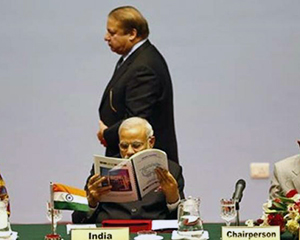
Dawn News, citing diplomatic observers, said Pakistan is exploring the possibility of creating a greater South Asian economic alliance to counter India's "controlling hold" on the eight-member South Asian Association for Regional Cooperation (SAARC).

A parliamentary delegation from Pakistan, which is now in New York, pitched this idea during its five-day visit to Washington last week, the report said.

"A greater South Asia is already emerging," Senator Mushahid Hussain Syed was quoted as saying in one of his interactions with the media.

"This greater South Asia includes China, Iran and the neighbouring Central Asian republics," he said.

He described the China-Pakistan Economic Corridor as the key economic route linking South Asia with Central Asia.

The Gwadar port, Syed said, would be the nearest warm water port, not only for China but also for the land-locked Central Asian states. "We want India to join this arrangement as well," said Syed.

Indians are "unlikely to accept" the offer as they are comfortable with the advantage that SAARC provides them, the report said.

"India used its influence in SAARC to isolate Pakistan when it announced that it would not attend the regional group's 19th summit, scheduled in Islamabad," the report said.

Citing continuous cross border terrorism by Pakistan, India had announced last month that "in the prevailing circumstances, the Indian government is unable to participate in the proposed Summit in Islamabad."

Besides India, four other SAARC members -- Bangladesh, Bhutan, Sri Lanka and Afghanistan -- had also pulled out of the summit.

"Among the eight SAARC nations, Afghanistan and Bangladesh are India's strong allies while Bhutan, surrounded by India from all sides, is too small to resist any move from New Delhi. The Maldives, Nepal and Sri Lanka have good ties with Pakistan, but they are not large enough to take on India," the report said.

The report cited that a senior diplomat had confirmed reports that Pakistan is actively seeking a new regional arrangement.

"Apparently, the showdown forced Pakistan to conclude that in its present shape, SAARC will always be dominated by India. That's why they are now talking about a greater South Asia," the diplomat was quoted as saying.

"Pakistan hopes that this new arrangement will give it more room to manoeuvre when India tries to force a decision on it," another diplomat said.

The report quoted diplomatic observers in Washington as saying that the proposed arrangement also suits China as it is also worried about India's rapidly growing influence in the region.

"They argue that China can play an important role in persuading Central Asian republics and Iran to join the new arrangement. But the observers warn that SAARC members will have little interest in supporting the idea," the report said.

"There is not much benefit for Bangladesh, Nepal and Sri Lanka in joining a land route far from their borders and Bangladesh and Sri Lanka have their own ports," it said.

The report stated thatt he member that is likely to get the most benefits from a greater South Asian alliance is Afghanistan, which is technically a land-locked Central Asian nation.

Any trade route that links South and Central Asian regions is good for Afghanistan, it noted.

"But observers believe that Afghanistan is too closely linked to India to join any arrangement that hurts India's interests. Afghanistan's presence in SAARC, however, justifies Pakistan's argument that Central Asian nations can be included in a greater South Asia.

Afghanistan applied for SAARC membership in 2006 and joined a year later, generating an interesting debate on the definition of South Asian identity because Afghanistan is a Central Asian country, the report said.

"But, as a South Asian diplomat pointed out, even if a greater South Asia became reality, there's no guarantee that its members would support Pakistan in its disputes with India," it said.

"Many Central Asian states have strong ties with India and Iran too has problems with Pakistan," the diplomat was quoted as saying.

Comments

Rikaz
 - 
Wednesday, 12 Oct 2016

India should not have cancelled this conference....

Add new comment

  • Coastaldigest.com reserves the right to delete or block any comments.
  • Coastaldigset.com is not responsible for its readers’ comments.
  • Comments that are abusive, incendiary or irrelevant are strictly prohibited.
  • Please use a genuine email ID and provide your name to avoid reject.
News Network
February 18,2020

Beijing, Feb 18: Police in China have arrested a prominent activist who had been a fugitive for weeks and criticised President Xi Jinping's handling of the coronavirus epidemic while in hiding, a rights group said Tuesday.

Anti-corruption activist Xu Zhiyong was arrested on Saturday after being on the run since December, according to Amnesty International.

China's ruling Communist Party has severely curtailed civil liberties since Xi took power in 2012, rounding up rights lawyers, labour activists and even Marxist students.

The death this month of a whistleblowing doctor who was reprimanded by police for raising the alarm about the deadly new virus before dying of it himself triggered rare calls for political reform and freedom of speech.

The "Chinese government's battle against the coronavirus has in no way diverted it from its ongoing general campaign to crush all dissenting voices," said Patrick Poon, China researcher at Amnesty International, in an emailed statement.

Another source, who spoke to news agency on the condition of anonymity, said Xu had been arrested in the southern city of Guangzhou.

Guangzhou police did not respond to requests for comment.

Xu went into hiding after authorities broke up a December gathering of intellectuals discussing political reform in the eastern coastal city of Xiamen in Fujian province, prior to the coronavirus crisis.

Over a dozen lawyers and activists were detained or disappeared after the Xiamen gathering, according to rights groups -- and Xu's detention appears linked to his presence at the meeting, explained Poon.

But while on the run, Xu continued to post information on Twitter about rights issues.

On February 4 Xu released an article calling on Xi to step down and criticised his leadership across a range of issues including the US-China trade war, Hong Kong's pro-democracy protests and the coronavirus epidemic, which has now killed nearly 1,900 people.

"Medical supplies are tight, hospitals are filled with patients, and a large number of infected people have no way to be diagnosed," he wrote. "It's a mess."

"The coronavirus outbreak shows just how important values like freedom of expression and transparency are -- the exact values that Xu has long advocated," Yaqiu Wang, China researcher at Human Rights Watch, told news agency.

But the disappearance of Xu illustrates how the Chinese state "persists in its old ways" by "silencing its critics", she said.

Xu -- who founded a movement calling for greater transparency among high-ranking officials -- previously served a four-year prison sentence from 2013 to 2017 for organising an "illegal gathering".

"That he was a fugitive for so many days while continuing to speak out, that in itself was... a kind of challenge to (Chinese authorities)," said Hua Ze, a long-time friend of Xu who told AFP she lost contact with the Chinese activist on Saturday morning.

Comments

Add new comment

  • Coastaldigest.com reserves the right to delete or block any comments.
  • Coastaldigset.com is not responsible for its readers’ comments.
  • Comments that are abusive, incendiary or irrelevant are strictly prohibited.
  • Please use a genuine email ID and provide your name to avoid reject.
News Network
April 23,2020

Geneva, Apr 23: The World Health Organisation (WHO) on Wednesday (local time) said that the COVID-19 crisis will not end any time soon, with several countries only in the initial stages of the fight against the virus.

"Make no mistake, we have a long way to go. Coronavirus will be with us for a long time. There is no question that stay at home orders and other physical distancing measures have successfully suppressed transmission in many countries," WHO chief Tedros Adhanom Ghebreyesus said in a press conference.

"Most countries are in the early stages of their epidemics. And some, which were affected early in the pandemic, are now starting to see a resurgence in the number of cases," he added.

COVID-19 has infected more than 2.6 million people around the world and a total of 1,83,027 people have died due to coronavirus, according to data from US-based Johns Hopkins University.

Comments

Add new comment

  • Coastaldigest.com reserves the right to delete or block any comments.
  • Coastaldigset.com is not responsible for its readers’ comments.
  • Comments that are abusive, incendiary or irrelevant are strictly prohibited.
  • Please use a genuine email ID and provide your name to avoid reject.
News Network
May 8,2020

May 8: Thousands of migrants have been stranded “all over the world” where they face a heightened risk of COVID-19 infection, the head of the UN migration agency International Organization for Migration (IOM) has said.

IOM Director-General António Vitorino said that more onerous health-related travel restrictions might discriminate disproportionately against migrant workers in future.

“Health is the new wealth,” Vitorino said, citing proposals by some countries to introduce the so-called immunity passports and use mobile phone apps designed to prevent the spread of the new coronavirus.

“In lots of countries in the world, we already have a system of screening checks to identify the health of migrants, above all malaria, tuberculosis… HIV-AIDS, and now I believe that there will be increased demands in health controls for regular migrants,” he said on Thursday.

Travel restrictions to try to limit the spread of the pandemic has left people on the move more vulnerable than ever and unable to work to support themselves, Vitorino told journalists via videoconference.

“There are thousands of stranded migrants all over the world.

 “In South-East Asia, in East Africa, in Latin America, because of the closing of the borders and with the travel restrictions, lots of migrants who were on the move; some of them wanted to return precisely because of the pandemic,” he said.

They are blocked, some in large groups, some in small, in the border areas, in very difficult conditions without access to minimal care, especially health screening, Vitorino said.

“We have been asking the governments to allow the humanitarian workers and the health workers to have access to (them),” he said.

Turning to Venezuelan migrants, who are believed to number around five million amidst a worsening economic crisis in the country, the IOM chief said “thousands… have lost their jobs in countries like Ecuador and Colombia and are returning back to Venezuela in large crowds without any health screening and being quarantined when they go back”.

In a statement, the IOM highlighted the plight of migrants left stranded in the desert in west, central and eastern Africa, either after having been deported without the due process, or abandoned by the smugglers.

The IOM’s immediate priorities for migrants include ensuring that they have access to healthcare and other basic social welfare assistance in their host country.

Among the UN agency’s other immediate concerns is preventing the spread of new coronavirus infection in more than 1,100 camps that it manages across the world.

They include the Cox’s Bazar complex in Bangladesh, home to around one million mainly ethnic Rohingya from Myanmar, the majority having fled persecution.

So far, no cases of infection have been reported there, the IOM chief said, adding that preventative measures have been communicated to the hundreds of thousands of camp residents, while medical capacity has been boosted.

Beyond the immediate health threat of COVID-19 infection, migrants also face growing stigmatization from which they need protection, Vitorino said.

Allowing hate speech and xenophobic narratives to thrive unchallenged also threatens to undermine the public health response to COVID-19, he said, before noting that migrant workers make up a significant percentage of the health sector in many developed countries including the UK, the US and Switzerland.

Populist narratives targeting migrants as carriers of disease could also destabilise national security through social upheaval and countries’ post-COVID economic recovery by removing critical workers in agriculture and service industries, he said.

Remittances have already seen a 30 per cent drop during the pandemic, Vitorino said, citing the World Bank data, meaning that some USD 20 billion has not been sent home to families in countries where up to 15 per cent of their gross domestic product comes from pay packets earned abroad.

Vitorino, in a plea, urged to give the health of migrants as much attention as that of the host populations in all countries.

“It is quite clear that health is the new wealth and that health concerns will be introduced in the mobility systems - not just for migration - but as a whole; where travelling for business or professional reasons, health will be the new gamechanger in town.

“If the current pandemic leads to a two or even three-tier mobility system, then we will have to try to solve the problem – the problem of the pandemic - but at the same time we have created a new problem of deepening the inequalities,” he said.

Comments

Add new comment

  • Coastaldigest.com reserves the right to delete or block any comments.
  • Coastaldigset.com is not responsible for its readers’ comments.
  • Comments that are abusive, incendiary or irrelevant are strictly prohibited.
  • Please use a genuine email ID and provide your name to avoid reject.