Pakistan can't take Kashmir to ICJ: Sushma Swaraj

June 5, 2017

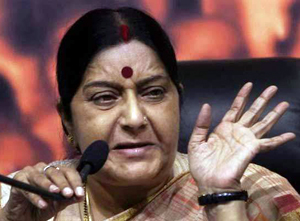
New Delhi, Jun 5: India today said Pakistan cannot take Kashmir to the International Court of Justice (ICJ) and asserted that the issue must be resolved bilaterally.Sushma Swaraj

India wants to settle all issues with Pakistan through dialogue, External Affairs Minister Sushma Swaraj said, but also made it amply clear that talks and terror cannot go together.

Swaraj was addressing a press conference on completion of three years of the government.

The minister said there was no flip-flop on part of the government in handling Pakistan.

"Pakistan cannot take Kashmir issue to International Court of Justice. Kashmir issue can only be resolved bilaterally," she said.

She was replying to a question on reported remarks of Pakistani law officer that Islamabad will take the Kashmir issue to ICJ.

"We want to resolve all issues with Pakistan bilaterally but talks and terror cannot go together," the minister said.

Comments

Add new comment

  • Coastaldigest.com reserves the right to delete or block any comments.
  • Coastaldigset.com is not responsible for its readers’ comments.
  • Comments that are abusive, incendiary or irrelevant are strictly prohibited.
  • Please use a genuine email ID and provide your name to avoid reject.
News Network
April 26,2020

Thiruvananthapuram, Apr 26: Kerala Chief Minister Pinarayi Vijayan on Saturday urged media houses not to resort to layoffs and pay cuts while the whole community is facing the COVID-19 pandemic.

The Chief Minister said the state government will also take necessary steps to test the media personnel in the state to ensure they have not contracted the deadly virus.

He also pointed out that the pandemic has severely impacted the media sector with many newspapers even reducing the number of pages.

"Journalists are among those who have been affected the most. Journalists on the field are also in danger. We have come to know about the reporters affected with coronavirus in other states. The government will take necessary precautions including testing to ensure that journalists don't contract the disease," Vijayan said.

He said the newspapers were not receiving advertisements these days because there are no social or public events resulting in less commercial activities in the society.

"I would like to urge the media houses not to engage in layoffs or salary cuts during this pandemic. Journalists are working shoulder to shoulder with health workers. During this pandemic, scribes are out in the field collecting news, despite the threat of disease and it was admirable," Vijayan said.

The chief minister said the government has asked the PRD to release the dues to various media houses.

Comments

Add new comment

  • Coastaldigest.com reserves the right to delete or block any comments.
  • Coastaldigset.com is not responsible for its readers’ comments.
  • Comments that are abusive, incendiary or irrelevant are strictly prohibited.
  • Please use a genuine email ID and provide your name to avoid reject.
Agencies
April 23,2020

New Delhi, Apr 23: The nationwide lockdown in India which started about a month ago has impacted nearly 40 million internal migrants, the World Bank has said.

The lockdown in India has impacted the livelihoods of a large proportion of the country's nearly 40 million internal migrants. Around 50,000 60,000 moved from urban centers to rural areas of origin in the span of a few days, the bank said in a report released on Wednesday.

According to the report -- 'COVID-19 Crisis Through a Migration Lens' -- the magnitude of internal migration is about two-and-a-half times that of international migration.

Lockdowns, loss of employment, and social distancing prompted a chaotic and painful process of mass return for internal migrants in India and many countries in Latin America, it said.

Thus, the COVID-19 containment measures might have contributed to spreading the epidemic, the report said.

Governments need to address the challenges facing internal migrants by including them in health services and cash transfer and other social programmes, and protecting them from discrimination, it said.

World Bank said that coronavirus crisis has affected both international and internal migration in the South Asia region.

As the early phases of the crisis unfolded, many international migrants, especially from the Gulf countries, returned to countries such as India, Pakistan, and Bangladesh until travel restrictions halted these flows.

Some migrants had to be evacuated by governments, such as those of China and Iran, it said.

Before the coronavirus crisis, migrant outflows from the region were robust, the report said.

The number of recorded, primarily low-skilled emigrants from India and Pakistan rose in 2019 relative to the prior year but is expected to decline in 2020 due to the pandemic and oil price declines impacting the Gulf countries.

In India, the number of low-skilled emigrants seeking mandatory clearance for emigration rose slightly by eight percent to 368,048 in 2019.

In Pakistan, the number of emigrants jumped 63 per cent to 6,25,203 in 2019, largely due to a doubling of emigration to Saudi Arabia, it said.

According to the bank, migration flows are likely to fall, but the stock of international migrants may not decrease immediately, since migrants cannot return to their countries due to travel bans and disruption to transportation services.

In 2019, there were around 272 million international migrants.

The rate of voluntary return migration is likely to fall, except in the case of a few cross-border migration corridors in the South (such as Venezuela-Colombia, Nepal-India, Zimbabwe South Africa, Myanmar-Thailand), it said.

Migrant workers tend to be vulnerable to the loss of employment and wages during an economic crisis in their host country, more so than native-born workers.

Lockdowns in labour camps and dormitories can also increase the risk of contagion among migrant workers.

Many migrants have been stranded due to the suspension of transport services. Some host countries have granted visa extensions and temporary amnesty to migrant workers, and some have suspended the involuntary return of migrants, it said.

Observing that government policy responses to the COVID-19 crisis have largely excluded migrants and their families back home, the World Bank said there is a strong case for including migrants in the near-term health strategies of all countries, given the externalities associated with the health status of an entire population in the face of a highly contagious pandemic.

The Bank said governments would do well to consider short, medium and long-term interventions to support stranded migrants, remittance infrastructure, loss of subsistence income for families back home, and access to health, housing, education, and jobs for migrant workers in host/transit countries and their families back home.

The pandemic has also highlighted the global shortage of health professionals and an urgent need for global cooperation and long-term investments in medical training, it said.


Comments

Add new comment

  • Coastaldigest.com reserves the right to delete or block any comments.
  • Coastaldigset.com is not responsible for its readers’ comments.
  • Comments that are abusive, incendiary or irrelevant are strictly prohibited.
  • Please use a genuine email ID and provide your name to avoid reject.
News Network
March 12,2020

New Delhi, Mar 12: The coronavirus pandemic could deal a crippling blow to the Indian travel and tourism industry, specially with the government suspending all visas, with the economic impact being assessed to run into thousands of crores of rupees. According to industry chamber CII, this is the one of the worst crises ever to hit the Indian tourism industry impacting all its geographical segments - inbound, outbound and domestic, almost all tourism verticals - leisure , adventure, heritage, MICE, cruise, corporate and niche segments.

The whole tourism value chain across hotels, travel agents, tour operations, destinations, restaurants, family entertainment venues and air, land and sea transportation have been hit.

In an impact assessment of the coronavirus pandemic, CII Tourism Committee said inbound foreign tourism of over USD 28 billion in value terms accounts for an average 60-65 per cent between October to March.

"As the news of the virus started picking up from November, the percentage of cancellations started going up in this segment exponentially and is reaching a peak of almost 80 per cent now in March in many Indian locations. The value at risk from this segment will be in multiples of tens of thousands of crores," the CII assessment report said.

With India cancelling all visas, the chamber said the impact "will be worse".

It further said,"The forward bookings for the inbound season of October 2020-March 2021 which should have started picking are all muted. These are showing highly discouraging signs with cancellations of important global travel marts which are marketplaces for contracting for the next season."

It further said there are reports of large scale forward cancellations from NRI segment from developed markets, which account for over 60 per cent during April to September inbound visits.

"Unless the progression of the virus stops, almost the entire value for the remainder of 2020 season is at risk," the report added.

ANAROCK Property Consultants Chairman Anuj Puri said India's hospitality sector will definitely be impacted by the announcement of a global pandemic, and the mounting numbers of confirmed coronavirus cases in the country.

"The cancellation of visas for foreigners as well as the strong advice issued to Indians to refrain from unnecessary travel will have a marked effect. This is the most unsettling healthcare crisis in recent times and hotel bookings will go south," he added.

On Indians being advised to refrain from unnecessary travel, as per the CII report almost 28 million plus Indians are estimated to have travelled outside in 2019 and there were almost 1.8 billion domestic tourist footfalls.

The holiday season of Indians -- those travelling within the country and outside -- is heavy in April-July, October and December.

"The December holiday season of 2019 took an estimated hit of almost 40-50 per cent, the holiday season of April to July 2020 is likely to take a humongous hit which could be as high as 80-100 per cent, unless there is positive news of the progression of virus decreasing," the CII assessment report said.

There are advanced cancellations and highly reduced forward booking pipelines for the holiday season. Only corporates are flying and that too only on highly essential same day travel. Most of the MNCs are advising work from home, stifling travel, it added.

On suspension of visas, MakeMyTrip Group CEO Rajesh Magow told ,"The period between February till the end of March is typically a lean period because of exam season but we are seeing a demand slowdown for the upcoming summer holiday season especially for international travel. The situation remains dynamic making it hard to quantify the actual impact on our business and industry at large."

He further said,"The decision by the government will have an impact on inbound and outbound international travel. So far there are no restrictions or advisories issued for domestic travel."

VFS Global Regional Group COO - South Asia, Middle East and North Africa, Americas Vinay Malhotra said,"While it is too early to comment on the impact of coronavirus on visa application trends, so far, our visa application processes in India continue on schedule as per the mandates of our client governments."

He also said the company is exploring steps to assuage concerns of people about visiting busy public areas due to the nature of the virus by considering discounted rates on courier return services for visa customers who want to avoid returning to the visa centres to pick up their passports.

Besides, he said,"We are also contemplating lower fees for our Visa at your doorstep service, for those customers who are requesting an alternative to visiting the centres to submit visa applications."

Comments

Add new comment

  • Coastaldigest.com reserves the right to delete or block any comments.
  • Coastaldigset.com is not responsible for its readers’ comments.
  • Comments that are abusive, incendiary or irrelevant are strictly prohibited.
  • Please use a genuine email ID and provide your name to avoid reject.