


Pakistan serves beef to Nepal earthquake survivors

April 30, 2015

Kathmandu, Apr 30: After experiencing major devastation and loss of lives in the April 25 earthquake, Nepal is left with an unsavoury taste in the mouth when it received packets of 'beef masala' as part of the relief package from Pakistan.

Since the majority-Hindu country treats cows as sacred and there is a blanket ban on slaughtering the animal, the development has the potential of triggering diplomatic acrimony between the South Asian Association for Regional Cooperation (SAARC) member countries.
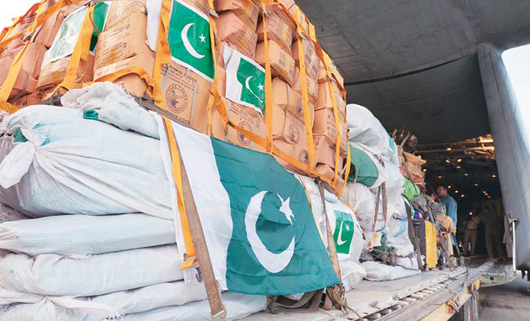
pak

Indian doctors at Kathmandu's Bir Hospital told Mail Today that packets of 'beef masala' were sent by Pakistan on Tuesday as part of relief aid to the temblor survivors. These doctors - drawn from Ram Manohar Lohia (RML) Hospital, Safdarjung Hospital and All India Institute of Medical Sciences (AIIMS) - are members of a 34-member medical team sent to Nepal for treating the survivors.

"When we reached the airport to collect the food items from Pakistan, we found packets of ready-to-eat meals, including packets of 'beef masala'. There were other food items too," Dr Balwinder Singh told Mail Today.

Perplexed, the doctors chose to have food from a hotel instead. "We did not touch the Pakistani aid," Dr Singh said.

"Most of the local people are not aware of the contents. When they understand, they avoid it," said another doctor on the condition of anonymity. He added: "Pakistan has hurt Nepal's religious sentiments by supplying the masala. Shockingly, it did not care about the sensitivity of the matter."

Exclusive photographs of the 'beef masala' packets supplied to Nepal are with Mail Today.

These pictures clearly show that the place of origin of these packets was Nowshera Cantt in Pakistan. These packets also prominently mention that these are not for sale and the contents include 'potato bhujia' and 'beef masala' (see photograph, right).

A top Nepal government official said: "The matter has been conveyed to Prime Minister Sushil Koirala and the intelligence chief. We are also starting an internal inquiry to verify the facts. If the report is correct, we will raise the matter at the diplomatic level with Pakistan. India, being our key partner, will also be informed of the developments."

Tasneem Aslam, spokesperson for Pakistan's ministry of foreign affairs, told Mail Today: "I am not aware of the issue... I am not responsible for the dispatch. The relief aid is sent by the National Disaster Management Authority."

A press note uploaded on the website of National Disaster Management Authority (NDMA), Pakistan (http://www.ndma.gov.pk/new/), states: "(The) National Disaster Management Authority has dispatched the second of two sorties of C-130 aircrafts on April 28 in collaboration with Pakistan Army, Ministry of Foreign Affairs and Pakistan Air Force. The relief goods include 250 tents, 200 food packs (2.6 tonne), 1,000 Meals Ready to Eat (MREs), 1,000 blankets and 33 cartons of medicines. These relief goods have been provided from NDMA stocks...."

The food items have been manufactured by PANA Force Foods. The consignment was supplied after receiving orders from Pakistan's NDMA.

"PANA Force food processing centre aims at providing quality goods at affordable prices. Currently, the company is supplying two brands of products to Pakistan Army commonly known as Meal Ready to Eat (MRE) and Emergency Pack Ration (EP Ration or high-energy biscuits) whereas a plant for the production of dehydrated vegetables and fruits is under construction," the official website of PANA Force Foods mentions.

The website also states that the processing centre provides food to civil population during natural calamities, like earthquakes and floods.

According to Hindu belief, eating beef is a religious offence since cow is a sacred animal and treated on a par with one's mother.

In Nepal - for long the world's only Hindu state - the first royal order officially prohibiting cow slaughter stated that the punishments for the crime were death and confiscation of all property of the offender.

The first Civil Code of Nepal, the Muluki Ain of 1854, stated: "This kingdom is the only kingdom in the world where cows, women, and Brahmins may not be killed." It trumpeted Nepal as the 'purest Hindu kingdom' and simultaneously signaled to Nepalese citizens that Hindu religious creeds would be the law of the land.

But an amendment in 1990 to the Civil Code made cow slaughter punishable by 12 years in prison.

Comments

Add new comment

  • Coastaldigest.com reserves the right to delete or block any comments.
  • Coastaldigset.com is not responsible for its readers’ comments.
  • Comments that are abusive, incendiary or irrelevant are strictly prohibited.
  • Please use a genuine email ID and provide your name to avoid reject.
News Network
January 12,2020

Bengaluru, Jan 12: Karnataka’s ranking in Niti Aayog’s sustainable development goals (SDG) index rose by one place to No. 6 in 2019, compared to the year before.

Of the 17 SDGs that are used to compute the overall index, Karnataka topped in two – ‘climate action’ and ‘life on water’. The former is a measure of how well a state integrates climate action into policies and strategies and promote mechanisms for raising capacity for effective climate change planning and management. The latter focuses on preventing marine pollution, ending illegal and destructive fishing practices, and sustainably managing and protecting marine and coastal ecosystems.

It also did well in ‘decent work and economic growth’ and ‘peace, justice and strong institutions’. But it fared poorly, slipping 16 places – from No. 5 in 2018 to No. 21 in 2019 – in ‘industry, innovation and infrastructure’. Rankings in ‘quality education’ and ‘zero hunger’ have also fallen. While in education it is now ranked 7, a drop of three places, in ‘zero hunger’, it has dropped to No. 17 from 13. SDG is a United Nations initiative. Niti Aayog has customised it for India, and 36 states and union territories are ranked. The organisation admits there is an issue of data availability in India, indicating the numbers may not exactly reflect the ground situation.

In ‘industry, innovation and infrastructure, Karnataka scored just 40 out of a target of 100. The country average was 65. It failed to achieve targets in all the four parameters for the category, except in the number of mobile connections, where it has 100 connections per 100 population. The biggest dip was in manufacturing industry jobs and in providing allweather roads under Pradhan Mantri Gram Sadak Yojana to targeted habitats. Niti Ayog has given a score of 0 for the latter. Speaking on the dismal performance in the ‘industry and infrastructure’ category, state planning commission vice-chairman BJ Puttaswamy said he was yet to look into this parameter. “I have asked the departments concerned to meet me by Monday,” he said.

Comments

Add new comment

  • Coastaldigest.com reserves the right to delete or block any comments.
  • Coastaldigset.com is not responsible for its readers’ comments.
  • Comments that are abusive, incendiary or irrelevant are strictly prohibited.
  • Please use a genuine email ID and provide your name to avoid reject.
News Network
May 29,2020

New Delhi, May 29: The Reserve Bank of India (RBI) has imposed a monetary penalty of Rs 1.2 crore on Karnataka Bank Limited for non-compliance of asset classification, divergence and provisioning norms.

"The penalty has been imposed in exercise of powers vested in RBI under the provisions of Section 47 A (1) (c) read with Section 46 (4) (i) of the Banking Regulation Act, 1949. 

This action is based on the deficiencies in regulatory compliance and is not intended to pronounce upon the validity of any transaction or agreement entered into by the bank with its customers," the central bank said in a statement on Thursday.

According to the central bank, the statutory inspection of the bank with reference to its financial position as on March 31, 2017, and as on March 31, 2018, and the Risk Assessment Reports (RAR) pertaining thereto revealed, inter-alia, non-compliance with the directions issued by RBI.

Earlier, a notice was issued to the bank advising it to show cause as to why penalty should not be imposed on it for non-compliance with the directions.

After considering the bank's reply to the notice, oral submissions made in the personal hearing and examination of additional submissions, RBI concluded that the charges of non-compliance with RBI directions warranted imposition of monetary penalty, according to a release.

This action is based on the deficiencies in regulatory compliance and is not intended to pronounce upon the validity of any transaction or agreement entered into by the bank with its customers.

Comments

Add new comment

  • Coastaldigest.com reserves the right to delete or block any comments.
  • Coastaldigset.com is not responsible for its readers’ comments.
  • Comments that are abusive, incendiary or irrelevant are strictly prohibited.
  • Please use a genuine email ID and provide your name to avoid reject.
coastaldigest.com news network
June 5,2020

Bengaluru, Jun 5: Karnataka registered its highest single-day spike of more than 500 new COVID-19 cases, taking the total number of infections in the state to 4,835, the health department said on Friday.

The previous biggest single-day spurt was recorded on June 2 with 388 cases.

Of the 515 fresh cases reported, 482 are returnees from other states, mostly (about 471) from neighboring Maharashtra. Udupi district saw a major spike with over 200 cases today and the total tally of the district breaching seven hundred cases mark, to stand at 768.

As of June 5 evening, cumulatively 4,835 COVID-19 positive cases have been confirmed in the state, which includes 57 deaths and 1,688 discharges, the department said in its bulletin.

It said, out of 3,088 active cases, 3,075 patients are in isolation at designated hospitals and are stable, while 13 are in ICU.

On Friday, 83 patients have been discharged.

According to state COVID-19 war room data, out of the total 4,835 cases, 93 per cent (4,488 cases) are asymptomatic and 7 per cent (347) are symptomatic.

The new cases include 471 from Maharashtra, three from Delhi, two each from Andhra Pradesh, Telangana and Haryana, and one from Tamil Nadu.

While one is with international travel history from Indonesia. Remaining cases include- contacts of patients earlier tested positive, those from containment zones, those who travelled from other districts, and the ones whose contact history is still being traced.

Among the districts where new cases were reported, Udupi accounts for 204 cases, followed by 74 from Yadgir, Vijayapura 53, Kalaburagi 42, Bidar 39, Belagavi 36, Mandya 13, Bengaluru Rural 12, Bengaluru Urban 10, Dakshina Kannada 8, Uttara Kannada 7, three each from Hassan, Dharwad and Chikkaballapura, two each from Ramanagara and Haveri, and one each from Davangere, Bagalkote, Ballari and Kolar.

Udupi district tops the list of positive cases, with a total of 768 infections, followed by Kalaburagi 552 and Bengaluru urban 434.

Among discharges, Bengaluru urban still tops the list with total 271 discharges, followed by Davangere 147 and Mandya 146.

A total of 3,60,720 samples were tested so far, out of which 13,627 were tested on Friday alone.

So far 3,49,951 samples have reported as negative, and out of them 12,797 were reported negative on Friday.

Comments

Add new comment

  • Coastaldigest.com reserves the right to delete or block any comments.
  • Coastaldigset.com is not responsible for its readers’ comments.
  • Comments that are abusive, incendiary or irrelevant are strictly prohibited.
  • Please use a genuine email ID and provide your name to avoid reject.