


Pakistan serves beef to Nepal earthquake survivors

April 30, 2015

Kathmandu, Apr 30: After experiencing major devastation and loss of lives in the April 25 earthquake, Nepal is left with an unsavoury taste in the mouth when it received packets of 'beef masala' as part of the relief package from Pakistan.

Since the majority-Hindu country treats cows as sacred and there is a blanket ban on slaughtering the animal, the development has the potential of triggering diplomatic acrimony between the South Asian Association for Regional Cooperation (SAARC) member countries.
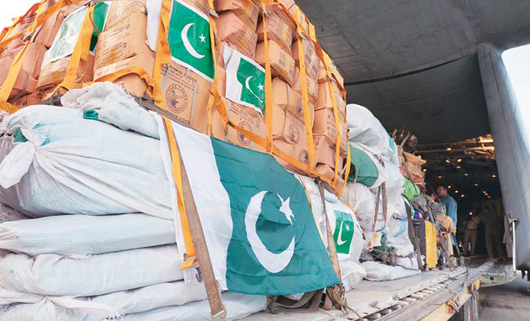
pak

Indian doctors at Kathmandu's Bir Hospital told Mail Today that packets of 'beef masala' were sent by Pakistan on Tuesday as part of relief aid to the temblor survivors. These doctors - drawn from Ram Manohar Lohia (RML) Hospital, Safdarjung Hospital and All India Institute of Medical Sciences (AIIMS) - are members of a 34-member medical team sent to Nepal for treating the survivors.

"When we reached the airport to collect the food items from Pakistan, we found packets of ready-to-eat meals, including packets of 'beef masala'. There were other food items too," Dr Balwinder Singh told Mail Today.

Perplexed, the doctors chose to have food from a hotel instead. "We did not touch the Pakistani aid," Dr Singh said.

"Most of the local people are not aware of the contents. When they understand, they avoid it," said another doctor on the condition of anonymity. He added: "Pakistan has hurt Nepal's religious sentiments by supplying the masala. Shockingly, it did not care about the sensitivity of the matter."

Exclusive photographs of the 'beef masala' packets supplied to Nepal are with Mail Today.

These pictures clearly show that the place of origin of these packets was Nowshera Cantt in Pakistan. These packets also prominently mention that these are not for sale and the contents include 'potato bhujia' and 'beef masala' (see photograph, right).

A top Nepal government official said: "The matter has been conveyed to Prime Minister Sushil Koirala and the intelligence chief. We are also starting an internal inquiry to verify the facts. If the report is correct, we will raise the matter at the diplomatic level with Pakistan. India, being our key partner, will also be informed of the developments."

Tasneem Aslam, spokesperson for Pakistan's ministry of foreign affairs, told Mail Today: "I am not aware of the issue... I am not responsible for the dispatch. The relief aid is sent by the National Disaster Management Authority."

A press note uploaded on the website of National Disaster Management Authority (NDMA), Pakistan (http://www.ndma.gov.pk/new/), states: "(The) National Disaster Management Authority has dispatched the second of two sorties of C-130 aircrafts on April 28 in collaboration with Pakistan Army, Ministry of Foreign Affairs and Pakistan Air Force. The relief goods include 250 tents, 200 food packs (2.6 tonne), 1,000 Meals Ready to Eat (MREs), 1,000 blankets and 33 cartons of medicines. These relief goods have been provided from NDMA stocks...."

The food items have been manufactured by PANA Force Foods. The consignment was supplied after receiving orders from Pakistan's NDMA.

"PANA Force food processing centre aims at providing quality goods at affordable prices. Currently, the company is supplying two brands of products to Pakistan Army commonly known as Meal Ready to Eat (MRE) and Emergency Pack Ration (EP Ration or high-energy biscuits) whereas a plant for the production of dehydrated vegetables and fruits is under construction," the official website of PANA Force Foods mentions.

The website also states that the processing centre provides food to civil population during natural calamities, like earthquakes and floods.

According to Hindu belief, eating beef is a religious offence since cow is a sacred animal and treated on a par with one's mother.

In Nepal - for long the world's only Hindu state - the first royal order officially prohibiting cow slaughter stated that the punishments for the crime were death and confiscation of all property of the offender.

The first Civil Code of Nepal, the Muluki Ain of 1854, stated: "This kingdom is the only kingdom in the world where cows, women, and Brahmins may not be killed." It trumpeted Nepal as the 'purest Hindu kingdom' and simultaneously signaled to Nepalese citizens that Hindu religious creeds would be the law of the land.

But an amendment in 1990 to the Civil Code made cow slaughter punishable by 12 years in prison.

Comments

Add new comment

  • Coastaldigest.com reserves the right to delete or block any comments.
  • Coastaldigset.com is not responsible for its readers’ comments.
  • Comments that are abusive, incendiary or irrelevant are strictly prohibited.
  • Please use a genuine email ID and provide your name to avoid reject.
News Network
March 7,2020

Bengaluru, Mar 7: As a precautionary measure to control the spread of coronavirus in Karnataka, the state government has planned to suspend biometric attendance for the time-being at its offices, also in corporate and IT companies, Medical Education Minister Dr K Sudhakar said on Saturday.

He said the government has taken all precautionary measures to control the spread of the virus in the state.

"Our Additional Chief Secretary has already spoken to IT companies yesterday on behalf of the government regarding guidelines that need to be followed, it is part of it...we will do it in the government also in the days to come," Sudhakar told reporters here.

He was responding to a question about suspending biometric attendance at offices in the wake of the coronavirus outbreak.

Asked about suspending biometric attendanceat government offices, he said, "we have planned to do it yesterday."

Sudhakar said so far in Karnataka not even one case has been identified, to that extent we have been taking precautionary measures effectively.

He said from villages to state capital Bengaluru at all levels the health department officials have been activated as part of the precautionary measures.

Also, committees headed by Deputy Commissioners have been formed in all district, he added.

"We have given certain guidelines to people. We have also included private hospitals. We have taken all precautionary measures to stop the virus from entering the state," he added.

In response to a question regarding masks, the Minister clarified that those who have the symptoms of the disease only should use them.

He said, "N95 masks are required only for those who have tested positive, there is not even a single positive case in the state so far...surgical masks that will have three layers can be used by those who have symptoms like cough, cold, fever."

In the state as a precautionary measure 2,500 beds have been kept ready if the situation arises, despite not having a single case.

Comments

Add new comment

  • Coastaldigest.com reserves the right to delete or block any comments.
  • Coastaldigset.com is not responsible for its readers’ comments.
  • Comments that are abusive, incendiary or irrelevant are strictly prohibited.
  • Please use a genuine email ID and provide your name to avoid reject.
Agencies
February 20,2020

India ranked 77th on a sustainability index that takes into account per capita carbon emissions and ability of children in a nation to live healthy lives and secures 131st spot on a flourishing ranking that measures the best chance at survival and well-being for children, according to a UN-backed report.

The report was released on Wednesday by a commission of over 40 child and adolescent health experts from around the world. It was commissioned by the World Health Organization (WHO), UN Children's Fund (UNICEF) and The Lancet medical journal.

In the report assessing the capacity of 180 countries to ensure that their youngsters can survive and thrive, India ranks 77th on the Sustainability Index and 131 on the Flourishing Index, it said.

Flourishing is the geometric mean of Surviving and Thriving. For Surviving, the authors selected maternal survival, survival in children younger than 5 years old, suicide, access to maternal and child health services, basic hygiene and sanitation, and lack of extreme poverty.

For Thriving, the domains were educational achievement, growth and nutrition, reproductive freedom, and protection from violence.

Under the Sustainability Index, the authors noted that promoting today's national conditions for children to survive and thrive must not come at the cost of eroding future global conditions for children's ability to flourish.

The Sustainability Index ranks countries on excess carbon emissions compared with the 2030 target. This provides a convenient and available proxy for a country's contribution to sustainability in future.

The report noted that under realistic assumptions about possible trajectories towards sustainable greenhouse gas emissions, models predict that global carbon emissions need to be reduced from 39·7 giga­ tonnes to 22·8 gigatonnes per year by 2030 to maintain even a 66 per cent chance of keeping global warming below 1·5°C.

It said that the world's survival depended on children being able to flourish, but no country is doing enough to give them a sustainable future.

"No country in the world is currently providing the conditions we need to support every child to grow up and have a healthy future," said Anthony Costello, Professor of Global Health and Sustainability at University College London, one of the lead authors of the report.

"Especially, they're under immediate threat from climate change and from commercial marketing, which has grown hugely in the last decade," said Costello – former WHO Director of Mother, Child and Adolescent health.

Norway leads the table for survival, health, education and nutrition rates - followed by South Korea and the Netherlands. Central African Republic, Chad and Somalia come at the bottom.

However, when taking into account per capita CO2 emissions, these top countries trail behind, with Norway 156th, the Republic of Korea 166th and the Netherlands 160th.

Each of the three emits 210 per cent more CO2 per capita than their 2030 target, the data shows, while the US, Australia, and Saudi Arabia are among the 10 worst emitters. The lowest emitters are Burundi, Chad and Somalia.

According to the report, the only countries on track to beat CO2 emission per capita targets by 2030, while also performing fairly – within the top 70 – on child flourishing measures are: Albania, Armenia, Grenada, Jordan, Moldova, Sri Lanka, Tunisia, Uruguay and Vietnam.

"More than 2 billion people live in countries where development is hampered by humanitarian crises, conflicts, and natural disasters, problems increasingly linked with climate change," said Minister Awa Coll-Seck from Senegal, Co-Chair of the commission.

The report also highlights the distinct threat posed to children from harmful marketing.

Evidence suggests that children in some countries see as many as 30,000 advertisements on television alone in a single year, while youth exposure to vaping (e-cigarettes) advertisements increased by more than 250 per cent in the US over two years, reaching more than 24 million young people.

Studies in Australia, Canada, Mexico, New Zealand and the US – among many others – have shown that self-regulation has not hampered commercial ability to advertise to children.

Children's exposure to commercial marketing of junk food and sugary beverages is associated with purchase of unhealthy foods and overweight and obesity, linking predatory marketing to the alarming rise in childhood obesity, it said.

The number of obese children and adolescents increased from 11 million in 1975 to 124 million in 2016 – an 11-fold increase, with dire individual and societal costs, the report said.

To protect children, the authors call for a new global movement driven by and for children.

Specific recommendations include stopping CO2 emissions with the utmost urgency, to ensure children have a future on this planet; placing children and adolescents at the centre of global efforts to achieve sustainable development, the report said.

New policies and investment in all sectors to work towards child health and rights; incorporating children's voices into policy decisions and tightening national regulation of harmful commercial marketing, supported by a new Optional Protocol to the UN Convention on the Rights of the Child, it said.

Comments

Add new comment

  • Coastaldigest.com reserves the right to delete or block any comments.
  • Coastaldigset.com is not responsible for its readers’ comments.
  • Comments that are abusive, incendiary or irrelevant are strictly prohibited.
  • Please use a genuine email ID and provide your name to avoid reject.
coastaldigest.com news network
May 5,2020

Mangaluru, May 5: Even as the coastal city entered third phase of lockdown to contain the spread of covid-19, a wild bison was spotted in Mangaluru today. 

According to sources, local residents at Hathill area and Mannagudda area spotted bison. It is not sure whether it was the same bison or two different bison.

Some reports claimed that it was spotted in Kudroli area too triggering panic among people. 

With the help of local residents and police, the forest officials managed to catch the bison around noon. 

It is assumed that the wild animal must have come to the city as there was less movement of people and vehicle due to lockdown for past few weeks.

Comments

Add new comment

  • Coastaldigest.com reserves the right to delete or block any comments.
  • Coastaldigset.com is not responsible for its readers’ comments.
  • Comments that are abusive, incendiary or irrelevant are strictly prohibited.
  • Please use a genuine email ID and provide your name to avoid reject.