


Pakistan serves beef to Nepal earthquake survivors

April 30, 2015

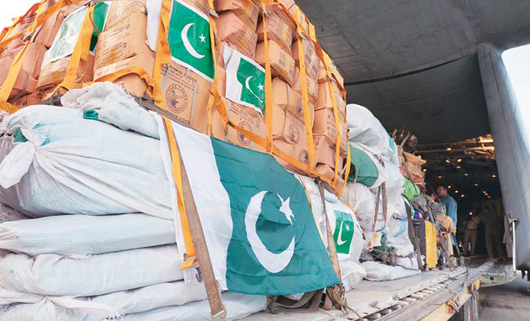
Kathmandu, Apr 30: After experiencing major devastation and loss of lives in the April 25 earthquake, Nepal is left with an unsavoury taste in the mouth when it received packets of 'beef masala' as part of the relief package from Pakistan.

Since the majority-Hindu country treats cows as sacred and there is a blanket ban on slaughtering the animal, the development has the potential of triggering diplomatic acrimony between the South Asian Association for Regional Cooperation (SAARC) member countries.
pak

Indian doctors at Kathmandu's Bir Hospital told Mail Today that packets of 'beef masala' were sent by Pakistan on Tuesday as part of relief aid to the temblor survivors. These doctors - drawn from Ram Manohar Lohia (RML) Hospital, Safdarjung Hospital and All India Institute of Medical Sciences (AIIMS) - are members of a 34-member medical team sent to Nepal for treating the survivors.

"When we reached the airport to collect the food items from Pakistan, we found packets of ready-to-eat meals, including packets of 'beef masala'. There were other food items too," Dr Balwinder Singh told Mail Today.

Perplexed, the doctors chose to have food from a hotel instead. "We did not touch the Pakistani aid," Dr Singh said.

"Most of the local people are not aware of the contents. When they understand, they avoid it," said another doctor on the condition of anonymity. He added: "Pakistan has hurt Nepal's religious sentiments by supplying the masala. Shockingly, it did not care about the sensitivity of the matter."

Exclusive photographs of the 'beef masala' packets supplied to Nepal are with Mail Today.

These pictures clearly show that the place of origin of these packets was Nowshera Cantt in Pakistan. These packets also prominently mention that these are not for sale and the contents include 'potato bhujia' and 'beef masala' (see photograph, right).

A top Nepal government official said: "The matter has been conveyed to Prime Minister Sushil Koirala and the intelligence chief. We are also starting an internal inquiry to verify the facts. If the report is correct, we will raise the matter at the diplomatic level with Pakistan. India, being our key partner, will also be informed of the developments."

Tasneem Aslam, spokesperson for Pakistan's ministry of foreign affairs, told Mail Today: "I am not aware of the issue... I am not responsible for the dispatch. The relief aid is sent by the National Disaster Management Authority."

A press note uploaded on the website of National Disaster Management Authority (NDMA), Pakistan (http://www.ndma.gov.pk/new/), states: "(The) National Disaster Management Authority has dispatched the second of two sorties of C-130 aircrafts on April 28 in collaboration with Pakistan Army, Ministry of Foreign Affairs and Pakistan Air Force. The relief goods include 250 tents, 200 food packs (2.6 tonne), 1,000 Meals Ready to Eat (MREs), 1,000 blankets and 33 cartons of medicines. These relief goods have been provided from NDMA stocks...."

The food items have been manufactured by PANA Force Foods. The consignment was supplied after receiving orders from Pakistan's NDMA.

"PANA Force food processing centre aims at providing quality goods at affordable prices. Currently, the company is supplying two brands of products to Pakistan Army commonly known as Meal Ready to Eat (MRE) and Emergency Pack Ration (EP Ration or high-energy biscuits) whereas a plant for the production of dehydrated vegetables and fruits is under construction," the official website of PANA Force Foods mentions.

The website also states that the processing centre provides food to civil population during natural calamities, like earthquakes and floods.

According to Hindu belief, eating beef is a religious offence since cow is a sacred animal and treated on a par with one's mother.

In Nepal - for long the world's only Hindu state - the first royal order officially prohibiting cow slaughter stated that the punishments for the crime were death and confiscation of all property of the offender.

The first Civil Code of Nepal, the Muluki Ain of 1854, stated: "This kingdom is the only kingdom in the world where cows, women, and Brahmins may not be killed." It trumpeted Nepal as the 'purest Hindu kingdom' and simultaneously signaled to Nepalese citizens that Hindu religious creeds would be the law of the land.

But an amendment in 1990 to the Civil Code made cow slaughter punishable by 12 years in prison.

Comments

Add new comment

  • Coastaldigest.com reserves the right to delete or block any comments.
  • Coastaldigset.com is not responsible for its readers’ comments.
  • Comments that are abusive, incendiary or irrelevant are strictly prohibited.
  • Please use a genuine email ID and provide your name to avoid reject.
News Network
July 12,2020

Mangaluru, Jul 12: The Expert Committee set up by the District authorities to inquire into death due to Covid-19 in Dakshina Kannada district declared that the death was due to patients late reporting to the hospitals and severe co-morbidities.

''Many were scared to visit the hospitals for treatment. Any patient suffering from fever, cold should stop self-medication and seek the advice of doctors. From what we have observed, the mortality was among patients who reported late to hospitals. Many had ignored symptoms assuming it to be a common cold,'' Expert Committee members Dr Hansraj Alva and Dr Muralidhar Yadiyal told mediapersons on Saturday night.

Wenlock Hospital Superintendent Dr Sadashiv said of the 38 deaths reported in the District, the expert committee had analysed 35 deaths. 9 persons who died are below 50 years old, 10 are in the age group of 50 to 60 years, 11 in the age group of 60 to 70 and five in the age group of above 70 years.

Comments

Add new comment

  • Coastaldigest.com reserves the right to delete or block any comments.
  • Coastaldigset.com is not responsible for its readers’ comments.
  • Comments that are abusive, incendiary or irrelevant are strictly prohibited.
  • Please use a genuine email ID and provide your name to avoid reject.
News Network
June 18,2020

Mysuru, Jun 18: The Karnataka government's proposal announced on Thursday to hold online classes for students amid concerns over COVID-19 has not gone down well with thousands of tribal students residing in villages across the state.

A team from Karnataka State Commission for Protection of Child Rights (KSCPCR) visited a few tribal hamlets in Mysuru and Kodagu recently and found that the students, unlike their urban counterparts, lack accessibility to not just smartphones and computers, but basic necessities like power supply.

''When such is the situation in the tribal hamlets, how can you expect students to catch up on their studies if classes are held online?'' wondered M L Parashurama Member, KSCPCR, who toured villages like Thithimathi, Beematagere, Devamachchi and Gaddadi in Kodagu's Virajpet taluk, besides Bavali, Balyadi, Machchuru, and Anemone in Mysuru's HD Kote taluk along with Chairperson Antony Sebastian.

Comments

Add new comment

  • Coastaldigest.com reserves the right to delete or block any comments.
  • Coastaldigset.com is not responsible for its readers’ comments.
  • Comments that are abusive, incendiary or irrelevant are strictly prohibited.
  • Please use a genuine email ID and provide your name to avoid reject.
News Network
March 15,2020

Bengaluru, Mar 15: The Karnataka government on Saturday said it would advice IT companies to allow employees to work from home as most coronavirus  affected patients or their relatives were from this sector.

"If anybody (IT companies) asks (employees to work in the office),I will speak to them through the deputy chief minister so that they take steps to issue a definite order. We have very clearly said, Stay Home, stay safe," medical education minister Dr K Sudhakar said. He recalled that the chief minister himself had issued a strict advisory to allow employees work from home.

The minister said the IT sector understands the gravity of the situation because they are educated, have travelled abroad and have more exposure to information world. "No action," he said to a question on what action would be taken against companies who do not follow the instructions.

"There is no action to be taken. We have not promulgated any law. It should be a kind of a cohesive approach from the government and the responsible citizen," he said.

The minister said he had also acted on the advice of Infosys Foundation chairperson Sudha Murty, who had told him that all areas where public and students gather, including malls, theatres, schools and colleges, should be closed.

Sudhakar claimed that the woman whose husband had tested positive for cornavirus here, had flown straight to Delhi from the city and had not come out of Bengaluru airport. He said the newly-wed couple came to Bengaluru airport on March 8 night and early on March 9, she flew alone to Delhi. From there she travelled to Agra by train. She did not come out of the airport, said the minister.

To a question on legal action being contemplated against her, the minister said he would take a call said he was not thinking of legal action at present and would take a call only after the woman, who has also tested positive for the virus, comes out of isolation. He insisted that the purpose of getting details was not to scare people.

On the preparedness in Kalaburagi, where the first Coronavirus death in India was reported, he said the administration had 'clamped down" the entire district. Meanwhile, the deputy commissioner of Ballari district ordered cancellation of tourists' entry to the world heritage site of Hampi from March 15 to 22 to prevent further spread of the virus.

Comments

Add new comment

  • Coastaldigest.com reserves the right to delete or block any comments.
  • Coastaldigset.com is not responsible for its readers’ comments.
  • Comments that are abusive, incendiary or irrelevant are strictly prohibited.
  • Please use a genuine email ID and provide your name to avoid reject.