


Pakistan serves beef to Nepal earthquake survivors

April 30, 2015

Kathmandu, Apr 30: After experiencing major devastation and loss of lives in the April 25 earthquake, Nepal is left with an unsavoury taste in the mouth when it received packets of 'beef masala' as part of the relief package from Pakistan.

Since the majority-Hindu country treats cows as sacred and there is a blanket ban on slaughtering the animal, the development has the potential of triggering diplomatic acrimony between the South Asian Association for Regional Cooperation (SAARC) member countries.
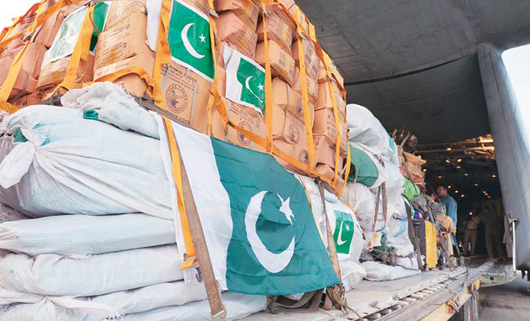
pak

Indian doctors at Kathmandu's Bir Hospital told Mail Today that packets of 'beef masala' were sent by Pakistan on Tuesday as part of relief aid to the temblor survivors. These doctors - drawn from Ram Manohar Lohia (RML) Hospital, Safdarjung Hospital and All India Institute of Medical Sciences (AIIMS) - are members of a 34-member medical team sent to Nepal for treating the survivors.

"When we reached the airport to collect the food items from Pakistan, we found packets of ready-to-eat meals, including packets of 'beef masala'. There were other food items too," Dr Balwinder Singh told Mail Today.

Perplexed, the doctors chose to have food from a hotel instead. "We did not touch the Pakistani aid," Dr Singh said.

"Most of the local people are not aware of the contents. When they understand, they avoid it," said another doctor on the condition of anonymity. He added: "Pakistan has hurt Nepal's religious sentiments by supplying the masala. Shockingly, it did not care about the sensitivity of the matter."

Exclusive photographs of the 'beef masala' packets supplied to Nepal are with Mail Today.

These pictures clearly show that the place of origin of these packets was Nowshera Cantt in Pakistan. These packets also prominently mention that these are not for sale and the contents include 'potato bhujia' and 'beef masala' (see photograph, right).

A top Nepal government official said: "The matter has been conveyed to Prime Minister Sushil Koirala and the intelligence chief. We are also starting an internal inquiry to verify the facts. If the report is correct, we will raise the matter at the diplomatic level with Pakistan. India, being our key partner, will also be informed of the developments."

Tasneem Aslam, spokesperson for Pakistan's ministry of foreign affairs, told Mail Today: "I am not aware of the issue... I am not responsible for the dispatch. The relief aid is sent by the National Disaster Management Authority."

A press note uploaded on the website of National Disaster Management Authority (NDMA), Pakistan (http://www.ndma.gov.pk/new/), states: "(The) National Disaster Management Authority has dispatched the second of two sorties of C-130 aircrafts on April 28 in collaboration with Pakistan Army, Ministry of Foreign Affairs and Pakistan Air Force. The relief goods include 250 tents, 200 food packs (2.6 tonne), 1,000 Meals Ready to Eat (MREs), 1,000 blankets and 33 cartons of medicines. These relief goods have been provided from NDMA stocks...."

The food items have been manufactured by PANA Force Foods. The consignment was supplied after receiving orders from Pakistan's NDMA.

"PANA Force food processing centre aims at providing quality goods at affordable prices. Currently, the company is supplying two brands of products to Pakistan Army commonly known as Meal Ready to Eat (MRE) and Emergency Pack Ration (EP Ration or high-energy biscuits) whereas a plant for the production of dehydrated vegetables and fruits is under construction," the official website of PANA Force Foods mentions.

The website also states that the processing centre provides food to civil population during natural calamities, like earthquakes and floods.

According to Hindu belief, eating beef is a religious offence since cow is a sacred animal and treated on a par with one's mother.

In Nepal - for long the world's only Hindu state - the first royal order officially prohibiting cow slaughter stated that the punishments for the crime were death and confiscation of all property of the offender.

The first Civil Code of Nepal, the Muluki Ain of 1854, stated: "This kingdom is the only kingdom in the world where cows, women, and Brahmins may not be killed." It trumpeted Nepal as the 'purest Hindu kingdom' and simultaneously signaled to Nepalese citizens that Hindu religious creeds would be the law of the land.

But an amendment in 1990 to the Civil Code made cow slaughter punishable by 12 years in prison.

Comments

Add new comment

  • Coastaldigest.com reserves the right to delete or block any comments.
  • Coastaldigset.com is not responsible for its readers’ comments.
  • Comments that are abusive, incendiary or irrelevant are strictly prohibited.
  • Please use a genuine email ID and provide your name to avoid reject.
News Network
May 8,2020

New Delhi, May 8: After deadly styrene gas leak in Visakhapatnam, Union Chemicals and Fertilisers Minister D V Sadananda Gowda urged all public and private chemical makers to exercise caution and care while reopening their plants.

Union Environment Ministry and State Pollution Control Boards have also issued separate directives to all companies to take extreme precaution while restarting their units that remained suspended due to the lockdown imposed to contain the spread of COVID-19 in the country, he said.

There was a gas leak from LG Polymers plant at Visakhapatnam in the early hours on Thursday, causing 10 deaths and hundreds of people getting hospitalised.

"LG Polymers does not come under direct control of our ministry. However, we have asked all public and private chemicals manufacturers to exercise caution and care while reopening their plants," Gowda told PTI.

The minister said his officers are coordinating with the Andhra Pradesh government.

He further said LG Polymers, a multinational chemical company, had kept its unit ready for reopening after one and half month of lockdown. The unit started leaking at around 3.40 am on Thursday due to pressure.

"The toxic gas leak has affected both people and animals. Around 850 people have been hospitalised," Gowda said, adding that measures have been taken to control the situation at the plant site and final updates are awaited.

At present, Indian chemicals market size is about USD 163 billion, which is only three per cent of the global chemical industry of USD 5 trillion, as per the official data.

Comments

Add new comment

  • Coastaldigest.com reserves the right to delete or block any comments.
  • Coastaldigset.com is not responsible for its readers’ comments.
  • Comments that are abusive, incendiary or irrelevant are strictly prohibited.
  • Please use a genuine email ID and provide your name to avoid reject.
News Network
August 9,2020

Bengaluru, Aug 9: A youth was killed and three others injured as a pillar of an old temple on the outskirts of Bengaluru fell on them as they and five others dug under it in search of treasure, police said on Saturday.

"One treasure hunter got crushed under a pillar, three suffered injuries and have been hospitalised while five are on the run," a police official said.

The incident occurred at a centuries-old Anjaneya temple in Hindiganala village near Hoskote, around 50 km away from the city, on Thursday night.

Suresh, 23, got crushed to death while Manjunath, 23, Srinivas, 22, and Sebastian Raja Rathna, 22, were injured.

Following the unexpected accident, the injured treasure hunters called a 108 ambulance, leading to the entire incident coming to light.

The ambulance staff helped the youth stuck under the temple pillars and took them to hospital.

Police have registered a case under various sections of the Ancient Monuments Act, the Karnataka Treasure Trove Act, and the Indian Penal Code.

According to the official, local youth the village as well as a nearby village were involved in the hunt.

Police are on the lookout for the five treasure hunters on the run.

However, the police official said that it was an old ruined temple and there was nothing there.

Comments

Add new comment

  • Coastaldigest.com reserves the right to delete or block any comments.
  • Coastaldigset.com is not responsible for its readers’ comments.
  • Comments that are abusive, incendiary or irrelevant are strictly prohibited.
  • Please use a genuine email ID and provide your name to avoid reject.
News Network
January 30,2020

Udupi, Jan 30: Fishermen in Udupi’s Malpe have netted ‘spanner crab’, a rare variety of deep sea crab, mostly found in Australia and Hawaiian coast.

Hundreds of onlookers were surprised to the see the catch when it was brought to Malpe harbour by the fisherman Prashanth Kunder and others on Tuesday evening.

Dr Shivakumar Haragi, Assistant Professor at Karnatak University, PG Centre Department of Marine Biology, Karwar identified this crab variety as ‘spanner crab’ and the scientific name of this crab is Ranina Ranina.

Ranina Ranina is mainly nocturnal as it remains active during night and is found buried in sand during the day .It is easily distinguished from other crab species in its habitat due to its red carapace and elongated midsection.

Resembling a frog in its shape, this crab species is found mainly in Africa, Hawaiian coast and also in the Great Barrier Reef, located in the Coral Sea, off the coast of Queensland, Australia. Its lifetime is seven to nine years and each crab weighs around 400-900 grams.

Prashanth Kunder and his associates have also netted a rare fish variety called yellow-edged lyretail. Another unique variety fish netted by Prashanth is epinephelus flavocaeruleus.

Comments

Add new comment

  • Coastaldigest.com reserves the right to delete or block any comments.
  • Coastaldigset.com is not responsible for its readers’ comments.
  • Comments that are abusive, incendiary or irrelevant are strictly prohibited.
  • Please use a genuine email ID and provide your name to avoid reject.