


Pakistan serves beef to Nepal earthquake survivors

April 30, 2015

Kathmandu, Apr 30: After experiencing major devastation and loss of lives in the April 25 earthquake, Nepal is left with an unsavoury taste in the mouth when it received packets of 'beef masala' as part of the relief package from Pakistan.

Since the majority-Hindu country treats cows as sacred and there is a blanket ban on slaughtering the animal, the development has the potential of triggering diplomatic acrimony between the South Asian Association for Regional Cooperation (SAARC) member countries.
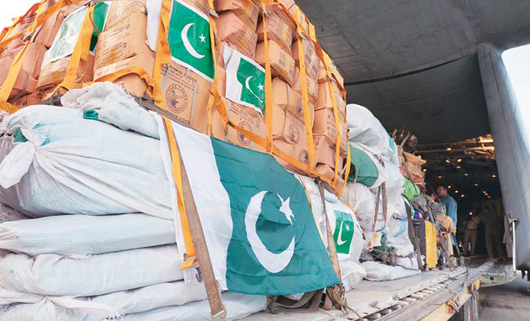
pak

Indian doctors at Kathmandu's Bir Hospital told Mail Today that packets of 'beef masala' were sent by Pakistan on Tuesday as part of relief aid to the temblor survivors. These doctors - drawn from Ram Manohar Lohia (RML) Hospital, Safdarjung Hospital and All India Institute of Medical Sciences (AIIMS) - are members of a 34-member medical team sent to Nepal for treating the survivors.

"When we reached the airport to collect the food items from Pakistan, we found packets of ready-to-eat meals, including packets of 'beef masala'. There were other food items too," Dr Balwinder Singh told Mail Today.

Perplexed, the doctors chose to have food from a hotel instead. "We did not touch the Pakistani aid," Dr Singh said.

"Most of the local people are not aware of the contents. When they understand, they avoid it," said another doctor on the condition of anonymity. He added: "Pakistan has hurt Nepal's religious sentiments by supplying the masala. Shockingly, it did not care about the sensitivity of the matter."

Exclusive photographs of the 'beef masala' packets supplied to Nepal are with Mail Today.

These pictures clearly show that the place of origin of these packets was Nowshera Cantt in Pakistan. These packets also prominently mention that these are not for sale and the contents include 'potato bhujia' and 'beef masala' (see photograph, right).

A top Nepal government official said: "The matter has been conveyed to Prime Minister Sushil Koirala and the intelligence chief. We are also starting an internal inquiry to verify the facts. If the report is correct, we will raise the matter at the diplomatic level with Pakistan. India, being our key partner, will also be informed of the developments."

Tasneem Aslam, spokesperson for Pakistan's ministry of foreign affairs, told Mail Today: "I am not aware of the issue... I am not responsible for the dispatch. The relief aid is sent by the National Disaster Management Authority."

A press note uploaded on the website of National Disaster Management Authority (NDMA), Pakistan (http://www.ndma.gov.pk/new/), states: "(The) National Disaster Management Authority has dispatched the second of two sorties of C-130 aircrafts on April 28 in collaboration with Pakistan Army, Ministry of Foreign Affairs and Pakistan Air Force. The relief goods include 250 tents, 200 food packs (2.6 tonne), 1,000 Meals Ready to Eat (MREs), 1,000 blankets and 33 cartons of medicines. These relief goods have been provided from NDMA stocks...."

The food items have been manufactured by PANA Force Foods. The consignment was supplied after receiving orders from Pakistan's NDMA.

"PANA Force food processing centre aims at providing quality goods at affordable prices. Currently, the company is supplying two brands of products to Pakistan Army commonly known as Meal Ready to Eat (MRE) and Emergency Pack Ration (EP Ration or high-energy biscuits) whereas a plant for the production of dehydrated vegetables and fruits is under construction," the official website of PANA Force Foods mentions.

The website also states that the processing centre provides food to civil population during natural calamities, like earthquakes and floods.

According to Hindu belief, eating beef is a religious offence since cow is a sacred animal and treated on a par with one's mother.

In Nepal - for long the world's only Hindu state - the first royal order officially prohibiting cow slaughter stated that the punishments for the crime were death and confiscation of all property of the offender.

The first Civil Code of Nepal, the Muluki Ain of 1854, stated: "This kingdom is the only kingdom in the world where cows, women, and Brahmins may not be killed." It trumpeted Nepal as the 'purest Hindu kingdom' and simultaneously signaled to Nepalese citizens that Hindu religious creeds would be the law of the land.

But an amendment in 1990 to the Civil Code made cow slaughter punishable by 12 years in prison.

Comments

Add new comment

  • Coastaldigest.com reserves the right to delete or block any comments.
  • Coastaldigset.com is not responsible for its readers’ comments.
  • Comments that are abusive, incendiary or irrelevant are strictly prohibited.
  • Please use a genuine email ID and provide your name to avoid reject.
News Network
April 4,2020

Mangaluru, Apr 4: The chemistry department of National Institute of Technology-Karnataka (NIT-K) here has started producing hand sanitizers in view of its shortage in the market after the coronavirus outbreak.

The social initiative led by Arun Isloor, professor and head of the department, was launched by NIT-K director K Uma Maheshwar Rao.

The raw materials needed for this product were provided by the institute.

Comments

Add new comment

  • Coastaldigest.com reserves the right to delete or block any comments.
  • Coastaldigset.com is not responsible for its readers’ comments.
  • Comments that are abusive, incendiary or irrelevant are strictly prohibited.
  • Please use a genuine email ID and provide your name to avoid reject.
News Network
February 21,2020

Thiruvananthapuram, Feb 21: A school in the city has allegedly denied admission to a boy whose parents did not fill the religion column in the application form, prompting the Kerala education department to seek a report.

The parents, Naseem and Dhayna, had sought admission for their son to the first standard at the St Mary's school, a government-aided institution. They alleged that school authorities had claimed that registration will not be possible on the education department's 'Sampoorna' portal without filling the 'religion' column.

"We were informed by the school authorities that it was not possible to give admission to our child as we wrote 'nil' in the religion column. They claimed that if nil is mentioned, the admission process will not get registered in the school management software of the education department," Naseem said.

Sampoorna is a school management system project implemented by the Kerala education department to automate the system and process of over 15,000 schools in the state.

The parents later approached the ministry and the Directorate of Public Instruction (DPI) to get further clarification.

"The state government officials denied that there were any issues with the software and confirmed to us that the admission process was going on.

When we approached the school authorities again, they asked us to give in writing that we, the parents will take responsibility of any issues that may occur in the future," Naseem said.

The parents then decided not to enroll their son at the school due to the manner in which the issue was handled by the institution. Reacting swiftly, the state government sought a report from the DPI and the deputy director of the education department on the matter.

"We have asked the DPI and the deputy director of the education department to look into the matter and file a report as soon as possible," Education minister C Raveendranath told PTI. The parents said after the news spread, a school official called them offering admission.

"But we decided not to enroll him there due to the approach of the school authorities," he said.

Naseem runs a catering business after returning from the Gulf.

The school management in a release claimed that they sought a letter in writing from the parents to avoid trouble in the future. "When school authorities asked why the religion column was left blank, the parents said they were not interested in filling that part. The parents have that right.

But most benefits given by the government to school children are based on religion. We just wanted to ensure that the parents take the responsibility in case the student misses out any such benefits in the future," the management said.

School authorities maintained they never denied admission to any student. The parents are now looking for admission for their son in other schools in Thiruvanathapuram.

Ravindranath recently claimed in the state Assembly that over one lakh children in Kerala had left columns relating to caste and religion blank in school admission records during the 2017-18 academic year. In a written reply, he said as many as 1,24,147 children had not filled these columns while enrolling in different classes in government and government-aided schools during the period.

Comments

Add new comment

  • Coastaldigest.com reserves the right to delete or block any comments.
  • Coastaldigset.com is not responsible for its readers’ comments.
  • Comments that are abusive, incendiary or irrelevant are strictly prohibited.
  • Please use a genuine email ID and provide your name to avoid reject.
News Network
January 21,2020

Bengaluru, Jan 21: A private hospital in Bengaluru, the capital of Karnataka, on Tuesday claimed that it has successfully performed a live liver transplant on a Jehovah's Witness from Nigeria, by not using blood or blood products, in order to protect the patient's religious beliefs.

It is said that Jehovah's Witnesses are followers of a Christian faith that prohibits the use of blood or blood products during their treatment. Gehojadak (37), a Jehovah's Witness follower, had developed decompensated liver disease and visited more than three countries seeking treatment over the last four years but was turned away by most doctors due to the highly risky nature of surgery, Aster CMI Hospital said.

The surgery was challenging compared to a normal liver transplant because in order to protect the patient's religious beliefs, the medical team could not use blood or blood products (Fresh frozen plasma, Cryoprecipitate, Platelets etc), it said in a release, adding that very few such surgeries have been successfully conducted worldwide.

The patient's brother was the donor, the hospital said, adding, without a liver transplant, Gehojadak's chances of survival were less than 10 per cent over the next two years. A team of liver specialists from the Hospital thoroughly reviewed the patient's medical history before recommending a bloodless liver transplant and charted out a feasible pathway to make the surgery a success.

"This transplant was especially challenging as we did not have the safety net (of using blood) even if the patient's life was at risk due to their advance directive. We have performed other non-transplant liver surgeries in Jehovah's Witnesses and this gave us the confidence to take on Gehojadak's transplant," Dr Rajiv Lochan, Consultant Liver Transplant Surgeon, said.

The critical surgery took a 12-hour period to complete where two teams of specialists with close to 25 doctors including anaesthetists, intensivists worked in absolute sync with each other and Gehojadak finally received a life-saving liver transplant, the Hospital said. In a period of two weeks, the patient and his brother were fit enough to go home and were discharged from the hospital.

"Even if their haemoglobin levels dropped to life-threatening levels, the patients were clear that they would not accept a blood transfusion. Keeping the limitations in mind, the most effective treatment path was planned, and we spent close to two months preparing the patients for surgery," Arun V, Consultant Anesthesiologist said. The hospital arranged customised artificial products like synthetic drug molecules, to conduct a bloodless liver transplant, he added.

Comments

Add new comment

  • Coastaldigest.com reserves the right to delete or block any comments.
  • Coastaldigset.com is not responsible for its readers’ comments.
  • Comments that are abusive, incendiary or irrelevant are strictly prohibited.
  • Please use a genuine email ID and provide your name to avoid reject.