



Parliament approves historic law to overturn collegium system

August 14, 2014

New Delhi, Aug 14: Overcoming resistance by the judiciary, Parliament today took the much-delayed historic step of clearing two bills to have a new mechanism to appoint judges to higher courts and scrap the collegium system which has been under severe criticism.Parliament
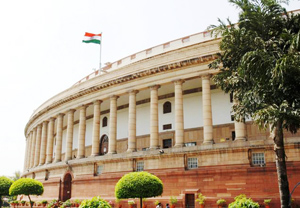
Rajya Sabha approved with overwhelming majority the 121st Constitution Amendment Bill along with the National Judicial Appointments Commission Bill, 2014, a day after Lok Sabha gave its nod to the measure with a crucial amendment of the opposition Congress being accepted by the government.

The Constitution Amendment Bill was passed with 179 votes in favour among 180 votes polled while noted lawyer Ram Jethmalani abstained. The Appointments Commission Bill was approved by voice vote.

Approval of the 245-member Upper House to the measure is significant as ruling NDA is in a minority there. The two measures were taken up separately after questions were raised by members over legislative competence of the House amid apprehensions that it could be struck down by the judiciary as 'ultra vires'.

A determined government asserted that Parliament is supreme and competent enough to enact laws and that it has no intention of transgressing on independence of the judiciary through the new law.

Law Minister Ravi Shankar Prasad underlined that the new measure of appointing judges to Supreme Court and High Courts will come into effect only after ratification of the Constitution Amendment Bill by 50 per cent state assemblies. The process could take up to eight months. After ratification, government will send it to the President for his approval.

With this step, the collegium system of judges appointing judges will be changed with a six-member Commission headed by Chief Justice of India making the appointments and transfers.

There have been several attempts to overturn the 20-year-old collegium system in the past, including by the previous NDA and UPA governments. The effort finally fructified on the last day of the first working session of Parliament under the new government.

To bring Opposition on board, government had yesterday dropped a controversial provision that required unanimity in recommendation if President seeks reconsideration.

The amendment dropped the provision requiring unanimity in the Commission's recommendation if President had referred the earlier recommendation back to the collegium for reconsideration.

The Constitution amendment bill will grant Constitutional status to the NJAC and its composition. The NJAC Bill, passed along with the statute amendment bill, lays down the procedure to be adopted by the commission for elevation of Supreme Court judges and transfer and posting of Chief Justices and other judges of the 24 High Courts.

Under the statute amendment bill, Chief Justice of India will head the NJAC. Besides the CJI, the judiciary would be represented by two senior judges of the Supreme Court. Two eminent personalities and the Law Minister will be the other members of the proposed body.

In his intervention, Finance Minister Arun Jaitley, a noted lawyer, said since there is a marginal role of the executive in the current system, "the effort is now to restore what is the spirit of the original Constitution" with checks and balances in place.

Prasad rejected the opposition charge that the measure was being brought in haste, saying the exercise has been going on for two decades during which several committees have recommended for changing the collegium system.

"Why is Parliament wary of using its powers? Parliament must have full trust in the ability of Parliament to pass the law," he said. Prasad said the power of appointing a judge rests with the President of India. "This House respects the independence of the judiciary and this House also respects the power of Parliament," he said.


Comments

Add new comment

  • Coastaldigest.com reserves the right to delete or block any comments.
  • Coastaldigset.com is not responsible for its readers’ comments.
  • Comments that are abusive, incendiary or irrelevant are strictly prohibited.
  • Please use a genuine email ID and provide your name to avoid reject.
Agencies
February 5,2020

New Delhi, Feb 5: Over five crore farmers were yet to get the third instalment of money under the Centre's ambitious PM-Kisan scheme, aimed at providing direct support of Rs 6,000 annually to them, according to the latest Ministry of Agriculture and Farmers' Welfare data.

The total amount of the scheme, which came into effect on December 1, 2018, is to be paid in three equal instalments of Rs 2,000 every four months.

The data showed about 2.51 crore farmers have not got even the second instalment and 5.16 crore of them were yet to get the third instalment.

Over 9 crore farmers have registered themselves under the scheme between December 2018 and November 2019, it said.

Of these, 7.62 crore or 84 per cent of farmers have received the first instalment.

The money through the second instalment was given to nearly 6.5 crore farmers and the amount under the third instalment was given to 3.85 crore beneficiaries, according to the data received in response to an RTI query filed by this PTI journalist.

The agriculture ministry, in its response, gave three sets of data mentioning the benefits given to farmers under the scheme between December 2018 and November 2019.

It said 4.74 crore farmers were registered between December 2018 and March 2019.

Of them, 4.22 crore received the first instalment, 4.02 crore the second and 3.85 crore the third.

There was no mention why nearly 50 lakh, 70 lakh and 90 lakh registered farmers during this period did not get the first, second and third instalment respectively.

There was no registered beneficiary in West Bengal and Sikkim, hence no amount was disbursed during this period, according to the data.

Giving details of the 3.08 crore farmers registered between April and July last year, it said 2.66 crore and 2.47 crore beneficiaries have got their first and second instalments respectively.

The RTI reply did no mention why around 40 lakh and 61 lakh registered farmers during this period did not get their first and second instalment respectively.

"The beneficiaries are eligible for the instalment for the period in which he/she gets registered and subsequent periods, thereafter. Therefore, the third instalment is not due for the beneficiaries registered in the period April 2019-July 2019," the ministry said.

There was no registered beneficiary during this period in West Bengal, Punjab and Chandigarh and therefore nobody was paid first and second instalments.

The ministry said around 1.19 crore beneficiaries were registered between August and November 30, 2019, of these nearly 73.66 lakh farmers have been given the first instalment.

There was no mention of payment of first instalment to over 45 lakh eligible beneficiaries during the period.

"The beneficiaries are eligible for the instalment for the period in which he/she gets registered and subsequent periods, thereafter. Therefore, the second and third instalments are not due for the beneficiaries registered in the period August 2019 to November 2019," it said.

The ministry was asked to provide the total number of farmers, state-wise, and the amount received by them under the Pradhan Mantri Kisan Samman Nidhi or PM-Kisan scheme.

"PM-Kisan Samman Nidhi scheme has been implemented from December 1, 2018. It is stated that PM-Kisan is a continuous and ongoing scheme, in which the financial benefits are transferred to the bank accounts of the identified beneficiaries as and when their correct and verified data is uploaded by the concerned states/union territories on PM-Kisan web portal," the ministry said in the RTI response vide its letter dated December 26, 2019.

The data of beneficiaries so uploaded by them undergoes a multi-level verification, including by banks, and only then the amount is released to the beneficiary, it said, adding that www.pmkisan.gov.in website can be accessed to get more details on the operational guidelines of the scheme.

According to the data updated on the website on February 3, around 8.82 crore farmers have been registered and 8.41 crore have received the first installment, 7.56 crore the second instalment, 6.19 crore the third and 3.03 crore have received the fourth installment.

In Assam, out of 16.97 lakh farmers registered during this period, 14.02 lakh got the first instalment, 13.72 lakh received the second and 9.87 lakh the third.

Of the 42.34 lakh registered beneficiaries in Maharashtra, 36.98 lakh got the first instalment, 31.53 lakh the second and 27.67 lakh got the third instalment.

As many as 23.83 lakh farmers in Kerala received their first instalment, 18.79 lakh got the second and 18.43 lakh the third. A total of 26.13 lakh beneficiaries were registered in the state between December 2018 and March 2019.

There was no beneficiary registered during the period from West Bengal, which has refused to implement the scheme, according to the ministry's response.

In Uttar Pradesh, nearly 9.57 lakh out of 19.64 lakh farmers have got the first instalment. In Gujarat, nearly 1.22 lakh out of 1.98 lakh registered farmers got the first instalment.

Around 9.78 lakh farmers out of the 17.18 lakh registered beneficiaries have received the first instalment in Madhya Pradesh. In Odisha, only 5,507 farmers out of 5.6 lakh registered farmers have got the first instalment, the ministry said.

None of the 7,326 farmers registered in Sikkim was paid the first instalment, according to the ministry's reply. In Delhi, 1,447 farmers out of 1,734 have got the first instalment.

Comments

Add new comment

  • Coastaldigest.com reserves the right to delete or block any comments.
  • Coastaldigset.com is not responsible for its readers’ comments.
  • Comments that are abusive, incendiary or irrelevant are strictly prohibited.
  • Please use a genuine email ID and provide your name to avoid reject.
Agencies
July 15,2020

New Delhi, Jul 15: Air India has started the process of identifying employees, based on various factors like efficiency, health and redundancy, who will be sent on compulsory leave without pay (LWP) for up to five years, according to an official order.

The airline's board of directors have authorised its Chairman and Managing Director Rajiv Bansal to send employees on LWP "for six months or for a period of two years extendable upto five years, depending upon the following factors - suitability, efficiency, competence, quality of performance, health of the employee, instance of non-availability of the employee for duty in the past as a result of ill health or otherwise and redundancy", the order said on Tuesday.

The departmental heads in the headquarter as well as regional directors are required to assess each employee "on the above mentioned factors and identify the cases where option of compulsory LWP can be exercised", stated the order dated July 14.

"Names of such employees need to be forwarded to the General Manager (Personnel) in headquarter for obtaining necessary approval of CMD," the order added.

In response to queries regarding this matter, Air India spokesperson said,"We would not like to make any comment on the issue."

Aviation sector has been significantly impacted due to the travel restrictions imposed in India and other countries due to the coronavirus pandemic. All airlines in India have taken cost-cutting measures such as pay cuts, LWP and firings of employees in order to conserve cash flow.

For example, GoAir has put most of its employees on compulsory LWP since April.

India resumed domestic passenger flights from May 25 after a gap of two months due to the coronavirus pandemic.

However, the airlines have been allowed to operate only a maximum of 45 per cent of their pre-COVID domestic flights. Occupancy rate in Indian domestic flights has been around 50-60 per cent since May 25.

Scheduled international passenger flights continue to remain suspended in India since March 23.

The passenger demand for air travel will contract by 49 per cent in 2020 for Indian carriers in comparison to 2019 due to COVID-19 crisis, said global airlines body IATA on Monday.

Comments

Add new comment

  • Coastaldigest.com reserves the right to delete or block any comments.
  • Coastaldigset.com is not responsible for its readers’ comments.
  • Comments that are abusive, incendiary or irrelevant are strictly prohibited.
  • Please use a genuine email ID and provide your name to avoid reject.
Agencies
July 31,2020

New Delhi, Jul 31: With the highest single-day spike of 55,079 COVID-19 cases in the last 24 hours, India's coronavirus tally breached the 16 lakh mark on Friday, informed the Union Ministry of Health and Family Welfare.

With this latest spike, the total cases in the country stand at 16,38,871. Among these cases 5,45,318 are active. A total of 10,57,806 patients have been cured/discharged/migrated.

779 deaths due to COVID-19 have been reported in the country in the last 24 hours, taking the death toll to 35,747.

As per the Union Health Ministry, Maharashtra has a total of 1,48,454 active cases and recorded 14,729 deaths due to COVID-19.
Tamil Nadu has a total of 57,962 active cases and 3,838 deaths in the state.

Delhi has a total of 10,743 active cases and 3,936 deaths.

The Indian Council of Medical Research on Friday informed that a total number of COVID-19 samples tested up to 30th July is 1,88,32,970 including 6,42,588 samples tested yesterday.

Comments

Add new comment

  • Coastaldigest.com reserves the right to delete or block any comments.
  • Coastaldigset.com is not responsible for its readers’ comments.
  • Comments that are abusive, incendiary or irrelevant are strictly prohibited.
  • Please use a genuine email ID and provide your name to avoid reject.