



Parties fail to take EVM hackathon challenge

June 4, 2017

New Delhi, Jun 4: Despite over a dozen political parties questioning the reliability of electronic voting machines, none of them took up the challenge to prove it they can be tampered with.
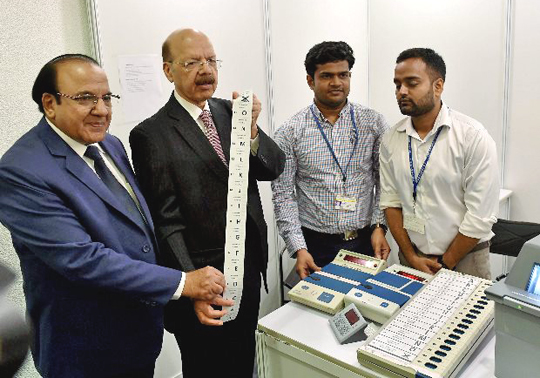
EVM

The Election Commission had recently thrown open a challenge to all political parties. Though the CPM and the NCP accepted the challenge and appeared for the event held here on Saturday, they opted out of the test. After the event, Chief Election Commissioner Nasim Zaidi told reporters that EVMs used by the poll panel are “non-tamperable”, and with 100% use of paper trail machines in all future elections, the issue of tamperability of the machines “stands closed”.

He also made it clear that there would be no such challenge in future to test the reliability of EVMs. The CPM said they didn't want to participate in the challenge, but wished to understand the EVM process.

The NCP team, for its part, informed they, too, didn't want to participate in any test, but were only interested to participate in an academic exercise, Zaidi said.

The challenge was organised after several major Opposition parties had claimed that the faith of people in the machines had eroded due to charges of tampering.

Representatives from both the parties were offered four machines and four hours to hack into them. The machines were brought from Punjab, Uttarakhand and Uttar Pradesh where the recent Assembly elections were held.

Zaidi said the CPM members were given a detailed demonstration by the commission about EVMs and they were “satisfied”.

The NCP team led by Rajya Sabha member Vandana Chavan conveyed that the main reason for their apprehension was over the voting machines used in the municipal polls in Maharashtra, the commission clarified that the EVMs used by the Maharashtra State Election Commission did not belong to the ECI.

However, when the NCP team again met the commission officials and sought time to participate in the challenge or by way of academic exercise by selecting the EVM and then accessing the memory and battery numbers by opening the machines themselves, the commission agreed to that, a statement said.

Earlier, the commission had rejected the AAP and Congress demand to allow them to access motherboard of the voting machines.

Comments

Add new comment

  • Coastaldigest.com reserves the right to delete or block any comments.
  • Coastaldigset.com is not responsible for its readers’ comments.
  • Comments that are abusive, incendiary or irrelevant are strictly prohibited.
  • Please use a genuine email ID and provide your name to avoid reject.
Agencies
May 8,2020

Washington D.C., May 8: The prime time for brain development in a child's life is the first year, where the infant spends most of the time asleep. It is the time when neural connections form and sensory memories are encoded.

However, when sleep is disrupted, as occurs more often among children with autism, brain development may be affected, too.

New research led by the University of Washington finds that sleep problems in a baby's first 12 months may not only precede an autism diagnosis but also may be associated with altered growth trajectory in a key part of the brain, the hippocampus.

The study, which was published in the American Journal of Psychiatry, researchers report that in a sample of more than 400 taken of 6- to 12-month-old infants, those who were later diagnosed with autism were more likely to have had difficulty falling asleep.

It also states that this sleep difficulty was associated with altered growth trajectories in the hippocampus.

"The hippocampus is critical for learning and memory, and changes in the size of the hippocampus have been associated with poor sleep in adults and older children.

As many as 80 per cent of the children with autism spectrum disorder have sleep problems," said Annette Estes, director of the UW Autism Center and senior author of the study.

"In our clinical experience, parents have a lot of concerns about their children's sleep, and in our work on early autism intervention, we observed that sleep problems were holding children and families back," added Estes, who is also a UW professor of speech and hearing sciences.

"It could be that altered sleep is part-and-parcel of autism for some children. One clue is that behavioural interventions to improve sleep don't work for all children with autism, even when their parents are doing everything just right. This suggests that there may be a biological component to sleep problems for some children with autism," said Estes.

To consider links among sleep, brain development, and autism, researchers at the IBIS Network looked at MRI scans of 432 infants, surveyed parents about sleep patterns, and measured cognitive functioning using a standardized assessment.

At the outset of the study, infants were classified according to their risk for developing autism: Those who were at higher risk of developing autism -- about two-thirds of the study sample -- had an older sibling who had already been diagnosed.

Infant siblings of children with autism have a 20 per cent chance of developing autism spectrum disorder -- a much higher risk than children in the general population.

In the current study, 127 of the 432 infants were identified as "low risk" at the time the MRI scans were taken because they had no family history of autism.

They later evaluated all the participants at 24 months of age to determine whether they had developed autism. Of the roughly 300 children originally considered "high familial risk," 71 were diagnosed with autism spectrum disorder at that age.

Problems with sleep were more common among the infants later diagnosed with an autism spectrum disorder, as were larger hippocampi. No other subcortical brain structures were affected, including the amygdala, which is responsible for certain emotions and aspects of memory, or the thalamus, a signal transmitter from the spinal cord to the cerebral cortex.

The authors note that while parents reported more sleep difficulties among infants who developed autism compared to those who did not, the differences were very subtle and only observed when looking at group averages across hundreds of infants.

Sleep patterns in the first years of life change rapidly as infants transition from sleeping around the clock to a more adult-like sleep/wake cycle. Until further research is completed, Estes said, it is not possible to interpret challenges with sleep as an early sign of increased risk for autism.

Comments

Add new comment

  • Coastaldigest.com reserves the right to delete or block any comments.
  • Coastaldigset.com is not responsible for its readers’ comments.
  • Comments that are abusive, incendiary or irrelevant are strictly prohibited.
  • Please use a genuine email ID and provide your name to avoid reject.
News Network
January 19,2020

Davanagere, Jan 19: Seven people, including four women, were arrested for allegedly selling a 13-month-old female baby here on Saturday.

Police said that the baby was sold to a couple who had no child. The couple hailed from Ranebennur town in Haveri District of Karnataka. They sold the baby, which was their fourth child.

The arrested were identified as Kavita (26) and her husband Manjunath (couple who sold the baby), Dakshayani (34) and her husband Ravi (49) of Ranebennur, Haveri District (the couple who purchased the baby, Chitramma (44) Nurse, Kamalamma (45) and Karibasappa, who acted as middlemen for the deal.

Comments

Add new comment

  • Coastaldigest.com reserves the right to delete or block any comments.
  • Coastaldigset.com is not responsible for its readers’ comments.
  • Comments that are abusive, incendiary or irrelevant are strictly prohibited.
  • Please use a genuine email ID and provide your name to avoid reject.
News Network
July 15,2020

Bengaluru, Jul 15: Toyota Kirloskar Motor (TKM) has announced temporary halt of production at its plant in Bidadi, which is on the outskirts of Bengaluru.

“Halting production will be from July 14 (second shift) to July 22 (first shift) and this is in accordance with the directives issued by the Government of Karnataka as well as to support the Govt. in their constant efforts to flatten the curve of the rising Covid-19 positive cases in Karnataka,” a statement from the company said.

Bengaluru Urban and Rural, and other districts are, are under lockdown from 8 pm on July 14 to 5 am on July 22.

“Since the onset of the pandemic, TKM has adopted a very proactive and multi-faceted approach to safeguard the physical as well as the mental well-being of all its stakeholders including customers, its employees, dealer and supplier partners,” the company said.

“The office staff at TKM’s corporate and regional offices, continue to work from home to help mitigate risks. In addition to the safety protocols that are being followed, TKM has provided safety kits containing essential items like sanitisers, 3 ply masks and handwashes to 5000 employees, their family members and their neighbourhoods.

“TKM understands the urgency of the situation. During these difficult times, TKM is taking obligatory actions to contain further spread and will continue to respond in accordance with guidance issued by the Government and its internal standards,” it added.

Comments

Add new comment

  • Coastaldigest.com reserves the right to delete or block any comments.
  • Coastaldigset.com is not responsible for its readers’ comments.
  • Comments that are abusive, incendiary or irrelevant are strictly prohibited.
  • Please use a genuine email ID and provide your name to avoid reject.