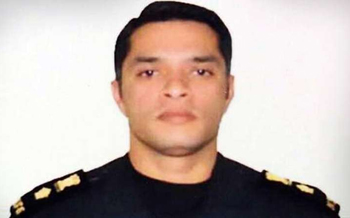
Pathankot NSG officer's last rites to be held in Kerala

January 3, 2016

Palakkad (Kerala), Jan 3: The body of an NSG officer, killed in the operation at the Indian Air Force base in Punjab's Pathankot town, will be brought back to his hometown near here on Monday for the last rites, a relative said on Sunday.

NSGLt. Col. Niranjan Kumar of the National Security Guard was killed in 'mopping up operations' in Pathankot, union Home Minister Rajnath Singh announced earlier on Sunday.

Niranjan Kumar, whose parents hail from here, was settled in Bengaluru. He is survived by his wife and a two-year-old child.

His uncle told the media on Sunday that the martyred officer's last rites would be performed here on Monday.

"The body will be brought by road from Bengaluru tomorrow (Monday). It would be placed at a school near here for the public to pay their homage," said Niranjan Kumar's uncle.

The officer's father has left from Bengaluru for Delhi to receive his son's mortal remains, which will then be brought to Bengaluru on Sunday night.

Locals recalled that the officer was a popular personality of the area and had a jovial nature. Chief Minister Oommen Chandy will also be in Palakkad to pay his last respects to the departed officer.

Comments

Arvind
 - 
Monday, 4 Jan 2016

RIP brave martyrs and god give strength to your family to bear the loss. We are indebted to you for the supreme sacrifice.
Death to terrorists and their supporters.
Jai Hind

Add new comment

  • Coastaldigest.com reserves the right to delete or block any comments.
  • Coastaldigset.com is not responsible for its readers’ comments.
  • Comments that are abusive, incendiary or irrelevant are strictly prohibited.
  • Please use a genuine email ID and provide your name to avoid reject.
coastaldigest.com web desk
July 24,2020

Indore, Jul 24: A woman who sells fruits on a cart and who lashed out at municipal officials here has done PhD in Materials Science. Her siblings too are well educated and sell fruits as they did not find jobs.

Dr Raisa Ansari, who lives at Bakery Street in Pardeshipura with her family said she wanted to be a scientist but did not get a job anywhere.

Speaking to media persons, Raisa said, "I have done PhD in Materials Science and wanted to be a scientist but did not get job anywhere. I sell fruit here but the municipal officials are bothering us. We are being forced to move from here to there like cattle. Our religion may be the reason why we are not getting jobs but we are proud to be Indian. I am still looking for a job."

Dr Raisa's mother Ayesha Ansari said she herself is not educated, but has four children of whom three girls and one boy studied a lot but no one got job.

Speaking to media persons Ayesha said, "I have four children and they are well educated. I have not studied but all my children are educated but did not get job so all of them sell fruits."

"When the matter came to marriage, one of the daughters got married. Raisa and Shahjahan Bi wanted an educated boy, but they were not able to find a suitable match because of their complexion and sometimes they rejected the proposal because of dowry, so both are single. Two of my grandchildren are studying biology. They will become doctors," said Ayesha.

Meanwhile, people in the neighbourhood lauded the family's abilities. They said theirs was an educated family had to sell fruits as they did not get jobs.

Comments

Add new comment

  • Coastaldigest.com reserves the right to delete or block any comments.
  • Coastaldigset.com is not responsible for its readers’ comments.
  • Comments that are abusive, incendiary or irrelevant are strictly prohibited.
  • Please use a genuine email ID and provide your name to avoid reject.
News Network
March 28,2020

Bengaluru, Mar 28: Sun Tsu, in 'The Art of War' speaks of a skilful general who can subdue his enemy without any fighting. This constitutes the ultimate triumph which is referred to as stratagem. Today, we would need one such when we are faced with the '21-day corona challenge' for India.
Nearly four weeks back, Dr Jyothsna Rao, Dr Gururaj Rao and I sat across the OPD in the afternoon at HCG Bengaluru discussing our ongoing cancer immunology research. While on this topic, we drifted into the discussion on the coronavirus. During this engaging discussion, we wondered the similarity of the enigma between the virus and cancer. I paused to ask Dr Jyothsna and Dr Guru - how we wish we could do something against this virus.
Dr Jyothsna is a PhD from NCBS and had worked under Dr Ralph Steinman, physician and researcher from Rockefeller University, who won the Nobel Prize for his discovery of the dendritic cell and its role in adaptive immunity in 2011. Dr Gururaj is a molecular and cell biologist who did his PhD at the Chapel Hill, University of North Carolina and is the Director of iCrest.
Jyothsna while hearing our perplexing conversation on the covid intervened, "Yes, surely. I think we should take a break from cancer and focus on the innate and adaptive immunity role in COVID-19."
Thus began this sincere attempt to relook the human immune system from the eyes of the COVID-19.
We have 10 types of immune cells at the least which are widely dispersed in millions across the body. When our body is invaded by a foreign organism (bacteria, fungi or virus), these cells work with each other to destroy the invader.
Now, the question is - how do the immune cells talk to each other? They use small-molecule substances called cytokines (cyto means cells; kine means movement). There are many cytokines that are involved in work on the immune system. The most relevant for viruses are interferons.
Interferons (IFN) as the name reflects have an ability to interfere with the viral activity and stop their multiplication. These specialised signal proteins are released by our cells in response to a viral attack to forewarn other cells. They help build the antiviral proteins within the cells to kill the virus as it tries to invade the new cells.
Historically, interferons are a group of cytokines known to be potent antiviral agents against viruses and a hallmark cytokine induced by the host upon viral infections. Interferons possess unique immunoregulatory activities and are signature cytokines released by (TH1) T immune cells, which are crucial in viral infections.
As the outbreak of COVID-19 grapples us, an urgent need for finding strategies to combat the virus is growing. Coronaviruses (CoVs) are a group of RNA viruses. In patients infected with coronavirus, it was indicated that the activation of the IFN does not occur until 48 hours post-infection. Thus the delayed IFN-related antiviral response by the healthy cells leads to coronavirus evade the immune response.
Numerous studies have presented the success in defeating CoVs by the direct administration of IFNs. In a combination as a concoction, it was shown to synergistically inhibit the virus replication in vitro.
Moreover, it is understood that the earlier induction of IFNs in children although they have a less developed immune system could be the reason behind the children being least affected.
The key to success in reducing the disease fatality might be the stimulation of the immune responses to trigger IFN production at the very early stages of the disease, which might be done through the administration of IFN. Despite the evidence for the efficacy of IFNs in treating CoV-induced infections, the proper dosing and ideal timing for such interventions needs to be verified in clinical trials.
For the later stages of the diseases in advance stages where patients are on ventilator and have developed respiratory distress, we propose to utilise the mesenchymal cells derived from donor bone marrow that have been known to treat acute respiratory syndrome. Mesenchymal cells are known to possess anti-inflammatory activity and thus used often in autoimmune diseases.
With this scientific background, we have activated T cells from healthy donors, in a cGMP facility at iCrest - HCG hospital with an enriched cocktail of cytokines rich in Interferons. Injections of this cocktail we believe will result in a surge of cytokines in the body of the infected person and will boost his ability to fight the virus in the early phases. We are in the initial phases of this study and hope to be ready in the coming weeks with meaningful data on its potential utility.
Currently, it awaits government approvals (Union and state) and we have applied to central drugs authority for their initial evaluation and further directions.
As my Guru often expounded the philosophy of 'Seva' - the goal of education is knowledge, the end goal of knowledge is service. In this attempt to serve our fellow humans at this brink of unprecedented crisis, medical fraternity stands with you and promises to do our best for your safety.
We assure to exhaust every bit of our spirit in this fight against coronavirus. We have lost the sight of shores and travelled thus far, but that is the mandatory first step to cross the ocean. Are we going to succeed in this battle, is something only time will answer. 

Comments

Add new comment

  • Coastaldigest.com reserves the right to delete or block any comments.
  • Coastaldigset.com is not responsible for its readers’ comments.
  • Comments that are abusive, incendiary or irrelevant are strictly prohibited.
  • Please use a genuine email ID and provide your name to avoid reject.
Agencies
January 19,2020

Bengaluru, Jan 19: Technology hub Hyderabad has edged out 129 other cities in the world to emerge as the world's most dynamic city, according to the seventh edition of the City Momentum Index by global real estate services firm JLL.

The city has pushed Bengaluru to second place to regain the top position after a gap of one year. Chennai is at fifth and Delhi is at sixth place.

While Hyderabad and Bengaluru are the top two cities globally for socio-economic momentum, a more active real estate market helped elevate Hyderabad to first position in the overall ranking, says the report released by the US-based Jones Lang Lasalle (JLL) on Saturday night.

Hyderabad recorded the highest office net absorption in 2019 (as a proportion of existing stock) of any city globally, while it is also among the world's best-performing cities for prime office rental growth.

While all seven major Indian cities feature in this year's Global Top 20, cities in south India in particular - Hyderabad, Bengaluru and Chennai (5th) "are ahead of their northern peers, supported by favourable demographics and business climates".

"Their expanding tech industries and start-up cultures make them a magnet for young and ambitious talent from across the country, with Bengaluru having one of the world's largest concentrations of 'engine room' population (20-40-year-olds), typically the most dynamic and productive age cohort," says the report.

Kolkata and Mumbai made it to the top 20 and stood at the 16th and 20th positions. Despite an economic slowdown, India leads the 2020 Index with seven Indian cities in the top 20.

"Commercial real estate in south Indian cities is growing at a rapid pace. Hyderabad has seen tremendous growth in 2019 in line with that of Bengaluru. The city has actively embraced technology-driven economic growth and attracted large tech giants and e-commerce players. The state government's focus on business-friendly policies and provision of high-quality infrastructure along with availability of quality talent pool and superior quality business parks has given Hyderabad a competitive edge," said Ramesh Nair, CEO and Country Head - India, JLL.

Telangana's Minister for Information Technology and Industry K T Rama Rao said he was thrilled over Hyderabad not only regaining the top slot but also over the fact that it was competing with cities like Shenzhen and Shanghai in innovation economy.

The minister said 50 percent weightage from socio-economic indicators beside the remaining 50 percent from commercial and real estate was also heartening.

KTR, as the minister is popularly known, noted that in 2014 when Telangana attained statehood, Hyderabad was not even in the list. He recalled that when Telangana was formed there were many doubts as to what would happen to Hyderabad. "It entered the top 20 in 2015 and rose to fifth place in 2016 and third position in 2017. Hyderabad topped the list in 2018 and finished second the last year. This year it is back at the top," he said.

The JLL City Momentum Index identifies a number of key growth drivers, including talent attraction, the expansion of innovation hubs and better urban planning, that cities can employ to meet the challenges faced by rapid momentum.

Several cities in the top 20 stand out as they transform their urban environments in pursuit of a low-carbon future. In India, Hyderabad is looking at technology to reduce the demand for air conditioning with cool roofs that reflect sunlight and absorb less heat, it said.

"The growth of "micro-mobility" is another positive step, illustrated by Hyderabad's introduction of smart bikes and electric cars. Smart city solutions, such as bike rentals, improved quality of life, help increase inclusion and aid in the transition to a low carbon environment."


Comments

Add new comment

  • Coastaldigest.com reserves the right to delete or block any comments.
  • Coastaldigset.com is not responsible for its readers’ comments.
  • Comments that are abusive, incendiary or irrelevant are strictly prohibited.
  • Please use a genuine email ID and provide your name to avoid reject.