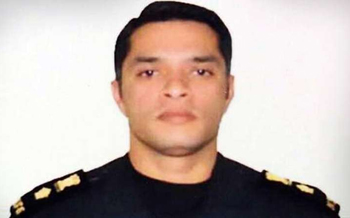
Pathankot NSG officer's last rites to be held in Kerala

January 3, 2016

Palakkad (Kerala), Jan 3: The body of an NSG officer, killed in the operation at the Indian Air Force base in Punjab's Pathankot town, will be brought back to his hometown near here on Monday for the last rites, a relative said on Sunday.

NSGLt. Col. Niranjan Kumar of the National Security Guard was killed in 'mopping up operations' in Pathankot, union Home Minister Rajnath Singh announced earlier on Sunday.

Niranjan Kumar, whose parents hail from here, was settled in Bengaluru. He is survived by his wife and a two-year-old child.

His uncle told the media on Sunday that the martyred officer's last rites would be performed here on Monday.

"The body will be brought by road from Bengaluru tomorrow (Monday). It would be placed at a school near here for the public to pay their homage," said Niranjan Kumar's uncle.

The officer's father has left from Bengaluru for Delhi to receive his son's mortal remains, which will then be brought to Bengaluru on Sunday night.

Locals recalled that the officer was a popular personality of the area and had a jovial nature. Chief Minister Oommen Chandy will also be in Palakkad to pay his last respects to the departed officer.

Comments

Arvind
 - 
Monday, 4 Jan 2016

RIP brave martyrs and god give strength to your family to bear the loss. We are indebted to you for the supreme sacrifice.
Death to terrorists and their supporters.
Jai Hind

Add new comment

  • Coastaldigest.com reserves the right to delete or block any comments.
  • Coastaldigset.com is not responsible for its readers’ comments.
  • Comments that are abusive, incendiary or irrelevant are strictly prohibited.
  • Please use a genuine email ID and provide your name to avoid reject.
Agencies
May 8,2020

Washington D.C., May 8: The prime time for brain development in a child's life is the first year, where the infant spends most of the time asleep. It is the time when neural connections form and sensory memories are encoded.

However, when sleep is disrupted, as occurs more often among children with autism, brain development may be affected, too.

New research led by the University of Washington finds that sleep problems in a baby's first 12 months may not only precede an autism diagnosis but also may be associated with altered growth trajectory in a key part of the brain, the hippocampus.

The study, which was published in the American Journal of Psychiatry, researchers report that in a sample of more than 400 taken of 6- to 12-month-old infants, those who were later diagnosed with autism were more likely to have had difficulty falling asleep.

It also states that this sleep difficulty was associated with altered growth trajectories in the hippocampus.

"The hippocampus is critical for learning and memory, and changes in the size of the hippocampus have been associated with poor sleep in adults and older children.

As many as 80 per cent of the children with autism spectrum disorder have sleep problems," said Annette Estes, director of the UW Autism Center and senior author of the study.

"In our clinical experience, parents have a lot of concerns about their children's sleep, and in our work on early autism intervention, we observed that sleep problems were holding children and families back," added Estes, who is also a UW professor of speech and hearing sciences.

"It could be that altered sleep is part-and-parcel of autism for some children. One clue is that behavioural interventions to improve sleep don't work for all children with autism, even when their parents are doing everything just right. This suggests that there may be a biological component to sleep problems for some children with autism," said Estes.

To consider links among sleep, brain development, and autism, researchers at the IBIS Network looked at MRI scans of 432 infants, surveyed parents about sleep patterns, and measured cognitive functioning using a standardized assessment.

At the outset of the study, infants were classified according to their risk for developing autism: Those who were at higher risk of developing autism -- about two-thirds of the study sample -- had an older sibling who had already been diagnosed.

Infant siblings of children with autism have a 20 per cent chance of developing autism spectrum disorder -- a much higher risk than children in the general population.

In the current study, 127 of the 432 infants were identified as "low risk" at the time the MRI scans were taken because they had no family history of autism.

They later evaluated all the participants at 24 months of age to determine whether they had developed autism. Of the roughly 300 children originally considered "high familial risk," 71 were diagnosed with autism spectrum disorder at that age.

Problems with sleep were more common among the infants later diagnosed with an autism spectrum disorder, as were larger hippocampi. No other subcortical brain structures were affected, including the amygdala, which is responsible for certain emotions and aspects of memory, or the thalamus, a signal transmitter from the spinal cord to the cerebral cortex.

The authors note that while parents reported more sleep difficulties among infants who developed autism compared to those who did not, the differences were very subtle and only observed when looking at group averages across hundreds of infants.

Sleep patterns in the first years of life change rapidly as infants transition from sleeping around the clock to a more adult-like sleep/wake cycle. Until further research is completed, Estes said, it is not possible to interpret challenges with sleep as an early sign of increased risk for autism.


Comments

Add new comment

  • Coastaldigest.com reserves the right to delete or block any comments.
  • Coastaldigset.com is not responsible for its readers’ comments.
  • Comments that are abusive, incendiary or irrelevant are strictly prohibited.
  • Please use a genuine email ID and provide your name to avoid reject.
News Network
January 2,2020

Tumakuru, Jan 2: Prime Minister Narendra Modi on Thursday slammed the Congress and its allies opposing the Citizenship Amendment Act, saying they are against giving relief to those who have been brutalised and victimised in Pakistan.

"Pakistan was founded on religious grounds due to which atrocities on minorities such as Hindus, Sikhs, Jains and Christians have increased. But Congress and its allies don't speak against Pakistan," he said at a function here.

He also said the Congress and its allies take out rallies and stage demonstrations against the efforts to prevent atrocities on religious lines and save women from sexual assaults.

Modi wondered why those opposed to the CAA were not speaking out against Pakistan's atrocities and asked what stopped them from doing so.

Strongly defending the CAA, he said it was adopted by Parliament in a historic move, but that the Congress and its allies and the ecosystem created by his party's rival were now against the very institution.

He said India cannot leave the Hindus, Christians and Sikhs apparently fleeing Pakistan to "their fate" and added it was the country's responsibility to protect them.

Modi pointed out that the efforts are especially to protect the Dalits and tribals in Pakistan.

The Prime Minister also pointed out that the abrogation of Article 370 was a step towards ending terrorism and uncertainty in Jammu and Kashmir.

Comments

Add new comment

  • Coastaldigest.com reserves the right to delete or block any comments.
  • Coastaldigset.com is not responsible for its readers’ comments.
  • Comments that are abusive, incendiary or irrelevant are strictly prohibited.
  • Please use a genuine email ID and provide your name to avoid reject.
News Network
March 5,2020

Mar 5: The Karnataka government on Thursday proposed to increase rate of tax on petrol and diesel by three per cent which would make the fuel dearer by Rs 1.60 and Rs 1.59 per litre, respectively.

Presenting the 2020-21 budget in the Legislative Assembly, Chief Minister B S Yediyurappa proposed to increase rate of tax on petrol from 32 per cent to 35 per cent and diesel from 21 per cent to 24 per cent, as part of additional resource mobilisation measures.

Yediyurappa, who also holds the finance portfolio, increased excise duty on Indian Made Liquor (KML) across 18 slabs by six per cent.

However, to promote affordable housing, the government proposed to reduce stamp duty on first time registration of new apartments/flats costing less than Rs 20 lakh from existing five per cent to two per cent.

This is the first budget of the BJP government after coming to power last year; it's the seventh presented by Yediyurappa.

"For the year 2020-21, a total amount of Rs 55,732 crore is provided for stimulating economic growth sector", the Chief Minister said.

He said the revenue collection target for the Commercial Taxes department for the year 2020-21 is fixed at Rs 82,443 crore.

Stating the government had fixed a revenue target of Rs 20,950 crore for the excise department for the year 2019- 20, he said at the end of February Rs 19,701 crore had been collected.

"We hope to achieve the budget target."

He also hoped with the increase in rates and effective enforcement and regulatory measures, the Excise department would be achieving the target of Rs 22,700 crore fixed for the financial year 2020-21.

On the transport sector, Yediyurappa said it is proposed to levy motor vehicle tax on contract carriages having seating capacity to carry more than 12 passengers, but not more than 20 passengers at the rate of Rs 900 per seat per quarter.

He said it is also proposed to levy vehicle tax on new model sleeper coaches which are granted permits under section 88 (9) of MV Act 1988 at the rate of Rs 4,000 per sleeper per quarter.

Noting that a target of Rs 7,100 crore revenue collection is expected to be achieved in 2019-20 in transport sector, he said for 2020-21 revenue collection target has been fixed at Rs 7,115 crore.

He said the revenue collection target for 2019-20 under stamps and registration was fixed at Rs 11,828 crore and against this Rs 10,248 crore has been collected till the end of February 2020 which is 87 per cent of full year target.

While the revenue collection target for 2020-21 under stamps and registration is fixed at Rs 12,655 crore.

Comments

Add new comment

  • Coastaldigest.com reserves the right to delete or block any comments.
  • Coastaldigset.com is not responsible for its readers’ comments.
  • Comments that are abusive, incendiary or irrelevant are strictly prohibited.
  • Please use a genuine email ID and provide your name to avoid reject.