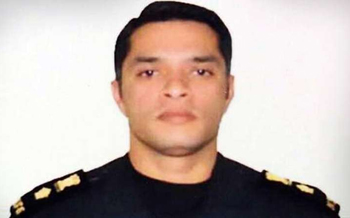
Pathankot NSG officer's last rites to be held in Kerala

January 3, 2016

Palakkad (Kerala), Jan 3: The body of an NSG officer, killed in the operation at the Indian Air Force base in Punjab's Pathankot town, will be brought back to his hometown near here on Monday for the last rites, a relative said on Sunday.

NSGLt. Col. Niranjan Kumar of the National Security Guard was killed in 'mopping up operations' in Pathankot, union Home Minister Rajnath Singh announced earlier on Sunday.

Niranjan Kumar, whose parents hail from here, was settled in Bengaluru. He is survived by his wife and a two-year-old child.

His uncle told the media on Sunday that the martyred officer's last rites would be performed here on Monday.

"The body will be brought by road from Bengaluru tomorrow (Monday). It would be placed at a school near here for the public to pay their homage," said Niranjan Kumar's uncle.

The officer's father has left from Bengaluru for Delhi to receive his son's mortal remains, which will then be brought to Bengaluru on Sunday night.

Locals recalled that the officer was a popular personality of the area and had a jovial nature. Chief Minister Oommen Chandy will also be in Palakkad to pay his last respects to the departed officer.

Comments

Arvind
 - 
Monday, 4 Jan 2016

RIP brave martyrs and god give strength to your family to bear the loss. We are indebted to you for the supreme sacrifice.
Death to terrorists and their supporters.
Jai Hind

Add new comment

  • Coastaldigest.com reserves the right to delete or block any comments.
  • Coastaldigset.com is not responsible for its readers’ comments.
  • Comments that are abusive, incendiary or irrelevant are strictly prohibited.
  • Please use a genuine email ID and provide your name to avoid reject.
News Network
April 29,2020

Washington, Apr 29: A US government panel on Tuesday called for India to be put on a religious freedom blacklist over a "drastic" downturn under Prime Minister Narendra Modi, triggering a sharp rebuttal from New Delhi.

The US Commission on International Religious Freedom recommends but does not set policy, and there is virtually no chance the State Department will follow its lead on India, an increasingly close US ally.

In an annual report, the bipartisan panel narrowly agreed that India should join the ranks of "countries of particular concern" that would be subject to sanctions if they do not improve their records.

"In 2019, religious freedom conditions in India experienced a drastic turn downward, with religious minorities under increasing assault," the report said.

It called on the United States to impose punitive measures, including visa bans, on Indian officials believed responsible and grant funding to civil society groups that monitor hate speech.

The commission said that Modi's Hindu nationalist government, which won a convincing election victory last year, "allowed violence against minorities and their houses of worship to continue with impunity, and also engaged in and tolerated hate speech and incitement to violence."

It pointed to comments by Home Minister Amit Shah, who notoriously referred to mostly Muslim migrants as "termites," and to a citizenship law that has triggered nationwide protests.

It also highlighted the revocation of the autonomy of Kashmir, which was India's only Muslim-majority state, and allegations that Delhi police turned a blind eye to mobs who attacked Muslim neighborhoods in February this year.

Coronavirus state-wise India update: Total number of confirmed cases, deaths on April 29

The Indian government, long irritated by the commission's comments, quickly rejected the report.

"Its biased and tendentious comments against India are not new. But on this occasion, its misrepresentation has reached new levels," foreign ministry spokesman Anurag Srivastava said.

"We regard it as an organization of particular concern and will treat it accordingly," he said in a statement.

The State Department designates nine "countries of particular concern" on religious freedom -- China, Eritrea, Iran, Myanmar, North Korea, Pakistan, Saudi Arabia, Tajikistan and Turkmenistan.

The commission asked that all nine countries remain on the list. In addition to India, it sought the inclusion of four more -- Nigeria, Russia, Syria and Vietnam.

Pakistan, India's historic rival, was added by the State Department in 2018 after years of appeals by the commission.

In its latest report, the commission said that Pakistan "continued to trend negatively," voicing alarm at forced conversions of Hindus and other minorities, abuse of blasphemy prosecutions and a ban on the Ahmadi sect calling itself Muslim.

India's citizenship law fast-tracks naturalization for minorities from neighbouring countries -- but not if they are Muslim.

Modi's government says it is not targeting Muslims but rather providing refuge to persecuted people and should be commended.

But critics consider it a watershed move by Modi to define the world's largest democracy as a Hindu nation and chip away at independent India's founding principle of secularism.

Tony Perkins, the commission's chair, called the law a "tipping point" and voiced concern about a registry in the northeastern state of Assam, under which 1.9 million people failed to produce documentation to prove that they were Indian citizens before 1971 when mostly Muslim migrants flowed in during Bangladesh's bloody war of independence.

"The intentions of the national leaders are to bring this about throughout the entire country," Perkins told an online news conference.

"You could potentially have 100 million people, mostly Muslims, left stateless because of their religion. That would be, obviously, an international issue," said Perkins, a Christian activist known for his opposition to gay rights who is close to President Donald Trump's administration.

Three of the nine commissioners dissented -- including another prominent Christian conservative, Gary Bauer, who voiced alarm about India's direction but said the ally could not be likened to non-democracies such as China.

"I am deeply concerned that this public denunciation risks exactly the opposite outcome than the one we all desire," Bauer said.

Trump, who called for a ban on Muslim immigration to the US when he ran for president, hailed Modi on a February visit to New Delhi.


Comments

Add new comment

  • Coastaldigest.com reserves the right to delete or block any comments.
  • Coastaldigset.com is not responsible for its readers’ comments.
  • Comments that are abusive, incendiary or irrelevant are strictly prohibited.
  • Please use a genuine email ID and provide your name to avoid reject.
News Network
March 3,2020

Mysuru, Mar 3: Three leopard cubs were rescued by a team of Forest Department in Mysuru on Tuesday.

The cubs were found in a sugarcane field and came into notice of a farmer while cutting the sugarcane.

The villagers alerted the forest department which rescued the three cubs.

Comments

Add new comment

  • Coastaldigest.com reserves the right to delete or block any comments.
  • Coastaldigset.com is not responsible for its readers’ comments.
  • Comments that are abusive, incendiary or irrelevant are strictly prohibited.
  • Please use a genuine email ID and provide your name to avoid reject.
coastaldigest.com web desk
June 27,2020

New Delhi, June 27: The Prime Minister Narendra Modi-led union government of India is not ready to stop all imports from aggressive China in spite of mount calls to boycott Chinese products in India.

The Centre is reportedly considering to stop only non-essential imports from the neighbouring country.

However, the Inward shipment in sectors such as automobiles, pharmaceuticals, certain electronics and others will continue until a domestic alternative is found.

“India will gradually move towards import substitution. It will not happen overnight. In the meantime, attention has to be paid on production and job creation. We cannot throttle our industry. There are certain absolutely essential imports. Needless to say, those will keep going,” official sources said.

Sources said that both the government and the industry are in the process of identifying products that can be domestically manufactured in the medium term. There are certain chemicals, automotive components, handicrafts, cosmetics, agriculture items and certain consumer electronics, which can be manufactured domestically in the short to medium term. The government is doing all it can to raise the capacity of domestic industries.

However, there are certain other imports in the automobile and the pharmaceutical sectors which cannot be done away within the short to medium term. Their domestic production at the moment may not be that cost-effective.

The six-crore strong traders’ body CAIT has been at the forefront of such a demand and has launched a campaign to celebrate Indian Diwali this year with a total absence of Chinese goods.

“Ease of doing business, capital availability at lower rates and globally competitive logistics and energy costs are some of the prerequisites that the government should look into to ensure the growth of the domestic auto component industry,” according to Automotive Component Manufacturers Association of India (ACMA) Director General Vinnie Mehta.

Maruti Suzuki Chairman R C Bhargava said, “People who are boycotting Chinese goods have to remember that in some cases it may lead to their being asked to pay more for the same product."

Meanwhile, domestic rating agency Acuite Ratings & Research has analysed the current import portfolio from China and found 40 sub-sectors have the potential to lower their import dependency on China. These sectors contribute to $33.6 billion worth of imports from China and about 25% of these imports can be substituted by local manufacturing without any significant additional investments.

Comments

Add new comment

  • Coastaldigest.com reserves the right to delete or block any comments.
  • Coastaldigset.com is not responsible for its readers’ comments.
  • Comments that are abusive, incendiary or irrelevant are strictly prohibited.
  • Please use a genuine email ID and provide your name to avoid reject.