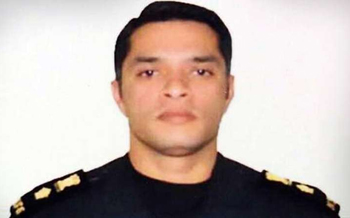
Pathankot NSG officer's last rites to be held in Kerala

January 3, 2016

Palakkad (Kerala), Jan 3: The body of an NSG officer, killed in the operation at the Indian Air Force base in Punjab's Pathankot town, will be brought back to his hometown near here on Monday for the last rites, a relative said on Sunday.

NSGLt. Col. Niranjan Kumar of the National Security Guard was killed in 'mopping up operations' in Pathankot, union Home Minister Rajnath Singh announced earlier on Sunday.

Niranjan Kumar, whose parents hail from here, was settled in Bengaluru. He is survived by his wife and a two-year-old child.

His uncle told the media on Sunday that the martyred officer's last rites would be performed here on Monday.

"The body will be brought by road from Bengaluru tomorrow (Monday). It would be placed at a school near here for the public to pay their homage," said Niranjan Kumar's uncle.

The officer's father has left from Bengaluru for Delhi to receive his son's mortal remains, which will then be brought to Bengaluru on Sunday night.

Locals recalled that the officer was a popular personality of the area and had a jovial nature. Chief Minister Oommen Chandy will also be in Palakkad to pay his last respects to the departed officer.

Comments

Arvind
 - 
Monday, 4 Jan 2016

RIP brave martyrs and god give strength to your family to bear the loss. We are indebted to you for the supreme sacrifice.
Death to terrorists and their supporters.
Jai Hind

Add new comment

  • Coastaldigest.com reserves the right to delete or block any comments.
  • Coastaldigset.com is not responsible for its readers’ comments.
  • Comments that are abusive, incendiary or irrelevant are strictly prohibited.
  • Please use a genuine email ID and provide your name to avoid reject.
News Network
February 10,2020

Bengaluru, Feb 10: The Rashtriya Swyamsevak Sangh (RSS) on Sunday conducted a route march (Pathsanchalan) in Ramanagara to express solidarity with the anti-Christian forces protesting against a project to install 114-feet tall Jesus Christ statue atop Kapalabetta in Harobele town in Kanakapura taluk in Ramanagara district.

Hindutva ideologue Kalladka Prabhakara Bhat, who had led a rally in Kanakapura last month against the project, also led the Sunday’s route march and addressed a public meeting following the march.

“The district name is Ramanagara, but they have not nurtured the culture of Ram here. They have developed a strong culture of Ravana, which we pledged to dislodge,” Bhat told the gathering.

He said the Sangh Parivar will never allow the statue to come up as he said it would foment religious conversion that is rampant in Harobele.

“The so called Kapalabetta is of stones, which are revered as Lord Muneswara by the Hindus. This hillock must be named as Muneswara Betta,” he added.

Referring to the ongoing protests against the Citizenship (Amendment) Act (CAA), Bhat said the law was brought in to protect the Hindu minority in Pakistan and Bangla Desh.

“The Muslims living in India hail Pakistan. But when we ask them to go to Pakistan, they will never go,” he took a jibe at the minority community.

Reacting to the RSS route march, senior Congress functionary DK Shivakunar, who represents Kanakapura assembly seat, said the Sangah Parivar is trying to disturb the communal harmony in the district and they will never succeed in it.

“The BJP is operating through the Sangh Parivar in the Ramanagara district. The party has won as may as 26 Lok Sabha seats in Karnataka, still they are doing all these things to keep their support base. People of Ramanagara will never back them,” said Shivakumar.

Comments

Add new comment

  • Coastaldigest.com reserves the right to delete or block any comments.
  • Coastaldigset.com is not responsible for its readers’ comments.
  • Comments that are abusive, incendiary or irrelevant are strictly prohibited.
  • Please use a genuine email ID and provide your name to avoid reject.
News Network
May 19,2020

Bengaluru, May 19: Containment zones in Karnataka will be much smaller in size under the latest lockdown norms. However, rules and loopholes will be tightened and action against violators will be stringent in order to check the spread of the disease.

Revised guidelines issued by the Centre to the state, reveal containment zones are delineated based on mapping of cases and contacts. Intensive action will be carried out in these areas with the aim of breaking the chain of transmission. Therefore, the area of a containment zone should be appropriately defined by the district administration/local urban bodies with technical inputs at local level.

The health department is considering shrinking the size of containment zones from the existing 100 metres to open up more space for economic activities. Medical education minister K Sudhakar, also a member of the Covid taskforce, said additional chief secretary (health department) Javed Akthar will issue a new definition of a containment zone after the Covid-19 taskforce holds its next meeting.

“We are planning to further shrink it and restrict containment zones to an apartment complex, independent house or even a lane where the Covid-19 patient resides,” Sudhakar said. He went on to say bigger containment zones will impede businesses and normal activities in the vicinity, something which the government wants to avoid.

The minister said Karnataka will also do away with colour-coding districts. “With restrictions being relaxed for almost all activities, it does not make sense to pursue with colour codes. It is either containment zone or outside containment zone,” he said.

In rural areas, the minister said containment zones will be identified by the taluk heads. Government sources say it is difficult to restrict activities to certain areas or smaller location in rural areas as farmers and people will have to travel to the outskirts of their villages for their livelihood.

An official said, a containment operation (large outbreak or cluster) is deemed successful when no case is reported in 28 days from the containment zone.

Comments

Add new comment

  • Coastaldigest.com reserves the right to delete or block any comments.
  • Coastaldigset.com is not responsible for its readers’ comments.
  • Comments that are abusive, incendiary or irrelevant are strictly prohibited.
  • Please use a genuine email ID and provide your name to avoid reject.
News Network
January 12,2020

Bengaluru, Jan 12: Chief Justice of India, Sharad Arvind Bobde on Saturday hinted at the possibility of Artificial Intelligence being developed for the court system while making it clear that it will never replace human discretion.

Speaking at an event here, Bobde said, "We have a possibility of developing Artificial Intelligence for the court system. Only for the purpose of ensuring that the undue delay in justice is prevented."

"I must make it clear at the outset as there are times when even judges have asked this. AI is not going to replace human judges or human discretion", he added.

Sharing more details of his vision, he stated, "It is only the repetitive, mathematical and mechanical parts of the judgments for which help can be taken from the system...we are exploring the possibility of implementing it."

Bobde stressed on the requirement of developing AI for judiciary while outlining the number of pending cases in different courts.

"Some people are in jail for 10-15 years and we are not in position to deal with their appeals. The high court's and Supreme Court take so long and ultimately the courts feel that it is just to release them on bail", he said.

Bobde also endorsed employing every talent and skill to ensure delivery of justice in a reasonable time.

"We must employ every talent, every skill we possess to ensure that justice is received within reasonable time. Delay in justice can't be a reason for anybody to take law into their hands. But it's very important for us as courts to ensure there's no undue delay in justice", he said.

CJI Bobde also highlighted the need for pre-litigation mediation and said, "Pre-litigation mediation is the need of the hour especially in the backdrop of a significant pendency that the courts are tackling with. There are innumerable areas where pre-litigation mediation could solve the problem."

He also stressed that the position of a judge is very unique under the constitution and they have to deal with a variety of problems.

"The foundation of civilisation rests on the law. Judicial officers have to deal with a variety of problems...Judges without adequate knowledge, skills and experience may cause distortion, delay and miscarriage of justice", he said.

Earlier in the day, Chief Justice of India Bobde inaugurated the phase-1 of the new building of the Karnataka Judicial Academy on Crescent Road in Bengaluru.

The new building has three floors, besides, the ground floor and two basement floors.

Comments

Add new comment

  • Coastaldigest.com reserves the right to delete or block any comments.
  • Coastaldigset.com is not responsible for its readers’ comments.
  • Comments that are abusive, incendiary or irrelevant are strictly prohibited.
  • Please use a genuine email ID and provide your name to avoid reject.