People click selfies as tribal man beaten to death in Kerala

News Network
February 23, 2018

Palakkad, Feb 23: A 35-year-old tribal man was beaten to death by local people for allegedly stealing articles from some shops at Agali here, police said.

The deceased, suspected to be mentally unsound, was identified as Madhu, hailing from Kadukumanna settlement of Attappady, one of the largest and backward tribal hamlets in the state.

The shabbily dressed man, who was living in the forest near Mukkali here for some months, used to be seen wandering in the area, police said.

He was beaten up by the local people, who accused him of stealing articles from some shops in the town, and later handed him over to the police yesterday.

Some television channels aired visuals purportedly showing people taking selfies with Madhu with his hands tied up.

Though, the police tried to rush him to the nearby Agali government hospital, he vomited, collapsed and died in the jeep itself and was declared by dead by the hospital, police said.

Agali police has registered a case and some persons have been taken into custody, they said.

"They are being interrogated and the arrest will be recorded after verification," a senior police officer told PTI.
Police said the post mortem would be conducted at the Thrissur Medical College hospital later, only after which the exact cause of the death will be known.

However, Madhu's relatives told Malayalam channels that he was suffering from a mental breakdown and was staying away from home for some months.

They also wanted exemplary punishment to the guilty.
Meanwhile, Chief Minister Pinarayi VIjayan condemned the incident and said stringent action would be taken against the accused.

Directions in this regard have been given to the director general of police, he said.

"Such violence cannot be accepted in a civilised society.

It cannot be accepted in anyway," Vijayan said in a Facebook post.

Comments

Vijay
 - 
Sunday, 25 Feb 2018

Rich people Take money and run to other Countries for Hifi Life but Public is Quite, One poor man stole items just for Hunger and people Killed Him.  Very Sad :( RIP Madhu 

ABDUL AZIZ S.A.
 - 
Saturday, 24 Feb 2018

really very sad ,  people have no mercy to the poor.  its bad name for the people who have done this cruel act

Sukesh
 - 
Friday, 23 Feb 2018

He was hungry. he took for eating. Dont call him thief, because we, our society made him poor, straving, begging man and at last a thief

Hareesh Bhatt
 - 
Friday, 23 Feb 2018

Such a cruel act. Seven people beating one man by tying hands.. How can men do like that..

Mohan
 - 
Friday, 23 Feb 2018

Shocking.. #Tribals_are _also_human_beings..

Suresh Kalladka
 - 
Friday, 23 Feb 2018

It's too dangerous...If the suspicion is correct also, people dont have right to kill or harm other people. This mentality will end up in total anarchy. Should Punish them properly and warn others

Kumar
 - 
Friday, 23 Feb 2018

This is not the right way. should stop "crowd punishment". they dont have the right to punish anybody. hang the goons

Hari
 - 
Friday, 23 Feb 2018

Brutal.. Should punish them equally

Add new comment

  • Coastaldigest.com reserves the right to delete or block any comments.
  • Coastaldigset.com is not responsible for its readers’ comments.
  • Comments that are abusive, incendiary or irrelevant are strictly prohibited.
  • Please use a genuine email ID and provide your name to avoid reject.
Wafa Sultana
April 4,2020

Over the last couple of days when the world was occupied with unifying efforts to fight the deadly Covid19 pandemic, sections of Indian media provided viewers a familiar scapegoat – the Indian Muslims – who are often stereotyped as a community being constantly at loggerheads with the citizenry and the State. Biased media channels were quick to resort to blaming the entire Muslim community for the spread of the disease in the country, thanks to an ill-timed Tablighi Jamaat gathering at its international headquarters in Delhi’s Nizamuddin. Unsurprisingly, the opprobrium was also marked by a sudden spike in WhatsApp forwards of videos with people wearing skullcaps licking spoons and performing Sufi breathing rituals, suggesting some sort of wild conspiracy on the part of the community to spread the virus.  Some media channels were quick to formulate, hypothesize and provide loose definitions of a newly discovered form of Jihad i.e. ‘Corona Jihad ’ thereby vilifying the Islamic faith and its followers.

While the investigation on the culpability of the organizers of the Nizamuddin event is still ongoing, there is enough information to suggest that the meeting was held before any lockdown was in force, and the problem began when there was no way of getting people out once the curfew was announced. Be that as it may, there is little doubt that organizing a meet of such a scale when there is a global pandemic smacks of gross misjudgment, and definitely the organizers should be held accountable if laws or public orders were defied. Attendees who attempt to defy quarantine measures must be dealt with strictly. However, what is alarming is that the focus and narrative have now shifted from the unfortunate event at Nizamuddin to the Tablighi Jamaat itself.

For those not familiar with the Tablighi Jamaat, the organization was founded in 1926 in Mewat by scholar Maulana Mohammad Ilyas. The Jamaat’s main objective was to get Muslim youth to learn and practice pristine Islam shorn of external influences. This is achieved through individuals dedicating time for moral and spiritual upliftment secluded from the rest of the world for a brief period of time. There is no formal membership process. More senior and experienced participants typically travel from one mosque to other delivering talks on religious topics, inviting local youth to attend and then volunteer for a spiritual retreat for a fixed number of days to a mosque in a nearby town or village to present the message to their co-religionists. Contrary to ongoing Islamophobic rhetoric, the movement does not actively proselytize. The focus is rather on getting Muslims to learn the teachings and practices of Islam.  This grassroots India-based movement has now grown to almost all countries with substantial Muslim populations. Its annual meets, or ‘ijtemas’ are among the largest Islamic congregations in the world after the annual Haj. One of the reasons for its popularity and wide network in the subcontinent and wordwide is the fact that it has eschewed the need for scholarly intervention, focusing on peer learning of fundamental beliefs and practice rather than high-falutin ideological debates. The Tablighi Jamaat also distinguishes itself from other Islamic movements through its strictly apolitical nature, with a focus on individual self-improvement rather than political mobilization. Hardships and difficulty in the world are expected to be face through ‘sabr’ (patience) and ‘dua’ (supplication),  than through quest for political power or influence. In terms of ideology, it is very much based on mainstream Sunni Islamic principles derived from the Deobandi school.

So, why is all this background important in the current context? While biased media entities have expectedly brought out their Islamophobic paraphernalia out for full display, more neutral commentators have tried to paint the Tablighi Jamaat as a fringe group and have tried to distance it from 'mainstream Muslims'. While the intent is no doubt innocent, this is a trap we must not fall into. This narrative, unfortunately, is also gaining ground due to apathy some Muslims have for the group, accusing it of being “disconnected from the realities of the world”. Unlike other Muslim organizations and movements, the Tablighi Jamat, by virtue of its political indifference, does not boast of high-profile advocates and savvy spokespersons who can defend it in mainstream or social media.  The use of adjectives such as 'outdated' and 'orthodox' by liberal columnists to describe the Jamaat feeds into the malignant attempt to change the narrative from the control of the spread of the pandemic due to the Nizamuddin gathering to 'raison d'etre' of the organization itself.

A large mainstream religious group like the Tablighi Jamaat with nearly a hundred-year history, normally considered to be peaceful, apolitical and minding its own business is now suddenly being villainized owing to unfortunate circumstances. Biased media reactions filled with disgust and hate seem to feed the Indian public conscience with a danngerous misconception - to be a nominal Muslim is okay but being a practicing one is not.  For those committed to the truth and fighting the spread of Islamophobia, the temptation to throw the entire Tablighi Jamaat under the bus must be resisted.

The writer is a lawyer and research scholar at Qatar University. Her research interests include Islamic law and politics.

Comments

zahoorahmed
 - 
Saturday, 4 Apr 2020

great article! provides a great perspective on tableeg jamat

Add new comment

  • Coastaldigest.com reserves the right to delete or block any comments.
  • Coastaldigset.com is not responsible for its readers’ comments.
  • Comments that are abusive, incendiary or irrelevant are strictly prohibited.
  • Please use a genuine email ID and provide your name to avoid reject.
coastaldigest.com news network
August 5,2020

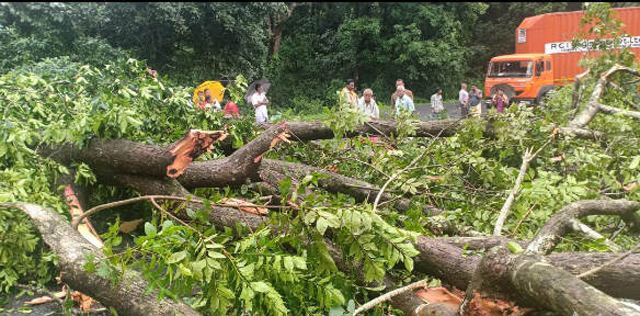
Mangaluru, Aug 5: Normal life was thrown out of gear as heavy rain and gusty winds lashed large parts of coastal and malnad districts of Karnataka in last 48 hours. Widespread power outages due to tree fall and minor landslides were reported in last 24 hours.

Meanwhile, Indian Meteorological Department has sounded a red alert for Uttara Kannada, Udupi and Dakshina Kannada districts 8:30am of August 5.

In Mangaluru city there were several tree falls disrupting power supply in key areas of the city. Four electricity poles were damaged after a tree fell on Boloor Jarandaya road due to rain and heavy winds. In Neermarga too, there were a couple of tree falls in the morning cutting off power supply, which was not restored till this report was sent.

Mescom bore the brunt of the rains in Udupi and Dakshina Kannada District and at the last count as many as 148 electric poles, 23 transformers and 65 kilometer conductor wires were damaged due to poles being damaged in tree fall and landslides.

Traffic was affected on Charmadi Ghat on the Mangaluru-Chikkamagaluru route due to a tree fall on the second hair pin bend. 

On Monday, landslides near Kottigehara, Chikkamagaluru District, left traffic badly affected. Though normalcy has been restored on the route after blocking the road for restoration till Tuesday morning, locals fear more landslides due to continuous downpour.

Kodagu district too received heavy rainfall in past 24 hours which resulted in water logging in low-lying areas.

In the Coast, Uttara Kannada received the highest amount of rainfall at 91mm, followed by Udupi at 75 and DK at 73mm. The highest Rainfall of 241 mm was recorded at Castlerock, Supa Taluk in Uttara Kannada District.

KSNMDC bulletin stated that widespread moderate to heavy rains associated with strong surface winds at times and isolated very heavy to extreme heavy rains was likely over Udupi, Dakshina Kannada and Uttara Kannada districts It also stated that wind speeds ranging between 50kmph to 60 kmph was forecast along the coast of Karnataka from Mangaluru to Karwar, warning fishermen not to venture into the sea.

Comments

Add new comment

  • Coastaldigest.com reserves the right to delete or block any comments.
  • Coastaldigset.com is not responsible for its readers’ comments.
  • Comments that are abusive, incendiary or irrelevant are strictly prohibited.
  • Please use a genuine email ID and provide your name to avoid reject.
News Network
January 8,2020

Bengaluru, Jan 8: The Karnataka high court on Tuesday directed the government to submit steps taken in respect of the order of Lokyukta in relation to the Kethaganahalli landgrab case involving former chief minister HD Kumaraswamy, his relatives and former minister DC Thammanna.

A division bench headed by Chief Justice Abhay Shreeniwas Oka gave the direction on a PIL filed by Samaj Parivartan Samudaya (SPS), an NGO. The petitioner said despite an order from the Lokayukta on August 5, 2014, to take action within 15 days, no action has been initiated till date in respect of encroachment of a huge tract of land in Kethaganahalli along Bengaluru-Mysuru highway.

SPS says the land was purchased in 1979 contrary to norms of Karnataka Land Revenue Act. It claims Kumaraswamy and others paid only Rs 5,000 per acre, although the prevailing market rate was Rs 25,000 to Rs 30,000 per acre.

Comments

Add new comment

  • Coastaldigest.com reserves the right to delete or block any comments.
  • Coastaldigset.com is not responsible for its readers’ comments.
  • Comments that are abusive, incendiary or irrelevant are strictly prohibited.
  • Please use a genuine email ID and provide your name to avoid reject.