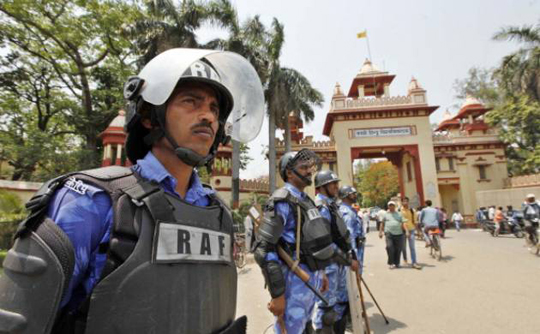
Petrol bombs seized from hostels at Banaras Hindu University

September 3, 2016

Varanasi, Sep 3: At least eight petrol bombs, dozens of iron rods, sticks, bricks, empty alcohol bottles and cigarette packets were recovered on Friday from different hostels of Banaras Hindu University following a search conducted after Wednesday night's violence at the campus, police said.

bomb

Police along with the BHU administration conducted searches at Acharya Narendra Dev, Birla and other hostels and sealed half-a-dozen of these hostels.

An investigation has also been launched to find how and why these bombs were kept and also their purpose. Meanwhile, BHU administration suspended 26 students for their alleged involvement in connection with Wednesday's violence and arson in the varsity campus and also formed a committee to probe and submit its report within a fortnight.

The petrol bombs were made in empty wine-beer bottles in which petrol was filled, police said.

An FIR has been registered against 175 students, including 25 identified and 150 unidentified students, at the Lanka police station following this incident.

FIR has been also registered against five junior doctors and four ward boys under various sections of IPC. The junior doctors of Trauma centre, who have been on strike since Thursday, called it off this evening even though medical services at Trauma centre and Sir Sunder Lal Hospital of BHU are in operation with senior doctors handling the patients.

District Magistrate Vijay Kiran Anand and SSP Akash Kulhary have ordered for opening of a new police outpost inside the trauma centre on the demand of doctors, who wanted security for themselves, complaining that scuffle breaks out quite often between the students and doctors.

A large number of police force and PAC personnel have been deployed in the BHU campus to prevent any fresh clashes between doctors and students. The two injured students, who were admitted in the hospital following the violence have now been discharged and their health condition was normal.

Violence erupted in BHU on Wednesday, with students resorting to arson and vandalism in the campus, after resident doctors and other staff at the trauma centre allegedly thrashed some students injuring six students.

Comments

Mohammed SS
 - 
Sunday, 4 Sep 2016

All the Universities belongs to Hindus should be checked properly. Most of the Hindu students became terrorists in all the universities, recently we have seen they are doing ruckus wearing saffron Dhupatta in one of the college in Mangalore about girls Hijab, these saffron in the colleges are either from terror group or from nasty cultured family.

Mohammed SS
 - 
Sunday, 4 Sep 2016

All the Universities belongs to Hindus should be checked properly, Most of the Hindu students became terrorists in all the universities, recently we have seen they are doing ruckus wearing saffron Dhupatta in one of the college in Mangalore about girls Hijab, these saffron in the colleges are either from terror group or from nasty cultured family.

muthhu
 - 
Saturday, 3 Sep 2016

Narenanna ...idella bare sullu alla....irbahudu....ekendre ee vidyarthigalu manasika aswastharu .....karana...................avarella Rashtriya spotaka sangahada membersgalalva

Enanthiri Naadig

SK
 - 
Saturday, 3 Sep 2016

As Kerala minister said, the temples in kerala are used as warehouses by RSS to store weapons.... Now the things are becoming clear, how the RSS is playing with the life of innocents, by storing weapons in Hostels, Temples, and placing meat in Nagabanas ....

SYED
 - 
Saturday, 3 Sep 2016

awaiting comments from so called hindutva groups....

Add new comment

  • Coastaldigest.com reserves the right to delete or block any comments.
  • Coastaldigset.com is not responsible for its readers’ comments.
  • Comments that are abusive, incendiary or irrelevant are strictly prohibited.
  • Please use a genuine email ID and provide your name to avoid reject.
News Network
March 29,2020

Mangaluru, Mar 29: Dakshina Kannada Co-operative Milk Producers’ Union Limited in a statement announced that their milk collection centres across Dakshina Kannada and Udupi districts will be closed on March 29 and 30.

Due to a shortage of storage space with them, the Union has decided to stop collecting milk on these two days, according to the statement issued here on Saturday.

The sale/retail of milk and milk products won’t be affected in these two days.

Comments

Add new comment

  • Coastaldigest.com reserves the right to delete or block any comments.
  • Coastaldigset.com is not responsible for its readers’ comments.
  • Comments that are abusive, incendiary or irrelevant are strictly prohibited.
  • Please use a genuine email ID and provide your name to avoid reject.
coastaldigest.com news network
July 2,2020

Yadgir, July 2: A fresh video of the health staff dragging the body of a Covid-19 victim and dumping it into a pit disgracefully has gone viral on social media.

The incident occurred in Yadgir district of Karnataka on Tuesday, just days after shocking visuals of bodies of Covid-19 victims being handled disrespectfully in Ballari district went viral.

In the fresh video, two persons with PPE suits can be seen dragging, hurling and dumping the dead body of a senior citizen who died of covid-19. The duo dragged the body using a wooden log inserted to both hands of a plastic body bag for nearly 300 meters.

After pulling till the pit, the body was heartlessly dumped including a wooden log. Several villagers were also seen in the video.

The victim was settled in Siravara in Raichur district, although he originally hailed from Yadgir. On Sunday he was busy overseeing his daughter' wedding that was first postponed due to lockdown.

According to a relative of the deceased, on Monday he complained of breathing problems following which an ambulance was called to carry him to Raichur Institute of Medical Sciences (RIMS).

Raichur Deputy Commissioner (DC), R Venkatesh said he was brought dead to the hospital as he succumbed en-route. The family members were quarantined and the body was packed as per the protocols and sent to Yadgir as his family members informed that the victim is from the neighbouring district. "In Yadgir district he was swabbed and his test results came positive," DC informed.

As soon as residents of Honagera village learned about the arrival of the body, the family members were harassed asking them to not to bury the body in any of the fields in the village.

Sridevi, a relative of the deceased said "the locals assembled near our house and threatened consequences if the body was brought here. Fearing backlash, we asked the district authorities to perform the last rites in the farmland owned by the victim. But it is now saddening to see the video where the body was inhumanely dragged and dumped."

Meanwhile Karnataka Chief Minister BS Yeddyurappa on Wednesday (July 1, 2020) said that six staff members have been suspended in connection with the inhumane funeral of a man who died of COVID-19 in Balari district.

Comments

Add new comment

  • Coastaldigest.com reserves the right to delete or block any comments.
  • Coastaldigset.com is not responsible for its readers’ comments.
  • Comments that are abusive, incendiary or irrelevant are strictly prohibited.
  • Please use a genuine email ID and provide your name to avoid reject.
Media Release
February 14,2020

Veteran journalist P. Sainath has said that the nation is in a crisis. And this crisis is not limited to just the rural area. It has become a national crisis at various areas such as agriculture, education, economy, job creation etc.

He was delivering the endowment lecture on the topic ‘Indian democracy at the post-liberalization and post-truth era’ at Media Manthan 2020 organized by the PG department of journalism and mass communication at St Aloysius College (Autonomous). 

Mr Sainath said that the many policies adopted in the 90s led to India becoming unusually unequal. Referring to the speech Ambedkar had made at the Constituent Assembly while handing over the draft of the Constitution, Mr Sainath said, “Ambedkar had warned about the weakness of Indian democracy that liberty without equality allows the supremacy of a few over the multitude. Liberty, equality and fraternity must be kept together as we cannot have one without the other.” 

Mr Sainath stated that the agrarian crisis was no longer about the loss of productivity, employment or about farmer suicide; it was a societal, civilizational crisis. Commenting on the lopsided policies such as cow-slaughter ban, he explained how cow slaughter ban had adversely affected many industries due to their interdependency. While Muslims who slaughtered cows were rendered helpless, the cattle traders who were mostly OBCs lost their earnings as the cattle prices crashed. An important industry like Kolhapur sandals industry in Maharashtra went bankrupt as a result of the cow slaughter ban in Maharashtra. He said the policymakers had no idea how the rural industries were interconnected. Demonetisation too devastated the rural economy as 98 percent of rural transactions happen through cash. 

Mr Sainath also spoke about the crisis of inequality which affects the Dalits and the Adivasis far more than anyone else as 90 percent of the rural households take home less than Rs 10,000/- per month. “Women are yet another group whose labour is never counted in the gross domestic product. Women and girls globally do unpaid work which amounts to about 12.5 billion working hours per year. Monetarily speaking, this is worth 10.8 trillion dollars,” Mr Sainath added. 

Speaking about the crisis of jobs Mr Sainath said that major companies were laying off employees just to create more profits for the investors and the adoption of artificial intelligence in the industry would further destroy millions of jobs.

Rector of St Aloysius College Institutions Fr Dionysius Vaz SJ, Principal Dr (Fr) Praveen Martis SJ, HOD of Journalism and Mass Communication department Dr (Fr) Melwyn Pinto SJ were present.

‘Veerappan and Vijay Mallya’s business models are interesting!’

Addressing the gathering during his endowment lecture on Friday, Mr Sainath made an interesting comment on the so called ‘revenue model’. “Whenever I visit IIMs and IITs for lectures on my PARI project, the students there ask me what my revenue model for my project is. I tell them that I do not have a revenue model. In fact, journalism does not begin with a revenue model. Gandhiji, Ambedkar, Bhagat Singh were all great journalists. But they did not have a revenue model,” Mr Sainath said.

On a lighter note, he said that the best revenue model that he liked was that of forest brigand Veerappan and liquor baron Vijay Mallya. “Veerappan ruled the forest for forty years and from the top ministers to the villagers he could dictate terms and liver royally. Similarly, Mallya’s revenue model was to steal the banks and run away abroad and live like a king,” Mr Sainath added.

Journalism is not and can never be a business. It is a calling, he opined. While newspaper can be a business, television can be a business, journalism per se cannot be reduced to a business. “Unfortunately today, journalists are recruited on a contract basis and they have no bargaining power; and there are no unions to fight for their cause. Hence, they are at the mercy of the corporate media houses for their survival and are made to write stories that cannot be called journalism,” Mr Sainath said.

Answering a question as to the pressures he faced as a journalist, he said that external pressures from the government or others could be very well handled. It is the internal pressures from once own media house that journalists find it difficult to manage.


 

Comments

Add new comment

  • Coastaldigest.com reserves the right to delete or block any comments.
  • Coastaldigset.com is not responsible for its readers’ comments.
  • Comments that are abusive, incendiary or irrelevant are strictly prohibited.
  • Please use a genuine email ID and provide your name to avoid reject.