



This physically challenged man from Ullal may need your help

[email protected] (Abdul Hameed Padubidri)
August 20, 2016

In spite of their disabilities and helplessness some people struggle hard in their lives to accomplish their goals. However, often they become helpless to achieve some of their basic needs in life. It remains their dream only unless they are supported and helped by others.man
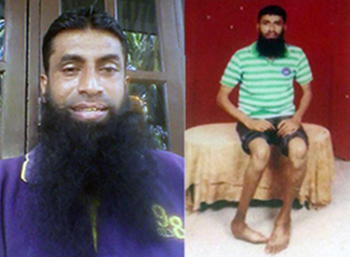
Ahamad Azmal, son of late Sheikh Ahmed, residing at Kodi, Ullal in Mangaluru taluk, is one such person. He is a physically challenged by birth. He is a father of three children, amongst whom, his elder son is studying in 4th grade; while second daughter is studying in UKG and third daughter is just two years old. He is living with his family in a rented house.

He is the only bread-earner of his family, and is earning for his livelihood, which is just enough for his monthly house rent and limited needs. Though he is very spirited to do something more for his other basic needs, he is not able to do any hard work because of his physical deformity.

His only wish is to have his own house so that he can reside decently there and save his monthly rent for other wants. But, it is very hard for him to materialize due to his incapability though he is enthusiastic to work relentlessly in that regard.

Despite this, he is never seen extending his hands for help from others as he is very mindful of sense of self-respect & dignity. For him and family's daily breads, his earning is decent.

"I never feel my physical disability as a my failure; it's all the God's test; I can't sitting idle at my home; I am doing my best for my decent earning within my maximum capacity; I never extended my hands for help with anyone so far; but if the God wills, I may not be deprived of helps by the big-hearted philanthropists... "

Those who wish to extend financial help to Ahamad Azmal may visit his rented house at Kodi, Ullal or contact him through his mobile: 0091-9035300318

Bank account details: AHAMAD AZMAL; A/C NO 31646850873; STATE BANK OF INDIA; CHOTA MANGALORE; IFSC CODE SBIN OO3669

Comments

Abc
 - 
Wednesday, 31 Aug 2016

please correct IFSC code SBIN0003669

Abu abdullah
 - 
Sunday, 21 Aug 2016

May Allah give him Hidaya

SK
 - 
Sunday, 21 Aug 2016

We pray the Almighty to shower his mercies on this family ...Aameen....Insha Allah...

Add new comment

  • Coastaldigest.com reserves the right to delete or block any comments.
  • Coastaldigset.com is not responsible for its readers’ comments.
  • Comments that are abusive, incendiary or irrelevant are strictly prohibited.
  • Please use a genuine email ID and provide your name to avoid reject.
Ram Puniyani
February 10,2020

Noam Chomsky is one of the leading peace workers in the world. In the wake of America’s attack on Vietnam, he brought out his classic formulation, ‘manufacturing consent’. The phrase explains the state manipulating public opinion to have the public approve of it policies—in this case, the attack of the American state on Vietnam, which was then struggling to free itself from French colonial rule.

In India, we are witness to manufactured hate against religious minorities. This hatred serves to enhance polarisation in society, which undermines India’s democracy and Constitution and promotes support for a Hindu nation. Hate is being manufactured through multiple mechanisms. For example, it manifests in violence against religious minorities. Some recent ghastly expressions of this manufactured hate was the massive communal violence witnessed in Mumbai (1992-93), Gujarat (2002), Kandhamal (2008) and Muzaffarnagar (2013). Its other manifestation was in the form of lynching of those accused of having killed a cow or consumed beef. A parallel phenomenon is the brutal flogging, often to death, of Dalits who deal with animal carcasses or leather.

Yet another form of this was seen when Shambhulal Regar, indoctrinated by the propaganda of Hindu nationalists, burned alive Afrazul Khan and shot the video of the heinous act. For his brutality, he was praised by many. Regar was incited into the act by the propaganda around love jihad. Lately, we have the same phenomenon of manufactured hate taking on even more dastardly proportions as youth related to Hindu nationalist organisations have been caught using pistols, while police authorities look on.

Anurag Thakur, a BJP minster in the central government recently incited a crowd in Delhi to complete his chant of what should happen to ‘traitors of the country...” with a “they should be shot”. Just two days later, a youth brought a pistol to the site of a protest at Jamia Millia Islamia university and shouted “take Azaadi!” and fired it. One bullet hit a student of Jamia. This happened on 30 January, the day Nathuram Godse had shot Mahatma Gandhi in 1948. A few days later, another youth fired near the site of protests against the CAA and NRC at Shaheen Bagh. Soon after, he said that in India, “only Hindus will rule”.

What is very obvious is that the shootings by those associated with Hindu nationalist organisations are the culmination of a long campaign of spreading hate against religious minorities in India in general and against Muslims in particular. The present phase is the outcome of a long and sustained hate campaign, the beginning of which lies in nationalism in the name of religion; Muslim nationalism and Hindu nationalism. This sectarian nationalism picked up the communal view of history and the communal historiography which the British introduced in order to pursue their ‘divide and rule’ policy.

In India what became part of “social common sense” was that Muslim kings had destroyed Hindu temples, that Islam was spread by force, and that it is a foreign religion, and so on. Campaigns, such as the one for a temple dedicated to the Hindu god Rama to be built at the site where the Babri masjid once stood, further deepened the idea of a Muslim as a “temple-destroyer”. Aurangzeb, Tipu Sultan and other Muslim kings were tarnished as the ones who spread Islam by force in the subcontinent. The tragic Partition, which was primarily due to British policies, and was well-supported by communal streams also, was entirely attributed to Muslims. The Kashmir conflict, which is the outcome of regional, ethnic and other historical issues, coupled with the American policy of supporting Pakistan’s ambitions of regional hegemony, (which also fostered the birth of Al-Qaeda), was also attributed to the Muslims.

With recurring incidents of communal violence, these falsehoods went on going deeper into the social thinking. Violence itself led to ghettoisation of Muslims and further broke inter-community social bonds. On the one hand, a ghettoised community is cut off from others and on the other hand the victims come to be presented as culprits. The percolation of this hate through word-of-mouth propaganda, media and re-writing of school curricula, had a strong impact on social attitudes towards the minorities.

In the last couple of decades, the process of manufacturing hate has been intensified by the social media platforms which are being cleverly used by the communal forces. Swati Chaturvedi’s book, I Am a Troll: Inside the Secret World of the BJP’s Digital Army, tells us how the BJP used social media to spread hate. Whatapp University became the source of understanding for large sections of society and hate for the ‘Other’, went up by leaps and bounds. To add on to this process, the phenomenon of fake news was shrewdly deployed to intensify divisiveness.

Currently, the Shaheen Bagh movement is a big uniting force for the country; but it is being demonised as a gathering of ‘anti-nationals’. Another BJP leader has said that these protesters will indulge in crimes like rape. This has intensified the prevalent hate.

While there is a general dominance of hate, the likes of Shambhulal Regar and the Jamia shooter do get taken in by the incitement and act out the violence that is constantly hinted at. The deeper issue involved is the prevalence of hate, misconceptions and biases, which have become the part of social thinking.

These misconceptions are undoing the amity between different religious communities which was built during the freedom movement. They are undoing the fraternity which emerged with the process of India as a nation in the making. The processes which brought these communities together broadly drew from Gandhi, Bhagat Singh and Ambedkar. It is these values which need to be rooted again in the society. The communal forces have resorted to false propaganda against the minorities, and that needs to be undone with sincerity.

Combating those foundational misconceptions which create hatred is a massive task which needs to be taken up by the social organisations and political parties which have faith in the Indian Constitution and values of freedom movement. It needs to be done right away as a priority issue in with a focus on cultivating Indian fraternity yet again.

Comments

Add new comment

  • Coastaldigest.com reserves the right to delete or block any comments.
  • Coastaldigset.com is not responsible for its readers’ comments.
  • Comments that are abusive, incendiary or irrelevant are strictly prohibited.
  • Please use a genuine email ID and provide your name to avoid reject.
News Network
February 17,2020

Kasaragod, Feb 17: A Kerala Muslim couple conducted the wedding of their Hindu foster daughter at a Bhagavathi temple in Kerala, scripting another tale of communal harmony at Kasaragod.

The wedding ceremony was held on Sunday.

The woman Rajeshwari tied the knot with Vishnu Prasad in the presence of family and friends belonging to both Hindu and Muslim communities.

Abdulla and Khadeeja adopted Rajeshwari after her father who worked at Abdulla's farm died. Rajeshwari's mother also passed away when she was a child.

Rajeshwari grew up alongside Abdulla and Khadeeja's three sons- Shameem, Najeeb and Shereef.

Earlier in January this year, cutting across the lines of religion, a mosque in Kerala's Kayamkulam hosted a Hindu marriage ceremony.

Comments

Add new comment

  • Coastaldigest.com reserves the right to delete or block any comments.
  • Coastaldigset.com is not responsible for its readers’ comments.
  • Comments that are abusive, incendiary or irrelevant are strictly prohibited.
  • Please use a genuine email ID and provide your name to avoid reject.
News Network
May 25,2020

The government of India has added 141 more flights to West Asian countries for the second phase of Vande Bharat Mission, its massive repatriation programme for citizens stranded overseas because of Covid-19-related travel restrictions.

The second phase was to end on May 22. However, External Affairs Ministry Spokesperson Anurag Srivastava said the ongoing phase will last till June 13 and that India is looking at making Frankfurt a hub for the mission.

With these new flights, more than half of them to the United Arab Emirates, the total number of flights in the second phase of the programme have gone up to more than 400, people familiar with developments said on condition of anonymity.

The flights were added due to increased demand from citizens stranded in West Asian countries and the availability of adequate quarantine facilities in states for the returning Indians, the people said. As with all the flights operated so far under Vande Bharat Mission, priority will be given in the second phase to Indian nationals with compelling reasons for returning to the country, they added.

The additional flights are from the UAE (81 flights), Oman and Saudi Arabia (15 flights each), Kuwait (14 flights), Qatar (11 flights) and Bahrain (five flights).

A majority of the flights are bound for Kerala (84 flights), while the other destinations are Delhi (10 flights), Tamil Nadu (nine flights), Telangana (six flights) Gujarat and Jammu and Kashmir (five flights each), Bihar, Rajasthan and Uttar Pradesh (four flights each), Punjab (three flights), Odisha and West Bengal (two flights each), Chandigarh, Karnataka and Goa (one flight each).

The other 260-odd flights being operated during the second phase of Vande Bharat Mission are from Armenia, Australia, Bangladesh, Belarus, Belgium, Canada, Egypt, Finland, France, Georgia, Germany, Indonesia, Ireland, Israel, Italy, Japan, Jordan, Kazakhstan, Kenya, Kyrgyzstan, Malaysia, Mauritius, Myanmar, Nepal, the Netherlands, New Zealand, Nigeria, Oman, the Philippines, Russia, Singapore, South Korea, Spain, Sri Lanka, Sweden, Tajikistan, the UK, Ukraine and the US.

The second phase of the repatriation programme began on May 16 and will continue till June 13, with all the flights being operated by state-run Air India and its subsidiary Air India Express. Private airlines are likely to be included in the third phase.

As of Thursday, a total of 23,475 Indians have been repatriated under Vande Bharat Mission. The second phase had included new destinations such as Istanbul, Ho Chi Minh City and Lagos, and had increased flights to the US and Europe.

More than 259,000 Indians in 98 countries across the world have registered to return under Vande Bharat Mission. Most of them are workers (28%), students (25%), professionals (14.5%), and short-term visa holders such as tourists (7.6%). Fishermen, deportees and Indian nationals who benefited from visa amnesties have also registered.

Comments

Uwaiz
 - 
Tuesday, 26 May 2020

No flights from oman to manglore nor to Banglore 

Add new comment

  • Coastaldigest.com reserves the right to delete or block any comments.
  • Coastaldigset.com is not responsible for its readers’ comments.
  • Comments that are abusive, incendiary or irrelevant are strictly prohibited.
  • Please use a genuine email ID and provide your name to avoid reject.