



PISJ-ES principal refuses to vacate post

November 21, 2013

PISJ-ES

Jeddah/Riyadh, Nov 21: The principal of the Pakistan International School Jeddah English Section (PISJ-ES), who was sacked by the Pakistan ambassador earlier this week, has rejected allegations against her and refused to vacate her position.

Sehar Kamran has instead accused Mohammad Naeem Khan, Pakistan’s ambassador, of playing politics because she is a member of the Pakistan People’s Party (PPP) that was defeated in the recent elections by the Pakistan Muslim League-Nawaz (PML-N).

Khan fired Kamran Tuesday following several allegations against her including corruption, mismanagement of funds, gross indiscipline, favoritism and using her political connections to get the job in 2008. Khan appointed Imran Raza Khan as acting principal with immediate effect.

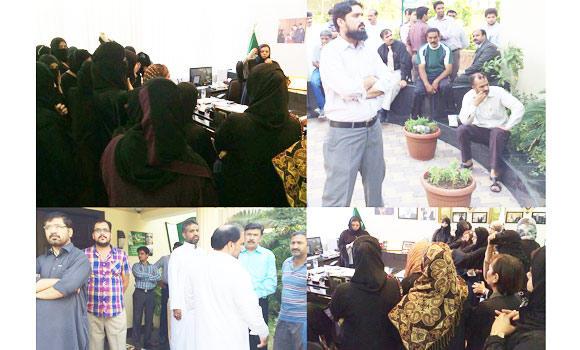
Kamran allegedly refused to allow the new acting principal to enter the school premises on Wednesday morning, ordered that the school close early and that it would remain close on Thursday, a move that angered some parents.

“We received a message to pick up the children around 10 a.m. The school belongs to the community. It is not her personal property to do what she likes with it,” said Imran Abasi, a parent. He said it took him almost an hour and a half to find his children.

Another parent, Khalid Cheema, said: “Parents do not want a political personality as principal.”

However, Arshad Javaid, also a parent, claimed that “90 percent of the parents are with Kamran and want her to run the school.”

The school’s link officer, Sohail Ali Khan, went to the school to pacify parents and said it would be open on Thursday. He said the decision to terminate Kamran had been taken by the governments of Saudi Arabia and Pakistan and was in accordance with Saudi regulations.

Aftab Khokhar, the Pakistan consul general, said Kamran’s decision to shut the school was illegal. He said the consulate would ensure that the school remains open and the Pakistan ambassador’s orders implemented.

Kamran rejected the allegations against her and lashed out at the embassy officials.

“I’ve served Pakistan for more than 21 years with honesty, love and loyalty. I’ve always worked for the development of Pakistan. I’ve served this school with my expertise and love for more than six years,” she said.

Kamran accused the ambassador of firing her because of her political affiliations. She said the officials had acted in an “unscrupulous” manner following the establishment of the government under the PML-N, and because she is a member of the PPP.

Kamran is the first woman to enter the upper house of Pakistan’s Parliament and won a senate election. The allegations were from people “playing high level politics ... and trying to destroy the image of Pakistan,” she said.

Some Pakistani parents and students came out in support of Kamran and held a demonstration at the Saudi Ministry of Education. The parents said they met with Khalid Al-Harthy, director of Foreign Education for the Western Region, and claimed he sent a letter to the Riyadh Ministry of Foreign Affairs and Education Ministry “for a decision.”

Comments

Naveeda Shahzad
 - 
Sunday, 19 Aug 2018

Why a political worker was appointed as principal of Pakistani School?

Was it a favour to her by Zardari govt?

Add new comment

  • Coastaldigest.com reserves the right to delete or block any comments.
  • Coastaldigset.com is not responsible for its readers’ comments.
  • Comments that are abusive, incendiary or irrelevant are strictly prohibited.
  • Please use a genuine email ID and provide your name to avoid reject.
January 15,2020

Asia, Jan 15: Iranian Foreign Minister Javad Zarif on Wednesday said that killing of Iranian general Qassem Soleimani showed the ignorance and arrogance of the United States and asserted that Washington looks at things from their perspective and not keeping the interests of the region in mind."The US looks at things from their perspective, not from the perspective of this region. The killing of Qassem Soleimani shows ignorance and arrogance. 430 Indian cities saw protests against killing of Soleimani," Zarif said at an event.
Hitting out at US President Donald Trump and Secretary of State Michael Pompeo, Zarif said that they were the only ones, along with the Islamic State (ISIS) who celebrated the death of Soleimani.

"Who is celebrating Soleimani's killing? President Trump, Pompeo and Daesh (Arabic name of ISIS). You wonder about strange bedfellows?" he said.

Tensions between the US and Iran soared dramatically earlier this month after Washington launched airstrikes at Baghdad International Airport, which killed Soleimani. Tehran retaliated by firing a volley of ballistic missiles at two military bases of US-led coalition forces in Iraq, leading to a strife in the region.

However, Zarif regretted the shooting down of the Ukrainian airline and said it happened because of "tension".

"Nine million people were out in the streets of Iran commemorating Soleimani. You cannot bring out so many people to protest. The shooting down of a plane was a mistake. 180 families are mourning the loss of their dear ones. It happened because of tension," he said.

Asked whether there a chance of a diplomatic solution to the ongoing crisis, Zarif ruled out negotiating with the US.

"Iran is interested in diplomacy. We are not interested in negotiating with the US. US did not keep its commitments under nuclear deal. We had a US deal and the US broke it. If we have a Trump deal, how long will it last?" he said.

Comments

Add new comment

  • Coastaldigest.com reserves the right to delete or block any comments.
  • Coastaldigset.com is not responsible for its readers’ comments.
  • Comments that are abusive, incendiary or irrelevant are strictly prohibited.
  • Please use a genuine email ID and provide your name to avoid reject.
Agencies
July 19,2020

Occupied Jerusalem, Jul 19: Israeli Prime Minister Benjamin Netanyahu’s corruption trial resumed on Sunday.

Netanyahu is charged with fraud, breach of trust and accepting bribes in a series of scandals in which he is alleged to have received lavish gifts from billionaire friends and exchanged regulatory favors with media moguls for more agreeable coverage of himself and his family.

Netanyahu denies wrongdoing, painting the accusations as a media-orchestrated witchhunt pursued by a biased law enforcement system.

The trial opened in May. Just before appearing in front of the judges, Netanyahu took to a podium inside the courthouse and flanked by his party members bashed the country’s legal institutions in an angry tirade.

Netanyahu was not expected to appear at Sunday’s hearing, which is taking place at an occupied Jerusalem court and is mostly a procedural deliberation.

The trial resumes as Netanyahu faces widespread anger over his government’s handling of the coronavirus crisis.

While the country appeared to have tamped down a first wave of infections, what’s emerged as a hasty and erratic reopening sent infections soaring. Yet even amid the rise in new cases Netanyahu and his emergency government — formed with the goal of dealing with the crisis — appeared to neglect the numbers and moved forward with other policy priorities and its reopening plans.

It has since paused them and even re-impose restrictions, including a weekend only lockdown set to begin later this week.

Netanyahu’s government has been criticized for a baffling, halting response to the new wave, which has seen daily cases rise to nearly 2,000. It has been slammed for its handling of the economic fallout of the crisis.

His trial thus comes at inopportune timing. Netanyahu had hoped to ride on the goodwill he gained from overcoming the first wave of infections going into his corruption trial, but the increasingly souring mood has affected his approval rating and may deny him the public backing he had hoped for. The anger has sparked protests over the past few weeks that have culminated in violent clashes with police.

Comments

Add new comment

  • Coastaldigest.com reserves the right to delete or block any comments.
  • Coastaldigset.com is not responsible for its readers’ comments.
  • Comments that are abusive, incendiary or irrelevant are strictly prohibited.
  • Please use a genuine email ID and provide your name to avoid reject.
Agencies
August 2,2020

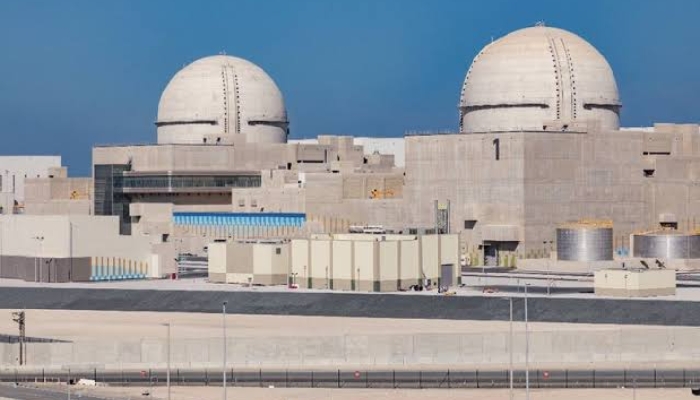
Dubai, Aug 2: The United Arab Emirates (UAE) announced on Saturday that it has started operations in the first of four reactors at the Barakah nuclear power station - the first nuclear power plant in the Arab world.

Emirates Nuclear Energy Corporation (ENEC), which is building and operating the plant with Korea Electric Power Corporation (KEPCO) said in a press release that its subsidiary Nawah Energy Company "has successfully started up Unit 1 of the Barakah Nuclear Energy Plant, located in the Al Dhafrah Region of Abu Dhabi".

That signals that Unit 1, which had fuel rods loaded in March, has achieved "criticality" - a sustained fission chain reaction.

"The start-up of Unit 1 marks the first time that the reactor safely produces heat, which is used to create steam, turning a turbine to generate electricity," said ENEC.

Barakah, which was originally scheduled to open in 2017, has been dogged by delays and is billions of dollars over budget. It has also raised myriad concerns among nuclear energy veterans who are concerned about the potential risks Barakah could visit upon the Arabian Peninsula, from an environmental catastrophe to a nuclear arms race.

Paul Dorfman, an honorary senior research fellow at the Energy Institute, University College London and founder and chair of the Nuclear Consulting Group, has criticised the Barakah reactors' "cheap and cheerful" design that he says cuts corners on safety.

Dorfman authored a report (PDF) last year detailing key safety features Barakah's reactors lack, such as a "core catcher" to literally stop the core of a reactor from breaching the containment building in the event of a meltdown. The reactors are also missing so-called Generation III Defence-In-Depth reinforcements to the containment building to shield against a radiological release resulting from a missile or fighter jet attack.

Both of these engineering features are standard on new reactors built in Europe, says Dorfman.

There have been at least 13 aerial attacks on nuclear facilities in the Middle East - more than any other region on earth.

The vulnerability of critical infrastructure in the Arabian Peninsula was further laid bare last year after Saudi Arabia's oil facilities at Abqaiq and Khurais were attacked by 18 drones and seven cruise missiles - an assault that temporarily knocked out more than half of the kingdom's oil production.

On Saturday, Dorfman reiterated his concern that there is no regional protocol in place to determine liability should an accident or incident at Barakah result in radioactive contamination spreading from the UAE to its neighbours. 

"Given Barakah has started up, because of all the well-rehearsed nuclear safety and security problems, it may be critically important that the Gulf states collectively evolve a Nuclear Accident Liability Convention, so that if anything does go wrong, victim states may have some sort of redress," Dorfman told Al Jazeera. 

The UAE has substantial oil and gas reserves, but it has made huge investments in developing alternative energy sources, including nuclear and solar.

Experts though have questioned why the UAE - which is bathed in sunlight and wind - has pushed ahead with nuclear energy - a far more expensive and riskier option than renewable energy sources.

When the UAE first announced Barakah in 2009, nuclear power was cheaper than solar and wind. But by 2012 - when the Emirates started breaking ground to build the reactors - solar and wind costs had plummeted dramatically.

Between 2009 and 2019, utility-scale average solar photovoltaic costs fell 89 percent and wind fell 43 percent, while nuclear jumped 26 percent, according to an analysis by the financial advisory and asset manager Lazard.

There are also concerns about the potential for Barakah to foment nuclear proliferation in the Middle East - a region rife with geopolitical fault lines and well-documented history of nuclear secrecy.

The UAE has sought to distance itself from the region's bad behaviour by agreeing not to enrich its own uranium or reprocess spent fuel. It has also signed up to the United Nation's nuclear watchdog's Additional Protocol, significantly enhancing inspection capabilities, and secured a 123 Agreement with the United States that allows bilateral civilian nuclear cooperation.

Comments

Add new comment

  • Coastaldigest.com reserves the right to delete or block any comments.
  • Coastaldigset.com is not responsible for its readers’ comments.
  • Comments that are abusive, incendiary or irrelevant are strictly prohibited.
  • Please use a genuine email ID and provide your name to avoid reject.