


PISJ-ES principal refuses to vacate post

November 21, 2013

PISJ-ES

Jeddah/Riyadh, Nov 21: The principal of the Pakistan International School Jeddah English Section (PISJ-ES), who was sacked by the Pakistan ambassador earlier this week, has rejected allegations against her and refused to vacate her position.

Sehar Kamran has instead accused Mohammad Naeem Khan, Pakistan’s ambassador, of playing politics because she is a member of the Pakistan People’s Party (PPP) that was defeated in the recent elections by the Pakistan Muslim League-Nawaz (PML-N).

Khan fired Kamran Tuesday following several allegations against her including corruption, mismanagement of funds, gross indiscipline, favoritism and using her political connections to get the job in 2008. Khan appointed Imran Raza Khan as acting principal with immediate effect.

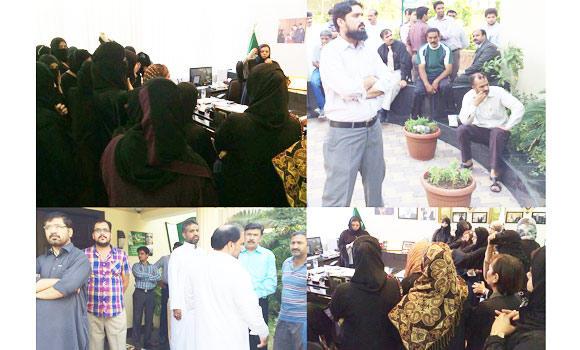
Kamran allegedly refused to allow the new acting principal to enter the school premises on Wednesday morning, ordered that the school close early and that it would remain close on Thursday, a move that angered some parents.

“We received a message to pick up the children around 10 a.m. The school belongs to the community. It is not her personal property to do what she likes with it,” said Imran Abasi, a parent. He said it took him almost an hour and a half to find his children.

Another parent, Khalid Cheema, said: “Parents do not want a political personality as principal.”

However, Arshad Javaid, also a parent, claimed that “90 percent of the parents are with Kamran and want her to run the school.”

The school’s link officer, Sohail Ali Khan, went to the school to pacify parents and said it would be open on Thursday. He said the decision to terminate Kamran had been taken by the governments of Saudi Arabia and Pakistan and was in accordance with Saudi regulations.

Aftab Khokhar, the Pakistan consul general, said Kamran’s decision to shut the school was illegal. He said the consulate would ensure that the school remains open and the Pakistan ambassador’s orders implemented.

Kamran rejected the allegations against her and lashed out at the embassy officials.

“I’ve served Pakistan for more than 21 years with honesty, love and loyalty. I’ve always worked for the development of Pakistan. I’ve served this school with my expertise and love for more than six years,” she said.

Kamran accused the ambassador of firing her because of her political affiliations. She said the officials had acted in an “unscrupulous” manner following the establishment of the government under the PML-N, and because she is a member of the PPP.

Kamran is the first woman to enter the upper house of Pakistan’s Parliament and won a senate election. The allegations were from people “playing high level politics ... and trying to destroy the image of Pakistan,” she said.

Some Pakistani parents and students came out in support of Kamran and held a demonstration at the Saudi Ministry of Education. The parents said they met with Khalid Al-Harthy, director of Foreign Education for the Western Region, and claimed he sent a letter to the Riyadh Ministry of Foreign Affairs and Education Ministry “for a decision.”

Comments

Naveeda Shahzad
 - 
Sunday, 19 Aug 2018

Why a political worker was appointed as principal of Pakistani School?

Was it a favour to her by Zardari govt?

Add new comment

  • Coastaldigest.com reserves the right to delete or block any comments.
  • Coastaldigset.com is not responsible for its readers’ comments.
  • Comments that are abusive, incendiary or irrelevant are strictly prohibited.
  • Please use a genuine email ID and provide your name to avoid reject.
Khaleej Times
May 27,2020

Dubai, May 27: As the authorities have taken steps to ease the Covid-19 restrictions to allow the people of Dubai to resume sporting activities from Wednesday, May 27, the Dubai Sports Council has answered your key questions.

Q&A

What are the age groups allowed to practice sports during this period?

From 12 years old to 60 years old.

Is it required to do the Coronavirus (Covid 19) medical test certificate before resuming physical activity?

Returning to the activity does not require a Coronavirus (Covid 19) test certificate.

Is it allowed for the elderly with chronic diseases to return to sports activities in fitness and yoga centers?

No, it is not allowed.

Is it allowed to use the shower cabins and bathrooms in fitness and yoga centers?

Shower cabins, saunas and jacuzzis are not allowed, while bathrooms are allowed, with sterilisation being emphasised after each use.

What sports can resume its activities?

All sports except water sports/swimming and that are practiced indoors and swimming pools.

What is the approved operational percentage within the sports facility?

A maximum 50% capacity

Comments

Add new comment

  • Coastaldigest.com reserves the right to delete or block any comments.
  • Coastaldigset.com is not responsible for its readers’ comments.
  • Comments that are abusive, incendiary or irrelevant are strictly prohibited.
  • Please use a genuine email ID and provide your name to avoid reject.
News Network
May 20,2020

Cairo, May 20: A senior Kuwaiti lawmaker has called for imposing a tax on expatriates’ remittances to shore up the country’s finances.

MP Khalil Al Saleh, the head of the parliament’s Human Resources Committee, has presented a draft law on the proposed tax to the legislature.

“Imposing fees on expatriates’ transfers will have a role in improving the state's revenues and diversify sources of income,” he told Al Rai newspaper.

Migrant workers transfer about 4.2 billion dinars annually from Kuwait, he added, citing figures from Kuwait’s Central Bank.

“This system is in effect in most countries of the world and in more than one Gulf country. Expats there have not objected to it. Allowing this money to exit the country is very dangerous and has a direct effect on economy,” MP Al Saleh said.

“We do not target brotherly expats because imposing symbolic fees on financial transfers will not affect their money, but will have a positive effect on the state’s sources,” he said. “This has become a necessity after the money transferred outside Kuwait has reached 4.2 billion dinars annually without the state [Kuwait] making any benefit from this.”

Foreign workers make up 3.3 million of Kuwait’s 4.6 million population.

Several Kuwaiti public figures have recently pushed for redrawing the demographic imbalance in the country, accusing expatriates of straining health facilities and increasing the Covid-19 threat.

Comments

Add new comment

  • Coastaldigest.com reserves the right to delete or block any comments.
  • Coastaldigset.com is not responsible for its readers’ comments.
  • Comments that are abusive, incendiary or irrelevant are strictly prohibited.
  • Please use a genuine email ID and provide your name to avoid reject.
News Network
July 1,2020

Riyadh, Jul 1: Saudis braced Wednesday for a tripling in value added tax, another unpopular austerity measure after the twin shocks of coronavirus and an oil price slump triggered the kingdom's worst economic decline in decades.

Retailers in the country reported a sharp uptick in sales this week of everything from gold and electronics to cars and building materials, as shoppers sought to stock up before VAT is raised to 15 percent.

The hike could stir public resentment as it weighs on household incomes, pushing up inflation and depressing consumer spending as the kingdom emerges from a three-month coronavirus lockdown.

"Cuts, cuts, cuts everywhere," a Saudi teacher in Riyadh told AFP, bemoaning vanishing subsidies as salaries remain stagnant.

"Air conditioner, television, electronic items," he said, rattling off a list of items he bought last week ahead of the VAT hike.

"I can't afford these things from Wednesday."

With its vast oil wealth funding the Arab world's biggest economy, the kingdom had for decades been able to fund massive spending with no taxes at all.

It only introduced VAT in 2018, as part of a push to reduce its dependence on crude revenues.

Then, seeking to shore up state finances battered by sliding oil prices and the coronavirus crisis, it announced in May that it would triple VAT and halt a cost-of-living monthly allowance to citizens.

The austerity push underscores how Saudi Arabia's once-lavish spending is becoming a thing of the past, with the erosion of the welfare system leaving a mostly young population to cope with reduced incomes and a lifestyle downgrade.

That could pile strain on a decades-old social contract whereby citizens were given generous subsidies and handouts in exchange for loyalty to the absolute monarchy.

The rising cost of living may prompt many to ask why state funds are being lavished on multi-billion-dollar projects and overseas assets, including the proposed purchase of English football club Newcastle United.

Shopping malls in the kingdom have drawn large crowds in recent days as retailers offered "pre-VAT sales" and discounts before the hike kicks in.

A gold shop in Riyadh told AFP it saw a 70 percent jump in sales in recent weeks, while a car dealership saw them tick up by 15 percent.

Once the new rate is in place, businesses are predicting depressed sales of everything from cars to cosmetics and home appliances.

Capital Economics forecast inflation will jump up to six percent year-on-year in July, from 1.1 percent in May, as a result.

"The government ended the country's lockdown (in June) and there are signs that economic activity has started to recover," Capital Economics said in a report.

"Nonetheless, we expect the recovery to be slow-going as fiscal austerity measures bite."

The kingdom also risks losing its edge against other Gulf states, including its principal ally the United Arab Emirates, which introduced VAT at the same time but has so far refrained from raising it beyond five percent.

"Saudi Arabia is taking massive risks with contractionary fiscal policies," said Tarek Fadlallah, chief executive officer of the Middle East unit of Nomura Asset Management.

But the kingdom has few choices as oil revenue declines.

Its finances have taken another blow as authorities massively scaled back this year's hajj pilgrimage, from 2.5 million pilgrims last year to around a thousand already inside the country, and suspended the lesser umrah because of coronavirus.

Together the rites rake in some $12 billion annually.

The International Monetary Fund warned the kingdom's GDP will shrink by 6.8 percent this year -- its worst performance since the 1980s oil glut.

The austerity drive would boost state coffers by 100 billion riyals ($26.6 billion), according to state media.

But the measures are unlikely to plug the kingdom's huge budget deficit.

The Saudi Jadwa Investment group forecasts the shortfall will rise to a record $112 billion this year.

Comments

Add new comment

  • Coastaldigest.com reserves the right to delete or block any comments.
  • Coastaldigset.com is not responsible for its readers’ comments.
  • Comments that are abusive, incendiary or irrelevant are strictly prohibited.
  • Please use a genuine email ID and provide your name to avoid reject.