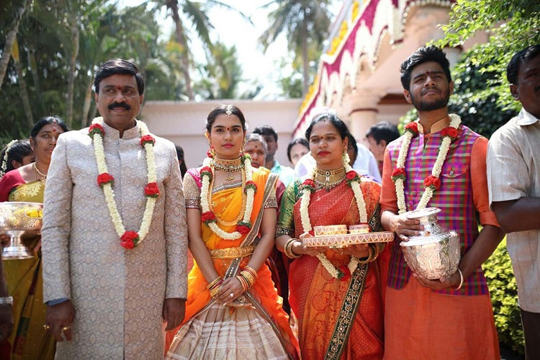
Plaint against mining baron Reddy over daughter's lavish wedding

November 16, 2016

Bengaluru, Nov 16: Karnataka minister and mining baron Gali Janardhan Reddy is in the eye of a political storm, a day before his daughter's wedding on Wednesday.

janardhan

An activist has filed a complaint with the directorate general of income tax (investigations) questioning the extravagant nature of the wedding.

In the complaint, RTI activist T Narasimha Murthy said the arrangements have already raised eyebrows, whilepeople are standing in long queues after the demonetisation'

Tax officials refused to comment on the issue.

According to reports, Reddy has planned to recreate a model of the 16th century Vijayanagara palace at the Bengaluru Palace Grounds for the November 16 wedding.

Local media is abuzz with rumours that Bollywood star Shah Rukh Khan will perform at a wedding function on Tuesday but the claim could not be confirmed.

The Bellary mining baron was arrested in 2011 on charges of illegally mining iron ore and was in prison for over three years. His company, Obulapuram Mining Company, was alleged to have shifted the borders that separated the neighbouring districts of Ballary in Karnataka and Anantapur in Andhra Pradesh to extract ore. He was granted bail in January 2015 by the Supreme Court.

The wedding of Reddy's daughter Brahmani hit the headlines for lavish replicas of Hampi and Tirumala temples erected at the venue. Reportedly, Reddy hired art directors from Bollywood to design the sets.

All eyes are now on the guests, who will attend the wedding, to be held in Bengaluru on Wednesday.

Reddy was formerly a part of the BJP. He and his two brothers shot to limelight during the 1999 Lok Sabha elections by helping Sushma Swaraj's campaign, who lost to Sonia Gandhi in the Bellary seat.

Local media in the state was rife with speculation that Bharatiya Janata Party (BJP) leaders might have been asked to stay away from the event.

Reddy was the state tourism minister in BS Yeddyurappa's government before his arrest on graft charges related to the iron ore mining industry.

However, BJP national general secretary P Muralidhar Rao told Hindustan Times that no official diktat had been issued by the party's central leadership. “Why would the party get involved in someone's private function? It is not a party function for us to issue any orders,” he said.

The wedding is set to be exclusively telecast by Janasri TV, which was launched by Reddy and his close associate B Sriramulu, who is the MP from Bellary, even though media persons from across the publications have been invited to the event.

Comments

Rikaz
 - 
Wednesday, 16 Nov 2016

Reddy is using 100 Rupees notes and cheques.....he does not have any black money....

Althaf
 - 
Wednesday, 16 Nov 2016

Nothing will happen because he is having the full support of Besharam Janatha party .

Add new comment

  • Coastaldigest.com reserves the right to delete or block any comments.
  • Coastaldigset.com is not responsible for its readers’ comments.
  • Comments that are abusive, incendiary or irrelevant are strictly prohibited.
  • Please use a genuine email ID and provide your name to avoid reject.
News Network
January 26,2020

Bengaluru, Jan 26: BJP state president Nalin Kumar Kateel has been served with a court notice asking him to personally appear before the special court for people’s representatives on February 24, in connection with a defamation suit filed by Congress MLA Rizwan Arshad.

Rizwan had lodged the defamation suit against Kateel and state BJP social media chief after the party, in a tweet during the 2019 Lok Sabha election, alleged Rizwan’s involvement in the manufacture of fake voter identity cards.

Apart from Kateel, head of the party’s social media unit has also been asked to appear in person at the above court on February 24.

Comments

Add new comment

  • Coastaldigest.com reserves the right to delete or block any comments.
  • Coastaldigset.com is not responsible for its readers’ comments.
  • Comments that are abusive, incendiary or irrelevant are strictly prohibited.
  • Please use a genuine email ID and provide your name to avoid reject.
News Network
January 25,2020

Bengaluru, Jan 25: Several women have completed a 24-hour protest here against the Citizenship Amendment Act (CAA) and are going strong to stretch it to 48 hours.

"More than a thousand women gathered on the Masjid Road at Frazer Town to denounce the CAA and National Register of Citizens (NRC)," participant and Mount Carmel College student Noor Zahira told IANS.

The women protesters extended their support to the students in Jamia Millia Islamia, the Aligarh Muslim University, the Jawaharlal Nehru University and others who were recently roughed up allegedly by police and masked goons.

Zahira, 20, said the women's protest was planned only for 24 hours but is continuing to touch 48 hours.

Starting 3pm on Thursday, the women, several of them in burqas, niqabs and hijabs, are sitting on the road just outside the Haji Sait mosque in Frazer Town in a flash protest. Though they have informed the police, they did not wait for the permission. Around 11 pm, police arrived and shut off the protesters' loud speakers.

Zahira said already four such women's anti-CAA protests were taken out in Bengaluru. Women from all ages groups have joined the protest and are sloganeering.

As the women are protesting on the road, men are guarding them standing on the opposite road, ensuring all supplies such as food and others to them, she added.

"Muslim women were not alone in denouncing the CAA... we were joined by the transgenders, Hindu women, Christian women, Dalits and others, " she said.

Some of the protesters also indulged in creative work such as composing songs against the CAA and making placards.

Though four anti-CAA women's protests happened at the Town Hall and other landmarks in Bengaluru, they were only a few hours long.

The protesting women are also showing support to women protesters at Shaheen Bagh in Delhi who were accused of demonstrating for Rs 500. However, the protest did not align anti-CAA demonstration with any political party, keeping it apolitical.

Comments

Add new comment

  • Coastaldigest.com reserves the right to delete or block any comments.
  • Coastaldigset.com is not responsible for its readers’ comments.
  • Comments that are abusive, incendiary or irrelevant are strictly prohibited.
  • Please use a genuine email ID and provide your name to avoid reject.
Ram Puniyani
February 4,2020

As democracy is seeping in slowly all over the world, there is an organization which is monitoring the degree of democracy in the individual countries, The Economist Intelligence Unit. As such in each country there are diverse factors which on one hand work to deepen it, while others weaken it. Overall there is a march from theoretical democracy to substantive one. The substantive democracy will herald not just the formal equality, freedom and community feeling in the country but will be founded on the substantive quality of these values. In India while the introduction of modern education, transport, communication laid the backdrop of beginning of the process, the direction towards deepening of the process begins with Mahatma Gandhi when he led the non-cooperation movement in 1920, in which average people participated. The movement of freedom for India went on to become the ‘greatest ever mass movement’ in the World.

The approval and standards for democracy were enshrined in Indian Constitution, which begins ‘We the people of India’, and was adopted on 26th January 1950. With this Constitution and the policies adopted by Nehru the process of democratization started seeping further, the dreaded Emergency in 1975, which was lifted later restored democratic freedoms in some degree. This process of democratisation is facing an opposition since the decade of 1990s after the launch of Ram Temple agitation, and has seen the further erosion with BJP led Government coming to power in 2014. The state has been proactively attacking civil liberties, pluralism and participative political culture with democracy becoming flawed in a serious way. And this is what got reflected in the slipping of India by ten places, to 51st, in 2019. On the index of democracy India slipped down from the score of 7.23 to 6.90. The impact of sectarian BJP politics is writ on the state of the nation, country.

Ironically this lowering of score has come at a time when the popular protests, the deepening of democracy has been given a boost and is picking up with the Shaheen Bagh protests. The protest which began in Shaheen Bagh, Delhi in the backdrop of this Government getting the Citizenship amendment Bill getting converted into an act and mercilessly attacking the students of Jamia Milia Islamia, Aligarh Muslim University along with high handed approach in Jamia Nagar and neighbouring areas.  From 15th December 2019, the laudable protest is on.

It is interesting to note that the lead in this protest has been taken by the Muslim women, from the Burqa-Hijab clad to ‘not looking Muslim’ women and was joined by students and youth from all the communities, and later by the people from all the communities. Interestingly this time around this Muslim women initiated protest has contrast from all the protests which earlier had begun by Muslims. The protests opposing Shah Bano Judgment, the protests opposing entry of women in Haji Ali, the protests opposing the Government move to abolish triple Talaq. So far the maulanas from top were initiating the protests, with beard and skull cap dominating the marches and protests. The protests were by and large for protecting Sharia, Islam and were restricted to Muslim community participating.

This time around while Narendra Modi pronounced that ‘protesters can be identified by their clothes’, those who can be identified by their external appearance are greatly outnumbered by all those identified or not identified by their appearance.

The protests are not to save Islam or any other religion but to protect Indian Constitution. The slogans are structured around ‘Defence of democracy and Indian Constitution’. The theme slogans are not Allahu Akbar’ or Nara-E-Tadbeer’ but around preamble of Indian Constitution. The lead songs have come to be Faiz Ahmad Faiz’s ‘Hum Dekhenge’, a protest against Zia Ul Haq’s attempts to crush democracy in the name of religion. Another leading protest song is from Varun Grover, ‘Tanashah Aayenge…Hum Kagaz nahin Dikhayenge’, a call to civil disobedience against the CAA-NRC exercise and characterising the dictatorial nature of the current ruling regime.

While BJP was telling us that primary problem of Muslim women is Triple talaq, the Muslim women led movements has articulated that primary problem is the very threat to Muslim community. All other communities, cutting across religious lines, those below poverty line, those landless and shelter less people also see that if the citizenship of Muslims can be threatened because of lack of some papers, they will be not far behind in the victimization process being unleashed by this Government.

While CAA-NRC has acted as the precipitating factor, the policies of Modi regime, starting from failure to fulfil the tall promises of bringing back black money, the cruel impact of demonetisation, the rising process of commodities, the rising unemployment, the divisive policies of the ruling dispensation are the base on which these protest movements are standing. The spread of the protest movement, spontaneous but having similar message is remarkable. Shaheen Bagh is no more just a physical space; it’s a symbol of resistance against the divisive policies, against the policies which are increasing the sufferings of poor workers, the farmers and the average sections of society.

What is clear is that as identity issues, emotive issues like Ram Temple, Cow Beef, Love Jihad and Ghar Wapasi aimed to divide the society, Shaheen Bagh is uniting the society like never before. The democratisation process which faced erosion is getting a boost through people coming together around the Preamble of Indian Constitution, singing of Jan Gan Man, waving of tricolour and upholding the national icons like Gandhi, Bhagat Singh, Ambedkar and Maulana Azad. One can feel the sentiments which built India; one can see the courage of people to protect what India’s freedom movement and Indian Constitution gave them.

Surely the communal forces are spreading canards and falsehood against the protests. As such these protests which is a solid foundation of our democracy. The spontaneity of the movement is a strength which needs to be channelized to uphold Indian Constitution and democratic ethos of our beloved country.


Comments

Add new comment

  • Coastaldigest.com reserves the right to delete or block any comments.
  • Coastaldigset.com is not responsible for its readers’ comments.
  • Comments that are abusive, incendiary or irrelevant are strictly prohibited.
  • Please use a genuine email ID and provide your name to avoid reject.