PM Modi continues to ignore Karnataka’s pleas on language policy

News Network
November 2, 2017

Bengaluru, Nov 2: Prime Minister Narendra Modi has not yet responded to Karnataka chief minister Siddaramaiah’s two letters seeking a national education policy, promoting the mother tongue as the medium of instruction in schools.

"It is the constitutional obligation of the state to provide compulsory education to children in the age group of 6-14. We have been urging the Centre to formulate a national education policy to impart school education in the mother tongue. I had written twice to the prime minister, requesting him to take steps to bring in the constitutional amendment required for the new policy. However, there is no reply from him," Siddaramaiah said during an address on AIR to the people of Karnataka on the occasion of Rajyotsava.

The chief minister, however, said he would write to the prime minister yet again. Siddaramaiah's reiterations on the language policy come at a time when his government is protesting against the Centre's alleged intention to impose Hindi on states, and the language issue is taking a political colour in the run-up to the assembly elections.

Siddaramaiah, however, said his love for Kannada had nothing to do with politics. "I am born a lover of Kannada.I started my political career as chairman on the Kannada monitoring committee (Kannada Kaavalu Samithi) and have never compromised on protecting the interests of the language. For me, Kannada is not about politics," he said.

"We are not against Hindi or English. But imposing other languages at the expense of Kannada is not acceptable. When Kannada outfits raised their voice against the imposition of Hindi on Namma Metro, we spoke to the Centre and got the two-language policy of English and Kannada implemented," he said.

Comments

Sandesh
 - 
Thursday, 2 Nov 2017

Why should BJP accept cong policies that also in Karnataka. If it is in Gujarat, its ok

Mohan
 - 
Thursday, 2 Nov 2017

No Kumar.. They dont have. They need to do the policy as their own idea. Thats why they are waiting as feku did cong policies now by changing names

Kumar
 - 
Thursday, 2 Nov 2017

BJP has some hope if modi accept the language policy.

Abdullah
 - 
Thursday, 2 Nov 2017

He is Busy with Ambani, Adhani, .....Etc.He never care about poor people Burden.


Add new comment

  • Coastaldigest.com reserves the right to delete or block any comments.
  • Coastaldigset.com is not responsible for its readers’ comments.
  • Comments that are abusive, incendiary or irrelevant are strictly prohibited.
  • Please use a genuine email ID and provide your name to avoid reject.
coastaldigest.com news network
August 7,2020

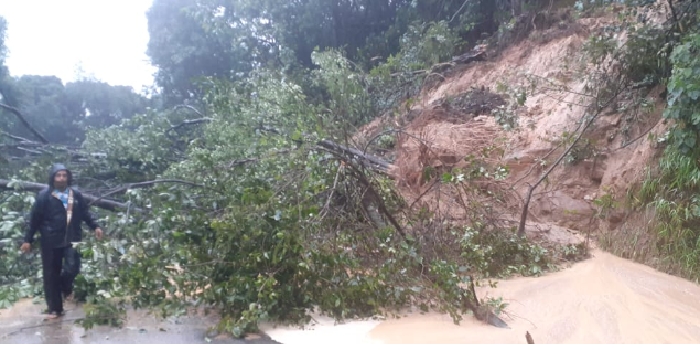
Mangaluru, Aug 7: Following the incessant rain for last few days and subsequent landslides reported at various places along Charmadi Ghat, the movement of vehicles been banned for two days. 

Charmadi Ghat road connects Dakshina Kannada and Chikkamagaluru districts on National Highway-73. The fresh landslides caused cracks on the road and uprooted many trees. 
Officials have closed Charmadi as well as Kottigehara check posts as a precautionary measure.

Belthangady tahsildar Mahesh J confirmed that multiple landslides have hit Charmadi Ghat road.

"The road has been closed for vehicular movement as the officials are at the spot to clear landslide debris. As a precautionary measure, vehicular movement has been banned as there are chances of further landslides," he said.

Hundreds of commuters who were stuck on various stretches of the ghat following a landslide between Maleyamaruta and Alekan falls in Chikkamagaluru district have been rescued.

Comments

Add new comment

  • Coastaldigest.com reserves the right to delete or block any comments.
  • Coastaldigset.com is not responsible for its readers’ comments.
  • Comments that are abusive, incendiary or irrelevant are strictly prohibited.
  • Please use a genuine email ID and provide your name to avoid reject.
Agencies
May 8,2020

Washington D.C., May 8: The prime time for brain development in a child's life is the first year, where the infant spends most of the time asleep. It is the time when neural connections form and sensory memories are encoded.

However, when sleep is disrupted, as occurs more often among children with autism, brain development may be affected, too.

New research led by the University of Washington finds that sleep problems in a baby's first 12 months may not only precede an autism diagnosis but also may be associated with altered growth trajectory in a key part of the brain, the hippocampus.

The study, which was published in the American Journal of Psychiatry, researchers report that in a sample of more than 400 taken of 6- to 12-month-old infants, those who were later diagnosed with autism were more likely to have had difficulty falling asleep.

It also states that this sleep difficulty was associated with altered growth trajectories in the hippocampus.

"The hippocampus is critical for learning and memory, and changes in the size of the hippocampus have been associated with poor sleep in adults and older children.

As many as 80 per cent of the children with autism spectrum disorder have sleep problems," said Annette Estes, director of the UW Autism Center and senior author of the study.

"In our clinical experience, parents have a lot of concerns about their children's sleep, and in our work on early autism intervention, we observed that sleep problems were holding children and families back," added Estes, who is also a UW professor of speech and hearing sciences.

"It could be that altered sleep is part-and-parcel of autism for some children. One clue is that behavioural interventions to improve sleep don't work for all children with autism, even when their parents are doing everything just right. This suggests that there may be a biological component to sleep problems for some children with autism," said Estes.

To consider links among sleep, brain development, and autism, researchers at the IBIS Network looked at MRI scans of 432 infants, surveyed parents about sleep patterns, and measured cognitive functioning using a standardized assessment.

At the outset of the study, infants were classified according to their risk for developing autism: Those who were at higher risk of developing autism -- about two-thirds of the study sample -- had an older sibling who had already been diagnosed.

Infant siblings of children with autism have a 20 per cent chance of developing autism spectrum disorder -- a much higher risk than children in the general population.

In the current study, 127 of the 432 infants were identified as "low risk" at the time the MRI scans were taken because they had no family history of autism.

They later evaluated all the participants at 24 months of age to determine whether they had developed autism. Of the roughly 300 children originally considered "high familial risk," 71 were diagnosed with autism spectrum disorder at that age.

Problems with sleep were more common among the infants later diagnosed with an autism spectrum disorder, as were larger hippocampi. No other subcortical brain structures were affected, including the amygdala, which is responsible for certain emotions and aspects of memory, or the thalamus, a signal transmitter from the spinal cord to the cerebral cortex.

The authors note that while parents reported more sleep difficulties among infants who developed autism compared to those who did not, the differences were very subtle and only observed when looking at group averages across hundreds of infants.

Sleep patterns in the first years of life change rapidly as infants transition from sleeping around the clock to a more adult-like sleep/wake cycle. Until further research is completed, Estes said, it is not possible to interpret challenges with sleep as an early sign of increased risk for autism.


Comments

Add new comment

  • Coastaldigest.com reserves the right to delete or block any comments.
  • Coastaldigset.com is not responsible for its readers’ comments.
  • Comments that are abusive, incendiary or irrelevant are strictly prohibited.
  • Please use a genuine email ID and provide your name to avoid reject.
News Network
May 15,2020

Mysuru, May 15: The Temple Town of Nanjangud was till now treated as one unit or a Cluster Containment Zone and was put under complete lock-down as per the containment protocol listed under COVID-19 regulations and Disaster Management Act, 2005.

However on Friday, some of the restrictions have been lifted by Mysuru Deputy Commissioner Abhiram G Sankar who permitted certain activities as no fresh positive cases were reported from the cluster area. The Cluster Containment Zone was declared on March 29 following one employee of Nanjangud-based Jubilant Generics tested positive for the killer Coronavirus. As there were chances of the positive person spreading the disease to other employees of the factory, the cluster rules were enforced. Moreover, there were over 1,000 employees in the Pharma Company and a majority of them lived in and around Nanjangud.

The declaration of Cluster Containment Zone with complete lock-down and quarantining of all the Pharma Company employees proved a success to the District Administration as whoever tested positive – over 73 were later tested positive — had already been quarantined and the dangerous community spread phase was successfully prevented. To a major extent, the Corona virus curve has been flattened. As such, restrictions have been relaxed a bit on Friday.

Comments

Add new comment

  • Coastaldigest.com reserves the right to delete or block any comments.
  • Coastaldigset.com is not responsible for its readers’ comments.
  • Comments that are abusive, incendiary or irrelevant are strictly prohibited.
  • Please use a genuine email ID and provide your name to avoid reject.