


PM Modi dedicates Kochi Metro to the nation

Agencies
June 17, 2017

Thiruvananthapuram, Jun 17: Kerala shifted tracks to a new phase in urban transport infrastructure on Saturday, with Prime Minister Narendra Modi dedicating the first phase of Kochi Metro to the nation.
viewimage

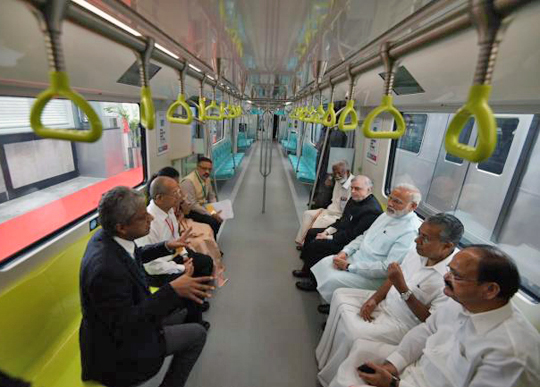
Before the formal opening of the 13.26-km first phase, between Palarivattom and Aluva, the Prime Minister took a ride on one of the trains. Addressing a gathering at the inaugural event’s venue in Kaloor, Modi highlighted features of Kerala’s first metro rail network which made it unique.

Kochi Metro is the first metro project commissioned with Communication-Based Train Controlling Signalling System. The Kochi Metro Rail Limited (KMRL) has provided jobs for about 1,000 women and 23 trans-genders. “The project is also an example of environment-friendly development. It plans to meet nearly 25% of the entire energy requirements from renewable sources, particularly solar energy. The long-term plan is to become a zero-carbon emitting urban transit system,” the Prime Minister said.

Modi said 50 cities in the country were ready to implement metro rail projects and foreign investment had been invited to the urban public transport sector. He said the National Transit Oriented Development Policy, issued in April, aimed to create “compact walkable communities” and bring public transport closer to transit.

Chief Minister Pinarayi Vijayan acknowledged contributions of migrant labourers in the construction of the Metro and requested KMRL to facilitate a Metro ride for them. Lauding the project coordinators for finishing work on the Metro on schedule, the Chief Minister said Kochi Metro sent out a message to potential investors that development projects could be completed in a time-bound manner in Kerala.

He sought assistance from the Centre to further the state-Centre association to pursue the development agenda while acknowledging the Centre’s “positive” approach to development. In a veiled reference to earlier uncertainties over the Prime Minister’s presence at the event, Vijayan said people who created the controversy were left “disappointed”. Kochi Metro will begin commercial operations on Monday.

Insets

On track

** Construction completed in four years
** Total project cost of Rs 5,181.79 crore
** Rs 2032.91 crore released by GoI
** Total 25.612 km, fully elevated, from Aluva to Petta
** 22 stations; 11 in phase 1
** 13.26 km in phase 1, in 20 minutes
** A train every 10 minutes, fares start at Rs 10
** First-in-India open-loop smart card for buses, taxi-cabs, autos
** 25% of energy requirements from renewable sources
** Covered vertical garden on every sixth pillar
** Water Metro as feeder service planned with 38 jetties

Cheers to Metro man

At the inaugural event attended by senior politicians and bureaucrats, the loudest cheers from the 3,000-odd crowd were reserved for ‘Metro Man’ and Chief Adviser for Kochi Metro, E Sreedharan. The applause, every time his name was mentioned on the dais, was significant after an earlier controversy over his exclusion from the dais. The veteran engineer, however, was characteristically self-effacing in his response. “(the cheers were) Probably because I’m a local,” he told reporters.

Fracas over a "free ride"

The presence of BJP state president Kummanam Rajasekharan during the Prime Minister’s inaugural Metro journey has come in for some criticism. Rajasekharan was not in the original list of passengers scheduled to travel with Modi, from Palarivattom to Pathadippalam.

The PM was accompanied by Governor P Sathasivam, Union Urban Development Minister Venkaiah Naidu, Pinarayi Vijayan, Chief Secretary Nalini Netto, Urban Development Secretary Rajiv Gauba, E Sreedharan and KMRL Managing Director Elias George. Rajasekharan’s presence was criticised on social media, also because elected representatives were not invited for the ride.

Comments

Shankar
 - 
Sunday, 18 Jun 2017

BJP is trying really hard to make a mark in Kerala. They are using all the PR tricks known to them.

Add new comment

  • Coastaldigest.com reserves the right to delete or block any comments.
  • Coastaldigset.com is not responsible for its readers’ comments.
  • Comments that are abusive, incendiary or irrelevant are strictly prohibited.
  • Please use a genuine email ID and provide your name to avoid reject.
News Network
May 17,2020

Udupi, May 17: A total of 1,460 migrant labourers left for Uttar Pradesh from Indrali Railway Station in Udupi in Shramik Special train on Sunday.

This is the first train to ferry migrant labourers from Udupi. As many as 236 from Karkala, 323 from Kundapura, 901 labourers from Brahmavar, Kaup and Udupi left for their native villages.

More than 2,000 labourers had gathered at the railway station and only 1,460 labourers received tickets to travel.

Those who did not receive tickets were disappointed and got into heated arguments with the officials.

The labourers were promised that they will receive tickets to another train, that would depart from Udupi before May 20. One bogie of the train was reserved for pregnant women, women and children.

As many as 1,712 from Jharkhand, 770 from Odisha, 977 from West Bengal, 1,600 from Bihar, 379 from Madhya Pradesh, 280 from Chattisgarh, 110 from Uttarkhand, 379 from Rajasthan had registered on Seva Sindhu portal.

Additional Deputy Commissioner B Sadashiva Prabhu said that there are plans to make arrangements to send migrant labourers from UP, Uttaranchal, Madhya Pradesh and Jharkhand.

Comments

Add new comment

  • Coastaldigest.com reserves the right to delete or block any comments.
  • Coastaldigset.com is not responsible for its readers’ comments.
  • Comments that are abusive, incendiary or irrelevant are strictly prohibited.
  • Please use a genuine email ID and provide your name to avoid reject.
News Network
May 13,2020

Mumbai, May 13: Members of the Muslim community helped in performing the last rites of their 72-year-old Hindu neighbour in Sewri area here after the deceased's relatives could not reach for his funeral due to the lockdown.

Pandurang Ubale, who was paralysed since the last few months, died at his residence in Zakaria Bunder area of Sewri on Monday. He had been staying there along with his wife and son since some decades.

After his death on Monday, his relatives staying in suburban Mulund, Belapur in adjoining Navi Mumbai and Alibaug in neighbouring Raigad district could not come over to his place in the wake of the coronavirus-induced lockdown.

As Ubale's wife and son were unable to make all arrangements for the funeral, they informed their neighbours, who came forward to help and even prepared the bier.

A neighbour, Asif Sheikh, who attended the funeral, said, We knew Ubale uncle since a long time. He always participated in our festivals and we used to be a part of their festivities. We all came forward to bid him a farewell and helped in performing his last rites."

Last month also,some Muslim men carried the body of a Hindu neighbour in suburban Bandra on their shoulders to the cremation ground after the deceased's relatives were unable to attend the last rites due to the lockdown.

Comments

Add new comment

  • Coastaldigest.com reserves the right to delete or block any comments.
  • Coastaldigset.com is not responsible for its readers’ comments.
  • Comments that are abusive, incendiary or irrelevant are strictly prohibited.
  • Please use a genuine email ID and provide your name to avoid reject.
Agencies
February 6,2020

Even more than three years after demonetisation and all-out efforts to make most transactions through electronic, cash is still king, as it thrives in a digital India, said fintech start-up Paytm founder Vijay Sekhar Sharma.

"While cashless economy is not possible in India, less cash economy will be in the future. Less cash is the only solution, not the elimination of cash," Sharma told IANS in an interview after unveiling an all-in-one payment gateway on Tuesday.

Asserting that it would take 5-10 years for India to make the transition to digital payments from the traditional mode of cash, Sharma, 41, said the e-payment industry benefitted more from the November 8, 2016 note ban and withdrawal of old Rs 1,000 and Rs 500 denominations.

"I think it (demonetisation) helped the industry despite lack of specific help. But the world has changed since then. It is about the scale of distribution of merchants that is what is propelling digital payments," said Sharma.

Most of the cash not only came back into circulation, but also remains as the mode of payment for the majority due to its convenience for the people used to such transactions.

Expounding Paytm's zero service charge, Sharma said the strategy is sustainable as it leads to acquiring more customers and merchants, enabling newer business opportunities.

Paytm also does not levy a service charge to small merchants for its payments services, unlike organised players like Uber.

"Though there is a monetisation model, the merchants who are small shopkeepers, become our financial services customers as they open a bank account, which is profitable."

Paytm secured a Payments Bank license from the Reserve Bank of India to offer a savings bank account, Rupay debit card and money transfer services.

"We are banking on payment services acquiring customers and merchants who avail banking, lending, insurance, wealth and software services like billing software and business ledger software services eventually," Sharma noted.

The mobile first bank services include zero balance and zero digital transaction charge accounts.

"Basically, payments, cloud, commerce and financial services are a cohort we follow. So, payments is our customer as well as merchant acquisition. If it breaks even, we are happy because other line items make more money, he affirmed.

Noting that in a market like India, one cannot price services at a premium unlike in a developed country like the US, the billionaire businessman said a consumer in a developing country would not be able to afford such a hefty charge.

Forbes ranked Sharma as India's youngest billionaire in 2017, with a net worth of $2.1 billion.

While several countries operate on the model of higher service charges, Sharma said newer business models have to be discovered in India, as customer lifecycle value is accounted for more stages than in other nations.

Asked about an upscale retailer like Zara not giving a wallet payment option during its recent end of season sale in Bengaluru, Sharma said Paytm was addressing such hiccups with its all-in-one payment solutions.

"It's an opportunity, because if the retailer has our all-in-one point of sale machine, where in they enter the amount, it shows both the Quick Response code (QR) and card payment options," he observed.

Sharma compared older swiping payment machine to feature phones and modern ones to feature-rich smartphones.

"If you notice, they look like feature phones and the modern day card machine is more a smartphone like. You can add the smatphone components, which can add the features," reiterated Sharma.

Though Paytm's all-in-one QR point of sale machine integrates the billing system, its chief executive said it was not ideal to have an independent QR feature.

Paytm has 16 million strong merchant user base, which Sharma aims to raise to 26 million base in the next one year.

Sharma has launched in this tech city an all-in-one payment gateway and Paytm Business Payments solution, which enable digital payments through multiple methods for small and medium enterprises (SMEs) and an Android point of sale machine.

With the new gateway solution, collecting digital payments through multiple methods can be achieved seamlessly while Paytm Business Payments solution enables automated vendor payments, including employee salaries and customer refunds among others.

The One97 Communications-owned Paytm aims to help SMEs streamline and digitise their business activities using its new solutions, which enhance the overall efficiency of both accepting and making payments.

Paytm has a data bank of over 200 million saved cards and bank accounts, a feature which enables partner apps to shorten transaction times and propel faster conversions while using the all-in-one payment gateway.

Complementing the two solutions, Sharma also launched an all-in-one Android point of sale machine, which can accept payments through all forms such as cards, wallets, UPI apps and even cash.

The device has a QR code that supports all contact and contactless payments, coming with integrated billing software customized solutions for different sectors such as catering, ticketing, parking and others.

The handheld Android device is equipped with an in-built printer, scanner and can also generate bills.

Valued at $16 billion, Paytm is not alone in the fiercely competitive Indian fintech space where a dozen players like PhonePe, MobiKwik, Kotak 811 and deep pocketed international giants Google Pay and Amazon Pay are in the fray.

Comments

Add new comment

  • Coastaldigest.com reserves the right to delete or block any comments.
  • Coastaldigset.com is not responsible for its readers’ comments.
  • Comments that are abusive, incendiary or irrelevant are strictly prohibited.
  • Please use a genuine email ID and provide your name to avoid reject.