


PM Modi dedicates Kochi Metro to the nation

Agencies
June 17, 2017

Thiruvananthapuram, Jun 17: Kerala shifted tracks to a new phase in urban transport infrastructure on Saturday, with Prime Minister Narendra Modi dedicating the first phase of Kochi Metro to the nation.
viewimage

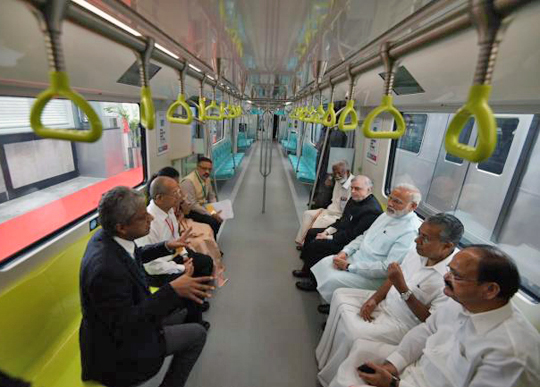
Before the formal opening of the 13.26-km first phase, between Palarivattom and Aluva, the Prime Minister took a ride on one of the trains. Addressing a gathering at the inaugural event’s venue in Kaloor, Modi highlighted features of Kerala’s first metro rail network which made it unique.

Kochi Metro is the first metro project commissioned with Communication-Based Train Controlling Signalling System. The Kochi Metro Rail Limited (KMRL) has provided jobs for about 1,000 women and 23 trans-genders. “The project is also an example of environment-friendly development. It plans to meet nearly 25% of the entire energy requirements from renewable sources, particularly solar energy. The long-term plan is to become a zero-carbon emitting urban transit system,” the Prime Minister said.

Modi said 50 cities in the country were ready to implement metro rail projects and foreign investment had been invited to the urban public transport sector. He said the National Transit Oriented Development Policy, issued in April, aimed to create “compact walkable communities” and bring public transport closer to transit.

Chief Minister Pinarayi Vijayan acknowledged contributions of migrant labourers in the construction of the Metro and requested KMRL to facilitate a Metro ride for them. Lauding the project coordinators for finishing work on the Metro on schedule, the Chief Minister said Kochi Metro sent out a message to potential investors that development projects could be completed in a time-bound manner in Kerala.

He sought assistance from the Centre to further the state-Centre association to pursue the development agenda while acknowledging the Centre’s “positive” approach to development. In a veiled reference to earlier uncertainties over the Prime Minister’s presence at the event, Vijayan said people who created the controversy were left “disappointed”. Kochi Metro will begin commercial operations on Monday.

Insets

On track

** Construction completed in four years
** Total project cost of Rs 5,181.79 crore
** Rs 2032.91 crore released by GoI
** Total 25.612 km, fully elevated, from Aluva to Petta
** 22 stations; 11 in phase 1
** 13.26 km in phase 1, in 20 minutes
** A train every 10 minutes, fares start at Rs 10
** First-in-India open-loop smart card for buses, taxi-cabs, autos
** 25% of energy requirements from renewable sources
** Covered vertical garden on every sixth pillar
** Water Metro as feeder service planned with 38 jetties

Cheers to Metro man

At the inaugural event attended by senior politicians and bureaucrats, the loudest cheers from the 3,000-odd crowd were reserved for ‘Metro Man’ and Chief Adviser for Kochi Metro, E Sreedharan. The applause, every time his name was mentioned on the dais, was significant after an earlier controversy over his exclusion from the dais. The veteran engineer, however, was characteristically self-effacing in his response. “(the cheers were) Probably because I’m a local,” he told reporters.

Fracas over a "free ride"

The presence of BJP state president Kummanam Rajasekharan during the Prime Minister’s inaugural Metro journey has come in for some criticism. Rajasekharan was not in the original list of passengers scheduled to travel with Modi, from Palarivattom to Pathadippalam.

The PM was accompanied by Governor P Sathasivam, Union Urban Development Minister Venkaiah Naidu, Pinarayi Vijayan, Chief Secretary Nalini Netto, Urban Development Secretary Rajiv Gauba, E Sreedharan and KMRL Managing Director Elias George. Rajasekharan’s presence was criticised on social media, also because elected representatives were not invited for the ride.

Comments

Shankar
 - 
Sunday, 18 Jun 2017

BJP is trying really hard to make a mark in Kerala. They are using all the PR tricks known to them.

Add new comment

  • Coastaldigest.com reserves the right to delete or block any comments.
  • Coastaldigset.com is not responsible for its readers’ comments.
  • Comments that are abusive, incendiary or irrelevant are strictly prohibited.
  • Please use a genuine email ID and provide your name to avoid reject.
Agencies
February 6,2020

Even more than three years after demonetisation and all-out efforts to make most transactions through electronic, cash is still king, as it thrives in a digital India, said fintech start-up Paytm founder Vijay Sekhar Sharma.

"While cashless economy is not possible in India, less cash economy will be in the future. Less cash is the only solution, not the elimination of cash," Sharma told IANS in an interview after unveiling an all-in-one payment gateway on Tuesday.

Asserting that it would take 5-10 years for India to make the transition to digital payments from the traditional mode of cash, Sharma, 41, said the e-payment industry benefitted more from the November 8, 2016 note ban and withdrawal of old Rs 1,000 and Rs 500 denominations.

"I think it (demonetisation) helped the industry despite lack of specific help. But the world has changed since then. It is about the scale of distribution of merchants that is what is propelling digital payments," said Sharma.

Most of the cash not only came back into circulation, but also remains as the mode of payment for the majority due to its convenience for the people used to such transactions.

Expounding Paytm's zero service charge, Sharma said the strategy is sustainable as it leads to acquiring more customers and merchants, enabling newer business opportunities.

Paytm also does not levy a service charge to small merchants for its payments services, unlike organised players like Uber.

"Though there is a monetisation model, the merchants who are small shopkeepers, become our financial services customers as they open a bank account, which is profitable."

Paytm secured a Payments Bank license from the Reserve Bank of India to offer a savings bank account, Rupay debit card and money transfer services.

"We are banking on payment services acquiring customers and merchants who avail banking, lending, insurance, wealth and software services like billing software and business ledger software services eventually," Sharma noted.

The mobile first bank services include zero balance and zero digital transaction charge accounts.

"Basically, payments, cloud, commerce and financial services are a cohort we follow. So, payments is our customer as well as merchant acquisition. If it breaks even, we are happy because other line items make more money, he affirmed.

Noting that in a market like India, one cannot price services at a premium unlike in a developed country like the US, the billionaire businessman said a consumer in a developing country would not be able to afford such a hefty charge.

Forbes ranked Sharma as India's youngest billionaire in 2017, with a net worth of $2.1 billion.

While several countries operate on the model of higher service charges, Sharma said newer business models have to be discovered in India, as customer lifecycle value is accounted for more stages than in other nations.

Asked about an upscale retailer like Zara not giving a wallet payment option during its recent end of season sale in Bengaluru, Sharma said Paytm was addressing such hiccups with its all-in-one payment solutions.

"It's an opportunity, because if the retailer has our all-in-one point of sale machine, where in they enter the amount, it shows both the Quick Response code (QR) and card payment options," he observed.

Sharma compared older swiping payment machine to feature phones and modern ones to feature-rich smartphones.

"If you notice, they look like feature phones and the modern day card machine is more a smartphone like. You can add the smatphone components, which can add the features," reiterated Sharma.

Though Paytm's all-in-one QR point of sale machine integrates the billing system, its chief executive said it was not ideal to have an independent QR feature.

Paytm has 16 million strong merchant user base, which Sharma aims to raise to 26 million base in the next one year.

Sharma has launched in this tech city an all-in-one payment gateway and Paytm Business Payments solution, which enable digital payments through multiple methods for small and medium enterprises (SMEs) and an Android point of sale machine.

With the new gateway solution, collecting digital payments through multiple methods can be achieved seamlessly while Paytm Business Payments solution enables automated vendor payments, including employee salaries and customer refunds among others.

The One97 Communications-owned Paytm aims to help SMEs streamline and digitise their business activities using its new solutions, which enhance the overall efficiency of both accepting and making payments.

Paytm has a data bank of over 200 million saved cards and bank accounts, a feature which enables partner apps to shorten transaction times and propel faster conversions while using the all-in-one payment gateway.

Complementing the two solutions, Sharma also launched an all-in-one Android point of sale machine, which can accept payments through all forms such as cards, wallets, UPI apps and even cash.

The device has a QR code that supports all contact and contactless payments, coming with integrated billing software customized solutions for different sectors such as catering, ticketing, parking and others.

The handheld Android device is equipped with an in-built printer, scanner and can also generate bills.

Valued at $16 billion, Paytm is not alone in the fiercely competitive Indian fintech space where a dozen players like PhonePe, MobiKwik, Kotak 811 and deep pocketed international giants Google Pay and Amazon Pay are in the fray.

Comments

Add new comment

  • Coastaldigest.com reserves the right to delete or block any comments.
  • Coastaldigset.com is not responsible for its readers’ comments.
  • Comments that are abusive, incendiary or irrelevant are strictly prohibited.
  • Please use a genuine email ID and provide your name to avoid reject.
News Network
February 6,2020

Panaji, Feb 6: Goa Chief Minister Pramod Sawant on Wednesday told the Legislative Assembly that neighbouring Karnataka has diverted the Mahadayi river water, due to which its flow in the state has taken a hit.

He was speaking during a debate on the motion of thanks to Governor Satya Pal Malik for his address.

Goa and Karnataka are locked in a dispute over sharing of the Mahadayi river water. Goa is strongly opposing the Kalasa Banduri project proposed to be built by Karnataka on the river, which is aimed at providing drinking water to three north Karnataka districts by diverting the Mahadayi water into the Malaprabha river.

Speaking in the House, Sawant said that the flow of Mahadayi river has reduced due to the diversion of water by Karnataka.

"I am admitting that they (Karnataka) have diverted the water. We have brought it to the notice of the Union Ministry of Environment, Forest and Climate Change," he said.

The Goa government has explained to the Centre that the water which flows into the state is "not wasted".

"We have told them that the perennial flow of water is necessary for Goa's wildlife," he said.

Sawant said that his government was serious on the issue of Mahadayi.

"Mahadayi is more than a mother to me. We have not compromised anywhere on the issue. I have been associated with the Mahadayi agitation since 2000," the chief minister said.

He said the issue would be fought before the Supreme Court, where special leave petition has been filed by the state.

Comments

Add new comment

  • Coastaldigest.com reserves the right to delete or block any comments.
  • Coastaldigset.com is not responsible for its readers’ comments.
  • Comments that are abusive, incendiary or irrelevant are strictly prohibited.
  • Please use a genuine email ID and provide your name to avoid reject.
Agencies
April 15,2020

San Diego, Apr 15: Several people lost their sense of smell or taste weeks ago globally and are still waiting for it to come back and now, researchers have identified an association between sensory loss and novel coronavirus 2019 (COVID-19) infection, indicating that loss of smell and taste may be considered as early symptoms of the deadly disease.

Interestingly, the study also found that persons who reported experiencing a sore throat more often tested negative for COVID-19.

The team from University of California-San Diego found high prevalence and unique presentation of certain sensory impairments in patients positive with COVID-19.

Of those who reported a loss of smell and taste, the loss was typically profound, not mild.

"Based on our study, if you have smell and taste loss, you are more than 10 times more likely to have COVID-19 infection than other causes of infection. The most common first sign of a COVID-19 infection remains fever, but fatigue and loss of smell and taste follow as other very common initial symptoms," explained study researcher Carol Yan from UC San Diego.

"We know COVID-19 is an extremely contagious virus. This study supports the need to be aware of smell and taste loss as early signs of COVID-19," Yan added.

For the findings, published in the journal International Forum of Allergy and Rhinology, the research team surveyed 1,480 patients with flu-like symptoms and concerns regarding potential COVID-19 infection who underwent testing at UC San Diego Health from March 3 through March 29, 2020.

Within that total, 102 patients tested positive for the virus and 1,378 tested negatives. The study included responses from 59 COVID-19-positive patients and 203 COVID-19-negative patients.

Encouragingly, the rate of recovery of smell and taste was high and occurred usually within two to four weeks of infection.

"Our study not only showed that the high incidence of smell and taste is specific to COVID-19 infection but we fortunately also found that for the majority of people sensory recovery was generally rapid," said Yan.

"Among the COVID-19 patients with smell loss, more than 70 per cent had reported improvement of smell at the time of the survey and of those who hadn't reported improvement, many had only been diagnosed recently," she added.

Sensory return typically matched the timing of disease recovery.

In an effort to decrease the risk of virus transmission, UC San Diego Health now includes loss of smell and taste as a screening requirement for visitors and staff, as well as a marker for testing patients who may be positive for the virus.

"It is our hope that with these findings other institutions will follow suit and not only list smell and taste loss as a symptom of COVID-19, but use it as a screening measure for the virus across the world," Yan said.

Comments

Add new comment

  • Coastaldigest.com reserves the right to delete or block any comments.
  • Coastaldigset.com is not responsible for its readers’ comments.
  • Comments that are abusive, incendiary or irrelevant are strictly prohibited.
  • Please use a genuine email ID and provide your name to avoid reject.