


PM Modi unveils word's tallest Statue of Unity in honour of Patel, flays 'political prism'

Agencies
October 31, 2018

Kevadiya, Oct 31: Prime Minister Narendra Modi on Wednesday dedicated to the nation the much- awaited 182-metre high Statue of Unity in honour of coutry's first Home Minister Sardar Vallabhbhai Patel.

Mr Modi urged critics not to dismiss his government's efforts to pay tributes to icons like Patel with 'political prism'. 

Paying rich tributes to Sardar Patel, the Prime Minister said the towering statue will serve as a reminder about the courage and firm political commitment of a man who brought in unity among all princely states in 1947 and later and thwarted efforts to disintegrate India.

Built on Sadhu Bet Island on Narmada river, the imposing statue is twice as high as the 93-metre Statue of Liberty in New York and surpasses the China's Spring Temple Buddha by about 29 metres. 

He lashed out at those skeptics and political detractors who try to see his government's efforts to show due respect to great sons of India such as Sardar Vallabhbhai Patel with 'political prism'.

"At times, they give an impression as if by remembering the contributions of great sons of India like Sardar Patel is an offence. Is it an offence?," Mr Modi said. 

The remarks from the Prime Minister came even as critics and a section of citizens on social network and micro blogging site Twitter have tried to suggest that showing tributes to the legacy of Patel was akin to election gimmick.

Three Indian Air Force planes flew past the Patel figure and created the tricolour in the sky on the occasion graced among others by Gujarat Governor O P Kohli, Chief Minister Vijay Rupani, BJP chief Amit Shah, Madhya Pradesh Governor Anandiben Patel and Karnataka Governor Vajubhai Vala.

The grand ceremony coincided with Patel's 143rd birth anniversary. Originally, the concept of such a grand statue was conceptualised by Mr Modi in 2010 during his stint as the Gujarat Chief Minister.

"It is in fitness of things that Sardar Patel's birthday today is being celebrated as Ekta Diwas in the country," Mr Modi said.

He said it goes to the visionary statesmanship of Sardar Patel that the fundamental right is today inherent part of India's democracy.

Approximately 70,000 tonnes of cement in addition to 18,500 tonnes of reinforcement steel and 6000 tonnes of structural steel have been used to build the statue - also billed as an architectural wonder.

"Had Sardar Patel not united the country, we would need visas to see lions in Gujarat or pay homage at Somnath or view the Charminar in Hyderabad," Mr Modi said, lauding the stellar role played by Sardar Patel in integrating the princely states after the partition of 1947.

PM Modi described the Statue of Unity as a symbol of the country's engineering and technical capabilities. He also took part in a 'pooja' on the occasion.

He also recorded appreciation of the erstwhile rulers of the princely states and said their 'sacrifice' and decision to merge with Indian union was no less.

A viewing gallery has been created at a height of 135 metres at the venue to enable tourists to have a view of the dam and nearby mountain ranges.

This Statue will boost tourism and help local tribals get a regular source of income, Mr Modi said.

The world's largest statue is also a symbol of 'New India' as being envisioned by his government, Mr Modi said.

"This statue is recognition of contribution of tribals and farmers who contributed iron pieces and their sincerity for the unique statue," the Prime Minister said.

"When I proposed this Statue on October 31, 2010, I wanted that the man deserves his due place in Indian history," the Prime Minister said. 

"There were skeptics who thought India's diversity will be a weakness. Sardar Patel proved the prophets of doom wrong. During the time of such skepticism, it was Sardar Patel who stood as a symbol of unity," the Prime Minister said.

Sardar Patel had the unique synthesis of 'Kautiyla's diplomacy and Shivaji's bravery', Mr Modi said.

Comments

Anti-modi
 - 
Thursday, 1 Nov 2018

when you vote for a man who always lie then your futur will be in danger, the day will come to india that they will be all poor people and all political people are rich and dont think thast they will develop hindu people, you are the most effected people in india not muslim or cristian.


softman
 - 
Wednesday, 31 Oct 2018

Use this money for poor in the name Sardar Patel.


Foolish decision to spend for statue

Add new comment

  • Coastaldigest.com reserves the right to delete or block any comments.
  • Coastaldigset.com is not responsible for its readers’ comments.
  • Comments that are abusive, incendiary or irrelevant are strictly prohibited.
  • Please use a genuine email ID and provide your name to avoid reject.
coastaldigest.com news network
July 27,2020

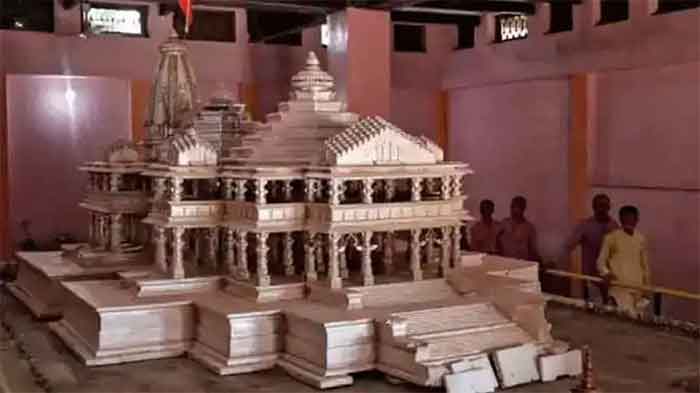
Ayodhya, Jul 27: With days to go for the August 5 "bhoomi pujan" ceremony of the Ram temple in Ayodhya, the mosques adjacent to the demolished Babri Masjid premises are spreading the message of a peaceful coexistence of Hindus and Muslims.

There are eight mosques and two mausoleums located close to the 70-acre Babri Masjid premises mandated by the Supreme Court for a temple of Sri Ram.

Azaan and namaaz are offered in the mosques and the annual "Urs" is held at the mausoleums without any objection from the local Hindus.

The eight mosques located near the upcoming Ram temple premises are Masjid Dorahikuan, Masjid Mali Mandir ke Bagal, Masjid Kaziyana Achchan ke Bagal, Masjid Imambara, Masjid Riyaz ke Bagal, Masjid Badar Paanjitola, Masjid Madaar Shah and Masjid Tehribazar Jogiyon ki.

The two mausoleums are Khanqaahe Muzaffariya and Imambara.

"It is the greatness of Ayodhya that the mosques surrounding the Ram temple are giving a strong message of communal harmony to the rest of the world," Haji Asad Ahmad, the corporator of the Ram Kot ward, said. The Ram temple area is situated in Ahmad's ward.

"Muslims take out the 'juloos' of Barawafaat that goes through the periphery of Ram Janmabhoomi. All religious functions and rituals of Muslims are respected by their fellow citizens," the corporator said.

Asked for a comment on the presence of mosques near the upcoming Ram temple premises, the chief priest of the temple, Acharya Satyendra Das, said, "We had a dispute only with the structure that was connected to the name of (Mughal emperor) Babur. We have never had any issue with the other mosques and mausoleums in Ayodhya. This is a town where Hindus and Muslims live in peace."

"Muslims offer namaaz, we perform our puja. The mosques around us will strengthen Ayodhya's communal harmony and peace will prevail," he added.

Both Hindus and Muslims have accepted the Supreme Court verdict over Ram Janmabhoomi, Das said, adding, "We have no dispute with each other."

Sayyad Akhlaq Ahmad Latifi, the "sajjada nasheen" and "pir" of the 500-year-old Khanqaahe Muzaffariya mausoleum, said Muslims in Ayodhya are performing all religious practices freely.

"We offer prayers five times a day in the mosque at Khanqaah and hold the yearly 'Urs'," he added.

"What a scene would it be -- a grand Ram temple surrounded by small mosques and mausoleums and everyone offering prayers according to their beliefs. That will be representative of the true culture of India," Mahant Yugal Kishore Sharan Shastri, the chief priest of the Sarayu Kunj temple adjacent to the Ram Janmabhoomi premises, said.

Reacting to the presence of mosques and mausoleums near the Ram Janmabhoomi premises, Triloki Nath Pandey, the decree holder of the land as the "first friend of Ram Lalla" as mandated by the Supreme Court, said, "We do not have any objection to either those mosques or any other mosques. We will not trigger a dispute regarding any structure, Ayodhya must live in peace and communal harmony."

Mahant Raju Das, the priest of the Hanumangarhi temple, said, "The presence of the mosques tells the story of Ayodhya's communal harmony. A Ram mandir will be built and there will be no objection to the mosques or religious practices of Muslims."

Comments

Add new comment

  • Coastaldigest.com reserves the right to delete or block any comments.
  • Coastaldigset.com is not responsible for its readers’ comments.
  • Comments that are abusive, incendiary or irrelevant are strictly prohibited.
  • Please use a genuine email ID and provide your name to avoid reject.
News Network
February 4,2020

New Delhi, Feb 4: Leader of Congress in Lok Sabha, Adhir Ranjan Chowdhury, on Tuesday attacked the BJP over Anantkumar Hegde's controversial remark on Mahatma Gandhi and termed the party as "Ravan ke aulad" (children of Ravana). "Aaj ye Mahatma Gandhi ko gaali dete hain. Ye Ravan ke aulad hain. Ram ke pujari ka ye apmaan kar rahe hain (Today, they abuse Mahatma Gandhi. They are children of Ravan. They are insulting Lord Ram's devotee)," Chowdhury said.

Later, BJP lawmakers object to Chowdhury's statement. Hegde, who is a Lok Sabha MP from Uttara Kannada, had on Saturday said that the freedom struggle led by Mahatma Gandhi was a "drama".

"None of these so-called leaders were beaten up by the cops even once. Their independence movement was one big drama. It was staged by these leaders with the approval of the British. It was not a genuine fight. It was an adjustment freedom struggle," Hegde had said while addressing a public event in Bengaluru. While several Congress leaders, including Karti Chidambaram and BK Hariprasad, have condemned Hegde's remark, BJP leaders too have distanced themselves from it.

Top leadership in BJP is unhappy with Anantkumar Hegde over his controversial remark on Mahatma Gandhi, party sources had said on Monday, adding that he has been asked to issue an unconditional apology.

Comments

Add new comment

  • Coastaldigest.com reserves the right to delete or block any comments.
  • Coastaldigset.com is not responsible for its readers’ comments.
  • Comments that are abusive, incendiary or irrelevant are strictly prohibited.
  • Please use a genuine email ID and provide your name to avoid reject.
News Network
January 24,2020

New Delhi, Jan 24: Under attack for doling out subsidies, Delhi Chief Minister Arvind Kejriwal on Friday said freebies in limited dose are good for the economy as they make more money available to the poor and boosts demand.

Opposition parties have been attacking the AAP-led Delhi government for giving "freebies" ahead of polls after it announced schemes like free bus rides for women and 200 units of free electricity.

"Freebies, in limited dose, are good for economy. It makes more money available to poor, hence boosts demand. However, it should be done in such limits so that no extra taxes have to be imposed and it does not lead to budget deficits," Kejriwal said in a tweet.

Slamming the BJP, Kejriwal said he is happy that the people of Delhi have forced the Saffron party to ask for votes on the basis of CCTVs, schools and unauthorised colonies.

Reacting to a tweet of the BJP Delhi in which Home Minister Amit Shah had asked how many schools have been constructed and cameras installed by the AAP government, Kejriwal said he is happy that Shah saw some CCTV cameras as earlier he had claimed that he could not find a single one.

"I am happy you saw some CCTV cameras. A few days back you said there was not a single camera. Take out some time we will show you our schools also. I am extremely happy that the people of Delhi have changed the politics by which the BJP has to ask for votes on CCTV, schools and raw colonies here," he said in a tweet.

Responding to Shah's allegation that he could not find WiFi in Delhi as promised by Kejriwal and that his battery drained out in the process, the Delhi chief minister said along with free WiFi they have also made arrangement for free charging points.

Comments

Add new comment

  • Coastaldigest.com reserves the right to delete or block any comments.
  • Coastaldigset.com is not responsible for its readers’ comments.
  • Comments that are abusive, incendiary or irrelevant are strictly prohibited.
  • Please use a genuine email ID and provide your name to avoid reject.