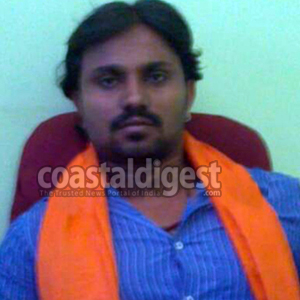
Police arrest prime accused in SDPI activist’s murder

CD Network
June 26, 2017

Mangaluru, Jun 26: Dakshina Kannada district police probing the murder of SDPI activist Mohammed Ashraf Kalai last week, arrested the prime accused Divyaraj Shetty on Monday. With this, the number of persons arrested in connection with the case rise to six. Police had arrested five persons on Saturday.prime

Divyaraj along with another rowdy sheeter Bharat Kumdelu had hatched the murder plot and participated in the brutal killing, SP C H Sudheer Kumar Reddy said.

Stating that efforts are on to nab Bharat, with whom RSS leader Kalladka Prabhakar Bhat shared a dias, the SP said that Divyaraj will be interrogated with the other accused to ascertain their exact roles in the crime. "We are almost through with the interrogation of the other five accused, and will no longer need their custody for time being," he noted.

The jurisdictional court incidentally had remanded the five accused - Pavan Kumar, 24 of Pudu village, Bantwal; Santosh, 23 of Thumbe village; Shivaprasad, 24 of Bollari house, Thumbe; Ranjith, 28, resident of Pudu village and Abhin Rai, 23 of Thenkabellur village - to three days of police custody on Saturday. Police top brass giving out details of the incident had maintained the murder was committed with an intention to create communal unrest in the district.

Except Santosh all the five accused arrested on Saturday have criminal cases against them. Abhin Rai was booked during Tipu Jayanti violence in Bantwal last year and a case was booked against Pavan in 2012 for defiling a religious place in Bantwal to create communal tension. Police said the murder plan was hatched a month ago and it was discussed at various places.

Also Read: 5 ‘Hindutva extremists’ arrested in SDPI activist Ashraf murder case

Comments

s
 - 
Wednesday, 28 Jun 2017

these people have history of creating communal tensions in the district still are left free because they have support from MLA's, MP's and police.

Arshi
 - 
Wednesday, 28 Jun 2017

Police custody is the safest place for them to get high protection knowing the fact that if they are out they will be beheaded soon. Killing innocents have become a trend for these goons.

Fairman
 - 
Wednesday, 28 Jun 2017

If these criminals don't get what they deserve, then the public will teach how to be handled such cases.

Unless equally punish no end.

Add new comment

  • Coastaldigest.com reserves the right to delete or block any comments.
  • Coastaldigset.com is not responsible for its readers’ comments.
  • Comments that are abusive, incendiary or irrelevant are strictly prohibited.
  • Please use a genuine email ID and provide your name to avoid reject.
News Network
June 12,2020

Mangaluru, Jun 12: A pregnant woman who returned from Maharashtra and tested positive for coronavirus on Wednesday, gave birth to a child at the Wenlock COVID-19 hospital in Mangaluru. After she experienced labour pain, a team of expert doctors performed the delivery through the caesarean section on Thursday.

Both the woman and the new born are safe, hospital sources said. The woman, who belongs to Kinnigoli in Dakshina Kannada district, had arrived in the city on Monday. She was in an advanced stage of pregnancy and was taken to another hospital the next day after she complained of weakness.

As she came from Maharashtra, she was shifted to a separate ward at the Wenlock hospital and quarantined. Her throat swab samples tested positive on Wednesday. A COVID-19 test will be done on the baby after a few days, district health officer Ramachandra Bairy said.

Comments

Add new comment

  • Coastaldigest.com reserves the right to delete or block any comments.
  • Coastaldigset.com is not responsible for its readers’ comments.
  • Comments that are abusive, incendiary or irrelevant are strictly prohibited.
  • Please use a genuine email ID and provide your name to avoid reject.
News Network
March 13,2020

Bengaluru, Mar 13: Google said on Friday that an employee at its Bengaluru office has tested positive for the COVID-19 coronavirus and the firm has directed all its employees in that office to work from home today as a precautionary measure.

"We can confirm that an employee from our Bangalore office has been diagnosed with COVID-19. They were in one of our Bangalore offices for a few hours before developing any symptoms. The employee has been on quarantine since then," Google said in a statement.

The firm has asked colleagues who were in close contact with the employee to quarantine themselves and monitor their health.

"Out of an abundance of caution, we are asking employees in that Bangalore office to work from home on Friday. We have taken and will continue to take all necessary precautionary measures, following the advice of public health officials, as we prioritize everyone's health and safety," it added.

The World Health Organisation (WHO) has declared the coronavirus outbreak a pandemic.

Coronavirus, which originated in the Wuhan city of China, has so far spread to more than 100 countries infecting over 1,20,000 people. India has confirmed 73 cases of the lethal infection.

Comments

Add new comment

  • Coastaldigest.com reserves the right to delete or block any comments.
  • Coastaldigset.com is not responsible for its readers’ comments.
  • Comments that are abusive, incendiary or irrelevant are strictly prohibited.
  • Please use a genuine email ID and provide your name to avoid reject.
Agencies
May 8,2020

Washington D.C., May 8: The prime time for brain development in a child's life is the first year, where the infant spends most of the time asleep. It is the time when neural connections form and sensory memories are encoded.

However, when sleep is disrupted, as occurs more often among children with autism, brain development may be affected, too.

New research led by the University of Washington finds that sleep problems in a baby's first 12 months may not only precede an autism diagnosis but also may be associated with altered growth trajectory in a key part of the brain, the hippocampus.

The study, which was published in the American Journal of Psychiatry, researchers report that in a sample of more than 400 taken of 6- to 12-month-old infants, those who were later diagnosed with autism were more likely to have had difficulty falling asleep.

It also states that this sleep difficulty was associated with altered growth trajectories in the hippocampus.

"The hippocampus is critical for learning and memory, and changes in the size of the hippocampus have been associated with poor sleep in adults and older children.

As many as 80 per cent of the children with autism spectrum disorder have sleep problems," said Annette Estes, director of the UW Autism Center and senior author of the study.

"In our clinical experience, parents have a lot of concerns about their children's sleep, and in our work on early autism intervention, we observed that sleep problems were holding children and families back," added Estes, who is also a UW professor of speech and hearing sciences.

"It could be that altered sleep is part-and-parcel of autism for some children. One clue is that behavioural interventions to improve sleep don't work for all children with autism, even when their parents are doing everything just right. This suggests that there may be a biological component to sleep problems for some children with autism," said Estes.

To consider links among sleep, brain development, and autism, researchers at the IBIS Network looked at MRI scans of 432 infants, surveyed parents about sleep patterns, and measured cognitive functioning using a standardized assessment.

At the outset of the study, infants were classified according to their risk for developing autism: Those who were at higher risk of developing autism -- about two-thirds of the study sample -- had an older sibling who had already been diagnosed.

Infant siblings of children with autism have a 20 per cent chance of developing autism spectrum disorder -- a much higher risk than children in the general population.

In the current study, 127 of the 432 infants were identified as "low risk" at the time the MRI scans were taken because they had no family history of autism.

They later evaluated all the participants at 24 months of age to determine whether they had developed autism. Of the roughly 300 children originally considered "high familial risk," 71 were diagnosed with autism spectrum disorder at that age.

Problems with sleep were more common among the infants later diagnosed with an autism spectrum disorder, as were larger hippocampi. No other subcortical brain structures were affected, including the amygdala, which is responsible for certain emotions and aspects of memory, or the thalamus, a signal transmitter from the spinal cord to the cerebral cortex.

The authors note that while parents reported more sleep difficulties among infants who developed autism compared to those who did not, the differences were very subtle and only observed when looking at group averages across hundreds of infants.

Sleep patterns in the first years of life change rapidly as infants transition from sleeping around the clock to a more adult-like sleep/wake cycle. Until further research is completed, Estes said, it is not possible to interpret challenges with sleep as an early sign of increased risk for autism.


Comments

Add new comment

  • Coastaldigest.com reserves the right to delete or block any comments.
  • Coastaldigset.com is not responsible for its readers’ comments.
  • Comments that are abusive, incendiary or irrelevant are strictly prohibited.
  • Please use a genuine email ID and provide your name to avoid reject.