



Police helicopter attacks Supreme Court in Venezuela

Agencies
June 28, 2017

Caracas, Jun 28: A Venezuelan police helicopter strafed the Supreme Court and a government Ministry on June 27, 2017, escalating the OPEC nation's political crisis in what President Nicolas Maduro called an attack by “terrorists” seeking a coup.Police
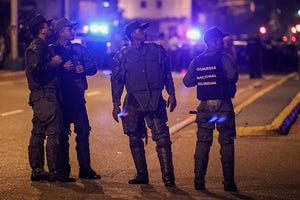
The aircraft fired 15 shots at the Interior Ministry, where scores of people were at a social event, and dropped four grenades on the court, where judges were meeting, officials said. However, there were no reports of injuries.

“Sooner rather than later, we are going to capture the helicopter and those behind this armed terrorist attack against the institutions of the country,” Mr. Maduro said. “They could have caused dozens of deaths,” he said.

The 54-year-old socialist leader has faced three months of protests from opposition leaders who decry him as a dictator who has wrecked a once-prosperous economy. There has been growing dissent too from within government and the security forces. At least 75 people have died, and hundreds more been injured and arrested, in the anti-government unrest since April 2017.

Demonstrators are demanding general elections, measures to alleviate a brutal economic crisis, freedom for hundreds of jailed opposition activists, and independence for the opposition-controlled National Assembly legislature. Mr. Maduro says they are seeking a coup against him with the encouragement of a U.S. government eager to gain control of Venezuela's oil reserves, the largest in the world.

Venezuela's government said in a communique the helicopter was stolen by an investigative police pilot called Oscar Perez, who declared himself in rebellion against Mr. Maduro. A video posted on Mr. Perez’s Instagram account around the same time showed him standing in front of several hooded armed men, saying an operation was underway to restore democracy. Mr. Perez said in the video he represented a coalition of military, police and civilian officials opposed to the "criminal” government, urged Mr. Maduro's resignation and called for general elections. “This fight is... against the vile government. Against tyranny,” he said.

Witnesses reported hearing several detonations in downtown Caracas, where the pro-Maduro Supreme Court, the presidential palace and other key government buildings are located. Opponents to Mr. Maduro view the Interior Ministry as a bastion of repression and also hate the Supreme Court for its string of rulings bolstering the president's power and undermining the opposition-controlled legislature.

Vote controversy

Mr. Maduro, who replaced Hugo Chavez in 2013, is pushing a July 30, 2017 vote for a special super-body called a Constituent Assembly, which could rewrite the national charter and supersede other institutions such as the opposition-controlled congress.

He has touted the assembly as the only way to bring peace to Venezuela. But opponents, who want to bring forward the next presidential election scheduled for late 2018, say it is a sham poll designed purely to keep the socialists in power.

They are boycotting the vote, and protesting daily on the streets to try and have it stopped. Opposition leaders call Mr. Maduro a tyrant who has wrecked a once-prosperous economy, while he calls them violent coup leaders following U.S. orders.

Mr. Maduro, who accuses Washington of seeking to control the nation's oil wealth, said the “destruction” of Venezuela would lead to a huge refugee wave dwarfing the Mediterranean crisis.

“Listen, President Donald Trump,” he said earlier on June 27, 2017. “You would have to build 20 walls in the sea, a wall from Mississippi to Florida, from Florida to New York, it would be crazy... You have the responsibility: stop the madness of the violent Venezuelan right wing.”

Opposition to the July 30, 2017 vote has come not just from Venezuelan opposition parties, but also from the chief state prosecutor Luisa Ortega and one-time government heavyweights like former intelligence service boss Miguel Rodriguez.

At a news conference on June 27, 2017, Mr. Rodriguez criticised Mr. Maduro for not holding a referendum prior to the Constituent Assembly election, as his predecessor Chavez had done in 1999. “This is a country without government, this is chaos,” he said. “The people are left out... They (the government) are seeking solutions outside the constitution... That deepens the crisis.”

Mr. Maduro said an ex-pilot of Mr. Rodriguez was involved in the June 27, 2017 helicopter attack.

Comments

Add new comment

  • Coastaldigest.com reserves the right to delete or block any comments.
  • Coastaldigset.com is not responsible for its readers’ comments.
  • Comments that are abusive, incendiary or irrelevant are strictly prohibited.
  • Please use a genuine email ID and provide your name to avoid reject.
News Network
March 19,2020

Rome, Mar 19: Italy on Wednesday reported 475 new deaths from the novel coronavirus, the highest one-day official toll of any nation since the first case was detected in China late last year.

The total number of deaths in Italy has reached 2,978, more than half of all the cases recorded outside China, while the number of infections stood at 35,713.

The previous record high of 368 deaths was also recorded in Italy, on Sunday. The nation of 60 million has now recorded 34.2 percent of all the deaths officially attributed to COVID-19 across the world.

With the death rate still climbing despite the Mediterranean country entering a second week under an effective lockdown, officials urged Italians to have faith and to stay strong.

"They main thing is, do not give up," Italian National Institute of Health chief Silvio Brusaferro said in a nationally televised press conference.

"It will take a few days before we see the benefits" of containment measures, said Brusaferro. "We must maintain these measures to see their effect, and above all to protect the most vulnerable."

Imposed nationally on March 12, the shutdown of most Italian businesses and a ban on public gatherings are due to expire on March 25.

But school closures and other measures, such as a ban fan attendance at sporting events, are due to run on until April 3.

A top government minister hinted Wednesday that the school closure would be extended well into next month, if not longer.

The rates within Italy itself remained stable, with two-thirds of the deaths -- 1,959 in all -- reported in the northern Lombardy region around Milan, the Italian financial and fashion capital.

Comments

Add new comment

  • Coastaldigest.com reserves the right to delete or block any comments.
  • Coastaldigset.com is not responsible for its readers’ comments.
  • Comments that are abusive, incendiary or irrelevant are strictly prohibited.
  • Please use a genuine email ID and provide your name to avoid reject.
Agencies
July 2,2020

Moscow, Jul 2: Russian voters approved changes to the constitution that will allow President Vladimir Putin to hold power until 2036, but the weeklong plebiscite that concluded Wednesday was tarnished by widespread reports of pressure on voters and other irregularities.

With most of the nation's polls closed and 20% of precincts counted, 72% voted for the constitutional amendments, according to election officials.

For the first time in Russia, polls were kept open for a week to bolster turnout without increasing crowds casting ballots amid the coronavirus pandemic a provision that Kremlin critics denounced as an extra tool to manipulate the outcome.

A massive propaganda campaign and the opposition's failure to mount a coordinated challenge helped Putin get the result he wanted, but the plebiscite could end up eroding his position because of the unconventional methods used to boost participation and the dubious legal basis for the balloting.

By the time polls closed in Moscow and most other parts of Western Russia, the overall turnout was at 65%, according to election officials. In some regions, almost 90% of eligible voters cast ballots.

On Russia's easternmost Chukchi Peninsula, nine hours ahead of Moscow, officials quickly announced full preliminary results showing 80% of voters supported the amendments, and in other parts of the Far East, they said over 70% of voters backed the changes.

Kremlin critics and independent election observers questioned the turnout figures.

We look at neighboring regions, and anomalies are obvious there are regions where the turnout is artificially (boosted), there are regions where it is more or less real, Grigory Melkonyants, co-chair of the independent election monitoring group Golos, told The Associated Press.

Putin voted at a Moscow polling station, dutifully showing his passport to the election worker. His face was uncovered, unlike most of the other voters who were offered free masks at the entrance.

The vote completes a convoluted saga that began in January, when Putin first proposed the constitutional changes.

He offered to broaden the powers of parliament and redistribute authority among the branches of government, stoking speculation he might seek to become parliamentary speaker or chairman of the State Council when his presidential term ends in 2024.

His intentions became clear only hours before a vote in parliament, when legislator Valentina Tereshkova, a Soviet-era cosmonaut who was the first woman in space in 1963, proposed letting him run two more times.

The amendments, which also emphasize the primacy of Russian law over international norms, outlaw same-sex marriages and mention a belief in God as a core value, were quickly passed by the Kremlin-controlled legislature.

Putin, who has been in power for more than two decades longer than any other Kremlin leader since Soviet dictator Josef Stalin said he would decide later whether to run again in 2024.

He argued that resetting the term count was necessary to keep his lieutenants focused on their work instead of darting their eyes in search for possible successors.

Analyst Gleb Pavlovsky, a former Kremlin political consultant, said Putin's push to hold the vote despite the fact that Russia has thousands of new coronavirus infections each day reflected his potential vulnerabilities.

Putin lacks confidence in his inner circle and he's worried about the future, Pavlovsky said.

He wants an irrefutable proof of public support.

Even though the parliament's approval was enough to make it law, the 67-year-old Russian president put his constitutional plan to voters to showcase his broad support and add a democratic veneer to the changes.

But then the coronavirus pandemic engulfed Russia, forcing him to postpone the April 22 plebiscite.

The delay made Putin's campaign blitz lose momentum and left his constitutional reform plan hanging as the damage from the virus mounted and public discontent grew.

Plummeting incomes and rising unemployment during the outbreak have dented his approval ratings, which sank to 59%, the lowest level since he came to power, according to the Levada Center, Russia's top independent pollster.

Moscow-based political analyst Ekaterina Schulmann said the Kremlin had faced a difficult dilemma: Holding the vote sooner would have brought accusations of jeopardizing public health for political ends, while delaying it raised the risks of defeat.

Holding it in the autumn would have been too risky, she said.

In Moscow, several activists briefly lay on Red Square, forming the number 2036 with their bodies in protest before police stopped them.

Some others in Moscow and St. Petersburg staged one-person pickets and police didn't intervene.

Several hundred opposition supporters rallied in central Moscow to protest the changes, defying a ban on public gatherings imposed for the coronavirus outbreak. Police didn't intervene and even handed masks to the participants.

Authorities mounted a sweeping effort to persuade teachers, doctors, workers at public sector enterprises and others who are paid by the state to cast ballots. Reports surfaced from across the vast country of managers coercing people to vote.

The Kremlin has used other tactics to boost turnout and support for the amendments.

Comments

Add new comment

  • Coastaldigest.com reserves the right to delete or block any comments.
  • Coastaldigset.com is not responsible for its readers’ comments.
  • Comments that are abusive, incendiary or irrelevant are strictly prohibited.
  • Please use a genuine email ID and provide your name to avoid reject.
Agencies
July 15,2020

Huawei will be completely removed from the UK's 5G networks by the end of 2027, the UK government announced on Tuesday after a review by the country's National Cyber Security Centre (NCSC) on the impact of US sanctions against the Chinese telecommunications giant.

In the lead up to this complete removal of all Huawei kit from UK networks, there will be a total ban on the purchase of any new 5G kit after December 31, 2020.

The decision was taken at a meeting of the UK's National Security Council (NSC) chaired by Prime Minister Boris Johnson, in response to new US sanctions against the telecom major imposed in May which removed the firm's access to products which have been built based on US semiconductor technology.

5G will be transformative for our country, but only if we have confidence in the security and resilience of the infrastructure it is built upon, said Oliver Dowden, UK Secretary of State for Digital, Culture, Media and Sport (DCMS).

Following US sanctions against Huawei and updated technical advice from our cyber experts, the government has decided it necessary to ban Huawei from our 5G networks. No new kit is to be added from January 2021, and UK 5G networks will be Huawei free by the end of 2027. This decisive move provides the industry with the clarity and certainty it needs to get on with delivering 5G across the UK, he said.

The minister, who laid out the details of the UK's ban on Huawei in the House of Commons, said the government will now seek to legislate with a new Telecoms Security Bill to put in place the powers necessary to implement the tough new telecoms security framework.

By the time of the next election (2024) we will have implemented in law an irreversible path for the complete removal of Huawei equipment from our 5G networks, said Dowden.

The new law will give the government the national security powers to impose these new controls on high risk vendors and create extensive security duties on network operators to drive up standards, DCMS said.

Technical experts at the NCSC reviewed the consequences of the US sanctions and concluded that Huawei will need to do a major reconfiguration of its supply chain as it will no longer have access to the technology on which it currently relies and there are no alternatives which we have sufficient confidence in.

They found the new restrictions make it impossible to continue to guarantee the security of Huawei equipment in the future.

After a ban on the purchase of new Huawei kit for 5G from next year, the aim is to completely remove the Chinese vendor's influence on 5G networks across the UK by the end of 2027.

The DCMS said Tuesday's decision takes into account the UK's specific national circumstances and how the risks from these sanctions are manifested in the country.

The existing restrictions on Huawei in sensitive and critical parts of the network remain in place, it highlighted.

The DCMS said the US action also affects Huawei products used in the UK's full fibre broadband networks. However, the UK has managed Huawei's presence in the UK's fixed access networks since 2005 and we also need to avoid a situation where broadband operators are reliant on a single supplier for their equipment.

As a result, following security advice from experts, DCMS is advising full fibre operators to transition away from purchasing new Huawei equipment. A technical consultation will determine the transition timetable, but it is expect this period to last no longer than two years.

The government said its new approach strikes the right balance by recognising full fibre's established presence and supporting the connections that the public relies on, while fully addressing the security concerns.

It stressed that its new policy in relation to high risk vendors has not been designed around one company, one country or one threat but as an enduring and flexible policy that will enable the UK to manage the risks to the network, now and in the future.

Comments

Add new comment

  • Coastaldigest.com reserves the right to delete or block any comments.
  • Coastaldigset.com is not responsible for its readers’ comments.
  • Comments that are abusive, incendiary or irrelevant are strictly prohibited.
  • Please use a genuine email ID and provide your name to avoid reject.