Police to import sophisticated weapons to fight terrorism

January 20, 2015

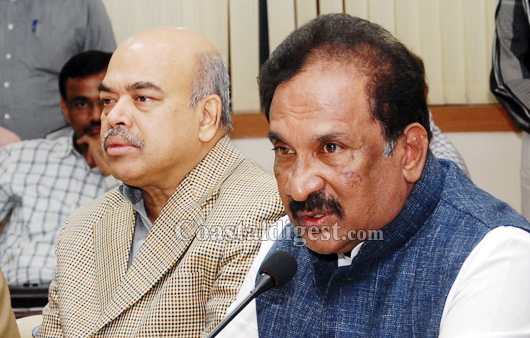
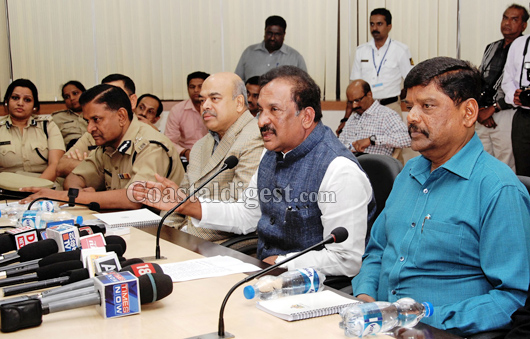
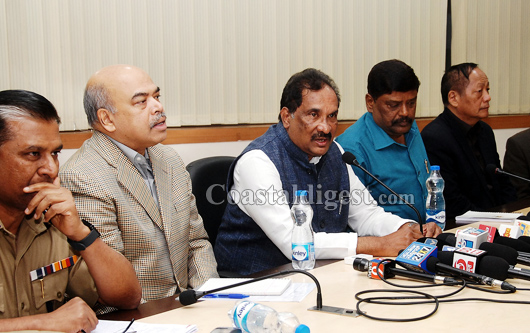
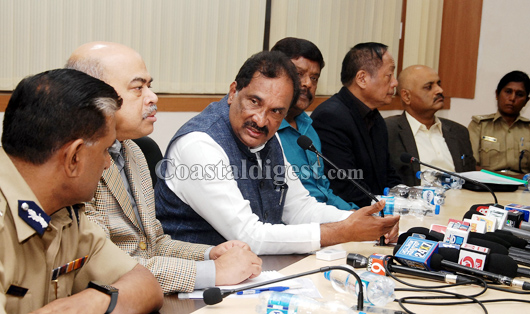
Bengaluru, Jan 20: The State government will spend Rs six crore to import sophisticated weapons for the police, Home Minister K J?George said here on Monday.

kj george 1

“The government has realised the fact that police personnel are using traditional weapons that are not suitable to fight in a terror-like situation.?Hence, we have decided to procure modern weapons from abroad. The Cabinet recently approved a Rs six-crore project in this regard,” he told a press conference.

The Home Minister said the government had decided to go out of the way and recruit professionals for technical wings such as cyber crime cell and Forensic Science Laboratory (FSL) to speed up the investigation of various cases. Terrorists are increasingly using various technological means to execute their attacks.?Hence, the government is contemplating to appoint experts in cyber cell and FSL, he said.

Referring to the upcoming Republic Day celebrations, he said the government had ensured massive security arrangements across the State especially in Bengaluru and requested the public to contact the Commissioners of Police, DG&IGP and SPs if they come across any suspicious objects or movements of people.

He said the police followed required legal procedure in arresting four suspected ultras recently and added the government would not deny any assistance to the suspects’ family members. To a question he said the police were yet to achieve a breakthrough in the Church Street blast case.

DG&IGP?L?R?Pachuau and Additional Chief Secretary (Home) S?K?Pattanayak were present on the occasion.

kj george 1

kj george 1

kj george 1

Comments

Add new comment

  • Coastaldigest.com reserves the right to delete or block any comments.
  • Coastaldigset.com is not responsible for its readers’ comments.
  • Comments that are abusive, incendiary or irrelevant are strictly prohibited.
  • Please use a genuine email ID and provide your name to avoid reject.
News Network
February 5,2020

Bengaluru, Feb 5: Despite installing a BJP government in Karnataka through disguised operation Kamala, the Prime Minister Narendra Modi-led union government has continued its step motherly attitude towards this south Indian state.

Under the new formula adopted to share central taxes among states Karnataka will be the worst-affected. Though the 15th Finance Commission has recommended a special grant of Rs 5,495 crore for the state for 2020-21, the Centre appears reluctant to pay up and instead has asked for the proposal to be reviewed.

During the Union budget, the report of the 14th Finance Commission headed by NK Singh for 2020-21 was tabled in Lok Sabha. It shows besides Karnataka, Telangana, Mizoram and Kerala saw their central tax share decrease, while Uttar Pradesh, Bihar and Maharashtra were top gainers.

Karnataka's share has decreased from 4.7% provided by the previous finance commission, to 3.6%. Acknowledging there is a steep decline in Karnataka's share from 2019-20, the finance commission has recommended a special grant of Rs 5,495 crore for the state.

Its share in 2019-20 was Rs 36,675 crore, but under the new formula, Karnataka will get only Rs 31,180 crore in 2020-21 from the divisible pool of Rs 8.5 lakh crore - a decline of 22.5%.

Also, the decrease for Karnataka comes on the back of a shortfall in 2019-20. While the state was entitled to Rs 39,806 crore from the divisible pool, it got only Rs 36,675 crore as the Centre suffered a tax revenue shortfall of Rs 1.5 lakh crore.

What is more disheartening though is the Centre's refusal to pay the special grant. Instead, the Union finance ministry has asked the finance commission to reconsider the recommendation. This has prompted the state to take up the issue with the Centre.

"The decline in central taxes devolution comes at a time when the state is going through a tough financial situation. Steps are being taken to ensure Karnataka gets justice," said chief secretary TM Vijay Bhaskar.

Officials said besides corrective measures for 2020-21, the focus will be on ensuring a fair share in subsequent years. However, Karnataka has little chance of getting its dues as the Centre is known to be prudent when distributing tax proceeds among states.

"The Centre has certain views on devolution. We have done our duty by submitting the interim report. It's up to the states to convince the Centre," said Ravi Kota, joint secretary of 15th Finance Commission.

Under the new formula, the commission changed the weightage for some of the six criteria it considers - population, area, forest cover, income distance, demographic performance and tax effort.

Comments

Add new comment

  • Coastaldigest.com reserves the right to delete or block any comments.
  • Coastaldigset.com is not responsible for its readers’ comments.
  • Comments that are abusive, incendiary or irrelevant are strictly prohibited.
  • Please use a genuine email ID and provide your name to avoid reject.
coastaldigest.com news network
May 25,2020

Bengaluru, May 25: Heavy rain accompanied by strong winds that lashed Bengaluru last evening left hundreds of trees uprooted near the BTM layout and other areas.

The India Meteorological Department (IMD) has predicted a thunderstorm accompanied with lightning in Karnataka for the next five days.

"Thunderstorm accompanied with lightning at will prevail at isolated places over Gangetic West Bengal, Odisha, Coastal Andhra Pradesh and Yanam, South Interior Karnataka, Kerala and Mahe and Tamilnadu, Puducherry and Karaikal," the IMD said its All Indian Weather Forecast Bulletin.

According to the forecasting agency, due to strong southerly wind from the Bay of Bengal to northeast India at lower tropospheric levels, heavy to very heavy rainfall with extremely heavy falls likely at isolated places over parts of northeastern states.

In addition to that heavy to very heavy rainfall at isolated places over adjoining parts of east India during 24th-28th. "Heavy rainfall at isolated places over parts south peninsular India from May 26th-28th, 2020," the IMD said its All Indian Weather Forecast Bulletin.

Comments

Add new comment

  • Coastaldigest.com reserves the right to delete or block any comments.
  • Coastaldigset.com is not responsible for its readers’ comments.
  • Comments that are abusive, incendiary or irrelevant are strictly prohibited.
  • Please use a genuine email ID and provide your name to avoid reject.
Media Release
February 14,2020

Veteran journalist P. Sainath has said that the nation is in a crisis. And this crisis is not limited to just the rural area. It has become a national crisis at various areas such as agriculture, education, economy, job creation etc.

He was delivering the endowment lecture on the topic ‘Indian democracy at the post-liberalization and post-truth era’ at Media Manthan 2020 organized by the PG department of journalism and mass communication at St Aloysius College (Autonomous). 

Mr Sainath said that the many policies adopted in the 90s led to India becoming unusually unequal. Referring to the speech Ambedkar had made at the Constituent Assembly while handing over the draft of the Constitution, Mr Sainath said, “Ambedkar had warned about the weakness of Indian democracy that liberty without equality allows the supremacy of a few over the multitude. Liberty, equality and fraternity must be kept together as we cannot have one without the other.” 

Mr Sainath stated that the agrarian crisis was no longer about the loss of productivity, employment or about farmer suicide; it was a societal, civilizational crisis. Commenting on the lopsided policies such as cow-slaughter ban, he explained how cow slaughter ban had adversely affected many industries due to their interdependency. While Muslims who slaughtered cows were rendered helpless, the cattle traders who were mostly OBCs lost their earnings as the cattle prices crashed. An important industry like Kolhapur sandals industry in Maharashtra went bankrupt as a result of the cow slaughter ban in Maharashtra. He said the policymakers had no idea how the rural industries were interconnected. Demonetisation too devastated the rural economy as 98 percent of rural transactions happen through cash. 

Mr Sainath also spoke about the crisis of inequality which affects the Dalits and the Adivasis far more than anyone else as 90 percent of the rural households take home less than Rs 10,000/- per month. “Women are yet another group whose labour is never counted in the gross domestic product. Women and girls globally do unpaid work which amounts to about 12.5 billion working hours per year. Monetarily speaking, this is worth 10.8 trillion dollars,” Mr Sainath added. 

Speaking about the crisis of jobs Mr Sainath said that major companies were laying off employees just to create more profits for the investors and the adoption of artificial intelligence in the industry would further destroy millions of jobs.

Rector of St Aloysius College Institutions Fr Dionysius Vaz SJ, Principal Dr (Fr) Praveen Martis SJ, HOD of Journalism and Mass Communication department Dr (Fr) Melwyn Pinto SJ were present.

‘Veerappan and Vijay Mallya’s business models are interesting!’

Addressing the gathering during his endowment lecture on Friday, Mr Sainath made an interesting comment on the so called ‘revenue model’. “Whenever I visit IIMs and IITs for lectures on my PARI project, the students there ask me what my revenue model for my project is. I tell them that I do not have a revenue model. In fact, journalism does not begin with a revenue model. Gandhiji, Ambedkar, Bhagat Singh were all great journalists. But they did not have a revenue model,” Mr Sainath said.

On a lighter note, he said that the best revenue model that he liked was that of forest brigand Veerappan and liquor baron Vijay Mallya. “Veerappan ruled the forest for forty years and from the top ministers to the villagers he could dictate terms and liver royally. Similarly, Mallya’s revenue model was to steal the banks and run away abroad and live like a king,” Mr Sainath added.

Journalism is not and can never be a business. It is a calling, he opined. While newspaper can be a business, television can be a business, journalism per se cannot be reduced to a business. “Unfortunately today, journalists are recruited on a contract basis and they have no bargaining power; and there are no unions to fight for their cause. Hence, they are at the mercy of the corporate media houses for their survival and are made to write stories that cannot be called journalism,” Mr Sainath said.

Answering a question as to the pressures he faced as a journalist, he said that external pressures from the government or others could be very well handled. It is the internal pressures from once own media house that journalists find it difficult to manage.


 

Comments

Add new comment

  • Coastaldigest.com reserves the right to delete or block any comments.
  • Coastaldigset.com is not responsible for its readers’ comments.
  • Comments that are abusive, incendiary or irrelevant are strictly prohibited.
  • Please use a genuine email ID and provide your name to avoid reject.