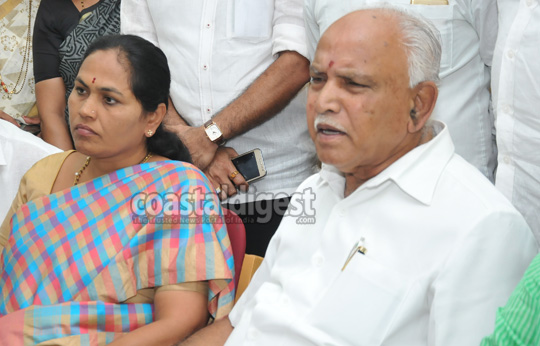
Police not given free hand in Dakshina Kannada, says Yeddyurappa

coastaldigest.com news network
July 14, 2017

Udupi, Jul 14: The reason for the failure of police in controlling the situation in Dakshina Kannada is the interference of ruling Congress, according to BJP leader and former chief minister B S Yeddyurappa.

bsy pm 3 

Speaking at a public meeting organised by the district unit of the BJP against the attacks on activists of saffron groups, here, he said that the police were working under tremendous pressure from the State government.

Mr. Yeddyurappa said that Chief Minister Siddaramaiah had in a meeting of top-level police officers in Bengaluru reportedly questioned the large crowds during the funeral procession of Sharath Madivala, an RSS activist, who was murdered at BC Road on July 4.

Mr. Siddaramaiah had berated the police officers in the meeting and had directed his advisor, Kempaiah, to take direct charge of the coastal districts.

“Does it mean that the Chief Minister has no confidence in his police officers?” he questioned.

He said that the death of RSS activist Sharath Madivala was deliberately announced 20 hours late and, as a result, his father, Taniya could not donate the former’s eyes.

As many as 24 persons belonging to the Hindutva groups had died in the last four years. But the government had not taken any action in the matter, he said.

Though it was nine days since the death of Sharath, the police were yet to trace his assailants.

Though there were prohibitory orders in force in Dakshina Kannada for over a week, the situation was showing no signs of returning to a normality, he said.

While the government was dealing with the Hindu groups firmly, it was treating both the Karnataka Forum for Dignity (KFD) and Popular Front of India (PFI) with kid gloves. Both these organisations should be banned, he said.

V. Sunil Kumar, Karkala MLA, said that since the government was not protecting the Hindus, the people of the Hindu community should start arming themselves with weapons during this “Ayudha Puja” festival.

Mattar Ratnakar Hegde, Raghupati Bhat, Udaykumar Shetty, T.V. Hegde, Sheela K. Shetty, Shyamala Kundar, BJP leaders, were present.

Comments

Rikaz
 - 
Sunday, 16 Jul 2017

She understood that Islam is the best religion to go with....

Add new comment

  • Coastaldigest.com reserves the right to delete or block any comments.
  • Coastaldigset.com is not responsible for its readers’ comments.
  • Comments that are abusive, incendiary or irrelevant are strictly prohibited.
  • Please use a genuine email ID and provide your name to avoid reject.
News Network
January 1,2020

Udupi, Jan 1: A 53-year-old Journalist of a Mangalore-based media house was found dead at his flat in Manipal on Tuesday.

The deceased has been identified as Rohit Raj (53), a resident of Pandeshwar Mangaluru.

According to the Manipal police, on December 31, Rohit Raj had attended a New Year party celebration at Kadiyali, Udupi along with his wife.

Comments

Add new comment

  • Coastaldigest.com reserves the right to delete or block any comments.
  • Coastaldigset.com is not responsible for its readers’ comments.
  • Comments that are abusive, incendiary or irrelevant are strictly prohibited.
  • Please use a genuine email ID and provide your name to avoid reject.
Agencies
February 20,2020

India ranked 77th on a sustainability index that takes into account per capita carbon emissions and ability of children in a nation to live healthy lives and secures 131st spot on a flourishing ranking that measures the best chance at survival and well-being for children, according to a UN-backed report.

The report was released on Wednesday by a commission of over 40 child and adolescent health experts from around the world. It was commissioned by the World Health Organization (WHO), UN Children's Fund (UNICEF) and The Lancet medical journal.

In the report assessing the capacity of 180 countries to ensure that their youngsters can survive and thrive, India ranks 77th on the Sustainability Index and 131 on the Flourishing Index, it said.

Flourishing is the geometric mean of Surviving and Thriving. For Surviving, the authors selected maternal survival, survival in children younger than 5 years old, suicide, access to maternal and child health services, basic hygiene and sanitation, and lack of extreme poverty.

For Thriving, the domains were educational achievement, growth and nutrition, reproductive freedom, and protection from violence.

Under the Sustainability Index, the authors noted that promoting today's national conditions for children to survive and thrive must not come at the cost of eroding future global conditions for children's ability to flourish.

The Sustainability Index ranks countries on excess carbon emissions compared with the 2030 target. This provides a convenient and available proxy for a country's contribution to sustainability in future.

The report noted that under realistic assumptions about possible trajectories towards sustainable greenhouse gas emissions, models predict that global carbon emissions need to be reduced from 39·7 giga­ tonnes to 22·8 gigatonnes per year by 2030 to maintain even a 66 per cent chance of keeping global warming below 1·5°C.

It said that the world's survival depended on children being able to flourish, but no country is doing enough to give them a sustainable future.

"No country in the world is currently providing the conditions we need to support every child to grow up and have a healthy future," said Anthony Costello, Professor of Global Health and Sustainability at University College London, one of the lead authors of the report.

"Especially, they're under immediate threat from climate change and from commercial marketing, which has grown hugely in the last decade," said Costello – former WHO Director of Mother, Child and Adolescent health.

Norway leads the table for survival, health, education and nutrition rates - followed by South Korea and the Netherlands. Central African Republic, Chad and Somalia come at the bottom.

However, when taking into account per capita CO2 emissions, these top countries trail behind, with Norway 156th, the Republic of Korea 166th and the Netherlands 160th.

Each of the three emits 210 per cent more CO2 per capita than their 2030 target, the data shows, while the US, Australia, and Saudi Arabia are among the 10 worst emitters. The lowest emitters are Burundi, Chad and Somalia.

According to the report, the only countries on track to beat CO2 emission per capita targets by 2030, while also performing fairly – within the top 70 – on child flourishing measures are: Albania, Armenia, Grenada, Jordan, Moldova, Sri Lanka, Tunisia, Uruguay and Vietnam.

"More than 2 billion people live in countries where development is hampered by humanitarian crises, conflicts, and natural disasters, problems increasingly linked with climate change," said Minister Awa Coll-Seck from Senegal, Co-Chair of the commission.

The report also highlights the distinct threat posed to children from harmful marketing.

Evidence suggests that children in some countries see as many as 30,000 advertisements on television alone in a single year, while youth exposure to vaping (e-cigarettes) advertisements increased by more than 250 per cent in the US over two years, reaching more than 24 million young people.

Studies in Australia, Canada, Mexico, New Zealand and the US – among many others – have shown that self-regulation has not hampered commercial ability to advertise to children.

Children's exposure to commercial marketing of junk food and sugary beverages is associated with purchase of unhealthy foods and overweight and obesity, linking predatory marketing to the alarming rise in childhood obesity, it said.

The number of obese children and adolescents increased from 11 million in 1975 to 124 million in 2016 – an 11-fold increase, with dire individual and societal costs, the report said.

To protect children, the authors call for a new global movement driven by and for children.

Specific recommendations include stopping CO2 emissions with the utmost urgency, to ensure children have a future on this planet; placing children and adolescents at the centre of global efforts to achieve sustainable development, the report said.

New policies and investment in all sectors to work towards child health and rights; incorporating children's voices into policy decisions and tightening national regulation of harmful commercial marketing, supported by a new Optional Protocol to the UN Convention on the Rights of the Child, it said.


Comments

Add new comment

  • Coastaldigest.com reserves the right to delete or block any comments.
  • Coastaldigset.com is not responsible for its readers’ comments.
  • Comments that are abusive, incendiary or irrelevant are strictly prohibited.
  • Please use a genuine email ID and provide your name to avoid reject.
News Network
February 17,2020

Varanasi, Feb 17: For the first time, the Indian Railways has reserved a seat for a deity on a train. The national transporter, which launched its third IRCTC operated train named Kashi Mahakal Express from Varanasi to Indore, has reserved a seat for Lord Mahakal (Lord Shiva) on board.

Speaking to media, Northern Railway spokesperson Deepak Kumar said: "It is for the first time that a seat has been left reserved for a deity."

"One seat in Kashi Mahakal Express (seat number 64 in B5 coach) has been left reserved for Lord Shiva," he said.

"Even a temple has been drawn on the seat to make people aware that the seat is reserved for Lord Mahakal," he said.

IRCTC's Director, Tourism, Rajni Hasija said that the practice would continue beyond the inaugural run.

Prime Minister Narendra Modi flagged off the Kashi Mahakal Express via video conferencing from Varanasi, where he is all launched several projects worth Rs 1,250 crore during the day's visit to his parliamentary constituency.

The third IRCTC train, after the two Tejas Express trains on New Delhi-Lucknow and Mumbai-Ahmedabad routes, the Kashi Mahakal Express will connect three places -- Jyotirlinga-Omkareshwar (near Indore), Mahakaleshwar (Ujjain) and Kashi Vishwanath (at Varanasi).

Also connecting the industrial and educational hub of Indore, with Bhopal, the train will begin its commercial run from February 20.

"The Kashi Mahakal Express will operate three days in a week and it will be a bi-weekly service through the Sultanpur-Lucknow route and a weekly service via the Prayagraj route," Kumar said.

Elaborating on the two routes from which the train will pass every week, Hasija said: "Once the new train starts its regular run from this week, it will depart from Varanasi at 2.45 p.m. every Tuesday and Thursday to reach Indore at 9.40 a.m. on Wednesday and Friday.

Similarly, the train will start from Indore at 10.55 a.m. every Wednesday and Friday and will reach Varanasi at 6.00 a.m. the next day. This train will have stoppages at Ujjain, Sant Hirdaram Nagar, Bina, Jhansi, Kanpur and Sultanpur stations in both directions.

Meanwhile, in the weekly service via Prayagraj route, the Kashi Mahakal Express will depart from Varanasi at 3.15 p.m. every Sunday to reach Indore at 9.40 a.m. the next day. On the other way, it will depart from Indore at 10.55 a.m. every Monday and reach Varanasi at 5 a.m. the next day.

"This train will halt at Ujjain, Sant Hirdaram Nagar, Bina, Jhansi, Kanpur and Allahabad stations in both directions," Kumar said.

Explaining the fares of the Kashi Mahakal Express, Hasija said, "Kashi Mahakal Express will follow a dynamic fare structure like the other two Tejas Express trains."

One-way journey from Varnasi to Indore will cost Rs 1,951, inclusive of four meals.

According to the IRCTC officials, the Indore-Varanasi Kashi Mahakal Express will be the first private train that will run overnight and for a comfortable long distance journey, will feature a host of facilities. The IRCTC will serve vegetarian food, and provide housekeeping services, on-board security services and bedrolls.

The IRCTC officials said that passengers will also get complementary insurance of Rs 10 lakh.

The train will have an advance reservation period of 120 days and will only have the general and foreign tourist quotas. The current booking will be available to the passengers on the platform itself after preparation of first chart, four hours to five minutes before the scheduled departure of the train.

To facilitate travel for pilgrims, the IRCTC is also introducing special tour packages for passengers who want to see the pilgrim centres enroute. The tour options are; Mahakal Darshan (Ujjain - Omkareshwar), Bhopal-Sanchi-Bhimbetka, Malwa Jyotrilinga Darshan (Ujjain-Omkareshwar- Maheshwar- Indore) and Bhopal-Sanchi-Bhimbetka-Ujjain. Other tour options include Kashi, Ayodhya and Prayag; Kashi Darshan; Kashi, Prayag, Ayodhya; Kashi and Prayag and only Kashi.

The train has silent features like CCTV cameras, which will be monitored online around the clock from the IRCTC centres, whereas for the first time the IRCTC has brought the marshals in the train for passengers safety and also to make people aware to not smoke inside the train as it has smoke and heat sensors installed in the coaches as well as in the bathroom. For the blind passengers, the train coaches have the seat numbers written in Braille, and the catering staff will be dressed in yellow kurta-pyjamas with a rudraksh malas on their necks to promote the train's theme.

Comments

ASIF
 - 
Tuesday, 18 Feb 2020

waw.. good header with superb news..

good going !!

Althaf
 - 
Tuesday, 18 Feb 2020

If you are truthful then go to china and stay with patients of carona virus. The carona virus should not affect you as you are a vegeterian. Prove this first. 

Add new comment

  • Coastaldigest.com reserves the right to delete or block any comments.
  • Coastaldigset.com is not responsible for its readers’ comments.
  • Comments that are abusive, incendiary or irrelevant are strictly prohibited.
  • Please use a genuine email ID and provide your name to avoid reject.