


Police not given free hand in Dakshina Kannada, says Yeddyurappa

coastaldigest.com news network
July 14, 2017

Udupi, Jul 14: The reason for the failure of police in controlling the situation in Dakshina Kannada is the interference of ruling Congress, according to BJP leader and former chief minister B S Yeddyurappa.
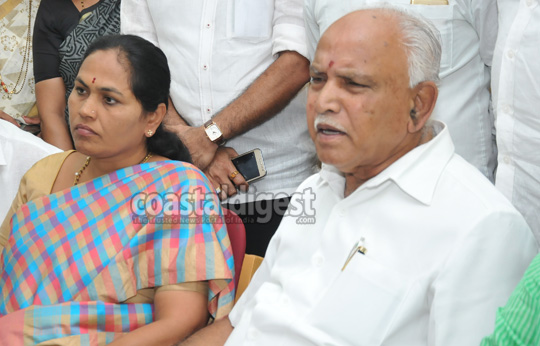
bsy pm 3 

Speaking at a public meeting organised by the district unit of the BJP against the attacks on activists of saffron groups, here, he said that the police were working under tremendous pressure from the State government.

Mr. Yeddyurappa said that Chief Minister Siddaramaiah had in a meeting of top-level police officers in Bengaluru reportedly questioned the large crowds during the funeral procession of Sharath Madivala, an RSS activist, who was murdered at BC Road on July 4.

Mr. Siddaramaiah had berated the police officers in the meeting and had directed his advisor, Kempaiah, to take direct charge of the coastal districts.

“Does it mean that the Chief Minister has no confidence in his police officers?” he questioned.

He said that the death of RSS activist Sharath Madivala was deliberately announced 20 hours late and, as a result, his father, Taniya could not donate the former’s eyes.

As many as 24 persons belonging to the Hindutva groups had died in the last four years. But the government had not taken any action in the matter, he said.

Though it was nine days since the death of Sharath, the police were yet to trace his assailants.

Though there were prohibitory orders in force in Dakshina Kannada for over a week, the situation was showing no signs of returning to a normality, he said.

While the government was dealing with the Hindu groups firmly, it was treating both the Karnataka Forum for Dignity (KFD) and Popular Front of India (PFI) with kid gloves. Both these organisations should be banned, he said.

V. Sunil Kumar, Karkala MLA, said that since the government was not protecting the Hindus, the people of the Hindu community should start arming themselves with weapons during this “Ayudha Puja” festival.

Mattar Ratnakar Hegde, Raghupati Bhat, Udaykumar Shetty, T.V. Hegde, Sheela K. Shetty, Shyamala Kundar, BJP leaders, were present.

Comments

Rikaz
 - 
Sunday, 16 Jul 2017

She understood that Islam is the best religion to go with....

Add new comment

  • Coastaldigest.com reserves the right to delete or block any comments.
  • Coastaldigset.com is not responsible for its readers’ comments.
  • Comments that are abusive, incendiary or irrelevant are strictly prohibited.
  • Please use a genuine email ID and provide your name to avoid reject.
Agencies
May 8,2020

Washington D.C., May 8: The prime time for brain development in a child's life is the first year, where the infant spends most of the time asleep. It is the time when neural connections form and sensory memories are encoded.

However, when sleep is disrupted, as occurs more often among children with autism, brain development may be affected, too.

New research led by the University of Washington finds that sleep problems in a baby's first 12 months may not only precede an autism diagnosis but also may be associated with altered growth trajectory in a key part of the brain, the hippocampus.

The study, which was published in the American Journal of Psychiatry, researchers report that in a sample of more than 400 taken of 6- to 12-month-old infants, those who were later diagnosed with autism were more likely to have had difficulty falling asleep.

It also states that this sleep difficulty was associated with altered growth trajectories in the hippocampus.

"The hippocampus is critical for learning and memory, and changes in the size of the hippocampus have been associated with poor sleep in adults and older children.

As many as 80 per cent of the children with autism spectrum disorder have sleep problems," said Annette Estes, director of the UW Autism Center and senior author of the study.

"In our clinical experience, parents have a lot of concerns about their children's sleep, and in our work on early autism intervention, we observed that sleep problems were holding children and families back," added Estes, who is also a UW professor of speech and hearing sciences.

"It could be that altered sleep is part-and-parcel of autism for some children. One clue is that behavioural interventions to improve sleep don't work for all children with autism, even when their parents are doing everything just right. This suggests that there may be a biological component to sleep problems for some children with autism," said Estes.

To consider links among sleep, brain development, and autism, researchers at the IBIS Network looked at MRI scans of 432 infants, surveyed parents about sleep patterns, and measured cognitive functioning using a standardized assessment.

At the outset of the study, infants were classified according to their risk for developing autism: Those who were at higher risk of developing autism -- about two-thirds of the study sample -- had an older sibling who had already been diagnosed.

Infant siblings of children with autism have a 20 per cent chance of developing autism spectrum disorder -- a much higher risk than children in the general population.

In the current study, 127 of the 432 infants were identified as "low risk" at the time the MRI scans were taken because they had no family history of autism.

They later evaluated all the participants at 24 months of age to determine whether they had developed autism. Of the roughly 300 children originally considered "high familial risk," 71 were diagnosed with autism spectrum disorder at that age.

Problems with sleep were more common among the infants later diagnosed with an autism spectrum disorder, as were larger hippocampi. No other subcortical brain structures were affected, including the amygdala, which is responsible for certain emotions and aspects of memory, or the thalamus, a signal transmitter from the spinal cord to the cerebral cortex.

The authors note that while parents reported more sleep difficulties among infants who developed autism compared to those who did not, the differences were very subtle and only observed when looking at group averages across hundreds of infants.

Sleep patterns in the first years of life change rapidly as infants transition from sleeping around the clock to a more adult-like sleep/wake cycle. Until further research is completed, Estes said, it is not possible to interpret challenges with sleep as an early sign of increased risk for autism.

Comments

Add new comment

  • Coastaldigest.com reserves the right to delete or block any comments.
  • Coastaldigset.com is not responsible for its readers’ comments.
  • Comments that are abusive, incendiary or irrelevant are strictly prohibited.
  • Please use a genuine email ID and provide your name to avoid reject.
coastaldigest.com news network
May 9,2020

Mangaluru, Ma 9: Three more persons from Bantwal taluk in Dakshina Kannada district tested positive for Covid-19 today. All three are members of a family.

The infection is reportedly linked to First Neuro Hospital of Mangaluru, which has emerged as a coronavirus hub in coastal Karnataka.

With this, the total number of coronavirus cases in the district mounted to 31 including six outsiders. Three of them have lost their lives. Currently there are 15 active cases in the district.

The newly identified coronavirus patients are a 30-year-old man and two elderly women aged 60 and 70 years.

They have contracted the infection from a 69-year-old man from Bantwal who was confirmed with COVID-19 infection on May 1. All the three members now infected belong to his family.

The man had got the infection from a woman identified as P-390. He happens to be a relative and neighbour of the deceased woman who belonged to Bantwal Kasaba village. Eight  members of his family were quarantined, of whom three tested positive today.

Comments

Add new comment

  • Coastaldigest.com reserves the right to delete or block any comments.
  • Coastaldigset.com is not responsible for its readers’ comments.
  • Comments that are abusive, incendiary or irrelevant are strictly prohibited.
  • Please use a genuine email ID and provide your name to avoid reject.
coastaldigest.com news network
June 24,2020

Riyadh, June 24: Thousands of expatriates who managed to return to their home countries from Saudi Arabia during covid-19 lockdown are now in a dilemma as the Kingdom has clarified that it will not allow their re-entry till the end of the corona crisis. 

The Directorate General of Passports (Jawazat) announced on Tuesday that the mechanism to resume extension of the exit and re-entry visas for expatriates who are outside the Kingdom will be announced only after the end of the pandemic crisis.

The Jawazat stated this on its Twitter account while responding to queries from a number of expatriates who are currently outside the Kingdom and whose exit and re-entry visas have expired.

They inquired about the possibility of returning to the Kingdom after the resumption of international flight service. 

The Jawazat reiterated that the return of expatriates who left Saudi Arabia will be only after the end of the pandemic and in accordance with the process to obtain a valid re-entry visa.

The directorate said that in the event of any new decisions or instructions in this regard, they will be announced through the official channels.

It is noteworthy that the Jawazat had previously confirmed that its electronic services are continuing through the Absher and Muqeem online portals of the Ministry of Interior and that the service for messages and requests is still available and continuing through Absher for all the beneficiaries of its services.

Comments

Add new comment

  • Coastaldigest.com reserves the right to delete or block any comments.
  • Coastaldigset.com is not responsible for its readers’ comments.
  • Comments that are abusive, incendiary or irrelevant are strictly prohibited.
  • Please use a genuine email ID and provide your name to avoid reject.