


Political vengeance: Crude bomb hurled at BJP office in Kerala

September 7, 2016

Thiruvananthapuram, Sep 7: A crude bomb was hurled at a BJP office in the heart of the city in Thiruvananthapuram, with the party alleging that CPI(M) workers were behind the attack. No one was injured in the incident, police said.
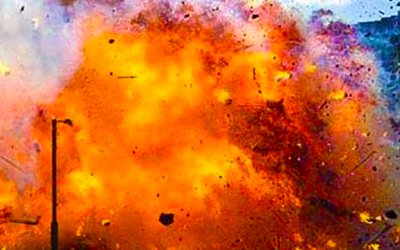
polivengThe incident occurred around midnight on Wednesday, shortly after BJP State president Kummanam Rajasekharan had left the office for Kozhikode, where preparations are on for the three-day National Executive and Council meeting from September 23, which is being attended by senior party leaders and Prime Minister Narendra Modi, party sources said.

At least four workers were on the top floor of the building, housing the office, when the bomb was hurled.

Though no one was injured, glass panes of the main entrance door were damaged in the incident, Thiruvananthapuram City Police Commissioner S. Sparjan Kumar said.

The incident comes close on the heels of a series of sporadic clashes between the CPI(M) and BJP workers in the past few months in northern Kannur district.

Mr. Rajasekharan alleged that CPI(M), the lead partner of the ruling LDF in Kerala, had taken law into its hands and police was a “mere spectator”.

“Violence of the CPI(M) is increasing each day. A BJP activist was hacked to death in Kannur recently and CPI(M) is behind it,” he said at Kozhikode.

“Despite so many incidents, CPI(M) leaders and Chief Minister Pinarayi Vijayan, who is also holding the Home portfolio, have not condemned the series of attacks against BJP and its workers,” he added.

BJP leaders P.K. Krishnadas and M.T. Ramesh slammed the CPI(M), saying the bomb attack against the party office should not be seen as an “isolated” incident.

“This is a calculated and well planned attack against the BJP and CPI(M) is behind it,” they said. All flex boards in front of the office were also destroyed, Mr. Krishnadas said.

Television channels telecast a CCTV video footage showing a man riding a motorcycle minutes before the blast and police are on the lookout for him.

Comments

SHAJI
 - 
Thursday, 8 Sep 2016

I am sure that this is done by BJP to get benefit

Rikaz
 - 
Wednesday, 7 Sep 2016

May be BJP itself had carried out this attack and blaming CPI....they had done it before too....and blamed Muslims.....

Add new comment

  • Coastaldigest.com reserves the right to delete or block any comments.
  • Coastaldigset.com is not responsible for its readers’ comments.
  • Comments that are abusive, incendiary or irrelevant are strictly prohibited.
  • Please use a genuine email ID and provide your name to avoid reject.
Media Release
March 12,2020

Manipal, Mar 12: Team WGSHA is proud to announce that the culinary museum in WGSHA has been listed in Limca Book of Records as India's First Living Culinary Arts Museum.

Limca Book of Records (LBR) is a catalogue of achievements made by Indians, at home and abroad in diverse fields of human endeavour. LBR is a celebration of exemplary exploits and recognizes accomplishments such as firsts, inventions, discoveries, honours, awards and the truly extraordinary.

Chef Thirugnanasambantham, Principal of WGSHA, while thanking MAHE and ITC Leadership for extending all support towards instituting this museum in Manipal and WGSHA, also appreciated and thanked all those who have directly or indirectly helped towards setting up this museum in Manipal.

"The process for WGSHA's culinary museum to make an entry into the popular Limca Book of Records started almost six months back and after validation by LBR recently, has been listed in the book of records. We are glad that we could be the first of its kind in such endeavour and we also hope to be in Guinness World Records soon", said Chef Thiru.

"We are indeed grateful to Michelin-starred Indian celebrity Chef Vikas Khanna, the founder and curator of this museum, who had this idea of establishing a culinary museum and donated thousands of kitchen tools and equipment worth millions of dollars to this museum for preserving the history of India's rich tradition of culinary arts and to educate the future generations. Chef Vikas Khanna, 'Distinguished Alumnus' of WGSHA, being very desirous of making such a museum in India, what better place it would be than in his own Alma Mater!", he said on the background of having the museum.

Chef Thiru mentioned that Udupi, popular for the famous 'Udupi Cuisine', and being a temple town, is adjacent to International University Town of Manipal Academy of Higher Education (MAHE).

MAHE is home to thousands of international students and visitors. With a great heritage of Udupi, combined with the large number of Indian and International students residing in and around Manipal, it was very apt for the college to create a museum for today's Indian youth and the International visitors to understand the rich culinary heritage of India, through the priceless kitchen tools and equipment donated by Chef Vikas Khanna.

"Has placed WGSHA in the global culinary map and we are proud to have joined all such efforts to preserve the history of cuisines and cultures across the world", said Chef Thiru.

The culinary art academic block housing the museum was opened in April 2018, spread approximately over 25,000 sq ft and is shaped in the form of a giant pot very similar to the ones found in Harappa.

There are historical as well as regular household items such as plates made by the Portuguese in India, a 100-year-old ladle used to dole out food at temples and bowls dating to the Harappan era, an old seed sprinkler, an ancient Kashmiri tea brewer known as 'samovar', vessels from the Konkan, Udupi and Chettinad regions, apart from a large collection of rolling pins, utensils of all shapes and sizes, tea strainers of different types etc.

Comments

Add new comment

  • Coastaldigest.com reserves the right to delete or block any comments.
  • Coastaldigset.com is not responsible for its readers’ comments.
  • Comments that are abusive, incendiary or irrelevant are strictly prohibited.
  • Please use a genuine email ID and provide your name to avoid reject.
News Network
June 9,2020

Udupi, Jun 9: A Mesolithic site has been discovered at Iduru-Kunjadi in Kundapura taluk of Udupi district of Karnataka by Prof T Murugeshi, Associate Professor of Ancient History and Archaeology at MSRS College, Shirva.

Prof Murugeshi said on Tuesday that the site is near a rock art site of the Mesolithic period that was unearthed. It is located in the Mookambika Wildlife Reserve Forest. At Iduru-Kunjadi, the finds of Mesolithic tools are characterised by blades, scrapers, burine, fluted cores, arrow-heads and flakes of the non-geometric pattern.

He said that though the site was found two years back, it took time to study and identify them. They resembled the tools found in a stratified context at Uppinangady on the Netravati basin, he added.

Comments

Add new comment

  • Coastaldigest.com reserves the right to delete or block any comments.
  • Coastaldigset.com is not responsible for its readers’ comments.
  • Comments that are abusive, incendiary or irrelevant are strictly prohibited.
  • Please use a genuine email ID and provide your name to avoid reject.
News Network
April 2,2020

The current physical distancing guidelines provided by the World Health Organisation (WHO) and by the US Centers for Disease Control and Prevention (CDC) may not be adequate to curb the coronavirus spread, according to a research which says the gas cloud from a cough or sneeze may help virus particles travel up to 8 metres. The research, published in the Journal of the American Medical Association, noted that the the current guidelines issued by the WHO and CDC are based on outdated models from the 1930s of how gas clouds from a cough, sneeze, or exhalation spread.

Study author, MIT associate professor Lydia Bourouiba, warned that droplets of all sizes can travel 23 to 27 feet, or 7-8 metres, carrying the pathogen.

According to Bourouiba, the current guidelines are based on "arbitrary" assumptions of droplet size, "overly simplified", and "may limit the effectiveness of the proposed interventions" against the deadly pandemic.

 She explained that the old guidelines assume droplets to be one of two categories, small or large, taking short-range semi-ballistic trajectories when a person exhales, coughs, or sneezes.

However based on more recent discoveries, the MIT scientist said, sneezes and coughs are made of a puff cloud that carries ambient air, transporting within it clusters of droplets of a wide range of sizes.

Bourouiba warned that this puff cloud, with ambient air entrapped in it, can offer the droplets moisture and warmth that can prevent it from evaporation in the outer environment.

"The locally moist and warm atmosphere within the turbulent gas cloud allows the contained droplets to evade evaporation for much longer than occurs with isolated droplets," she said.

"Under these conditions, the lifetime of a droplet could be considerably extended by a factor of up to 1000, from a fraction of a second to minutes," the researcher explained in the study.

The MIT scientist, who has researched the dynamics of coughs and sneezes for years, added that these droplets settle along the trajectory of a cough or sneeze contaminating surfaces, with their residues staying suspended in the air for hours.

"Even when maximum containment policies were enforced, the rapid international spread of COVID-19 suggests that using arbitrary droplet size cutoffs may not accurately reflect what actually occurs with respiratory emissions, possibly contributing to the ineffectiveness of some procedures used to limit the spread of respiratory disease," Bourouiba wrote in the study

Comments

Add new comment

  • Coastaldigest.com reserves the right to delete or block any comments.
  • Coastaldigset.com is not responsible for its readers’ comments.
  • Comments that are abusive, incendiary or irrelevant are strictly prohibited.
  • Please use a genuine email ID and provide your name to avoid reject.