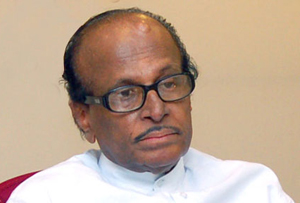
Poojary continues to target Karnataka govt over Yettinahole, ACB

[email protected] (CD Network)
March 27, 2016

Udupi, Mar 27: Congress leader B Janardhan Poojary has continued to exert pressure on Chief Minister Siddaramaiah to drop the proposal to set up an Anti Corruption Bureau (ACB) and the Yettinahole diversion project.Poojary

Speaking to media persons, the former Union minister said the chief minister's hasty decision to set up an ACB will cost the government in terms of support from the public. He said that by setting up the bureau, the chief minister would weaken the Lokayukta institution. “A person who is charged under some crime will be probed by two separate institutions by filing cases in both in ACB?and Lokayukta.

Setting up of two separate institutions to investigate a single case is not permitted by the Constitution and it has been clearly mentioned in the Article 20,” he insisted.

He accused the chief minister of intending to hand over cases pertaining to his government and officials to the newly created investigation agency, the ACB.

Mr Poojary said that the government should give up the Yettinahole project as it would not only create a host of environmental problems but also lead to chronic water shortage in Dakshina Kannada district.

He said the Uppinangady region in Dakshina Kannada was prone to water shortages during summer. The Yettinahole project would only worsen the problem there. The river diversion project would not only affect people but also the fragile biodiversity of the Western Ghats.

Mr. Poojary said it was a tragedy that all ministers, parliamentarians and legislators of all parties of the Coastal districts were backing the Yettinahole project despite knowing it was disastrous to these districts. “In fact, it is their duty to save the Netravati River, which is the lifeline of the Coastal districts,” he said.

Chief Minister Siddaramaiah should undertake a tour of the regions from Gundia to Kumaradhara and listen to the opinion of the people. This would give him a first-hand knowledge of the problems faced by the people in Belthangady region of Dakshina Kannada due to the Yettinahole project, he said.

Comments

Aakhash
 - 
Sunday, 27 Mar 2016

Mr. Poojary an elderly congress man ,, no job now .just giving Un important statements

Add new comment

  • Coastaldigest.com reserves the right to delete or block any comments.
  • Coastaldigset.com is not responsible for its readers’ comments.
  • Comments that are abusive, incendiary or irrelevant are strictly prohibited.
  • Please use a genuine email ID and provide your name to avoid reject.
coastaldigest.com web desk
April 30,2020

In the wake of Saudi Arabia's assurance that Masjid al-Haram of Makkah and Masjid an-Nabawi of Madinah will be opened for believers after some days, a message has gone viral on social media claiming that both the holy mosques will open on Ramadan 8 (May 1).

The message which was widely circulated on Facebook and WhatsApp, also contained certain condition such as people should fetch their own prayer mats and that they should not use the washrooms in the mosques. 

Clarification

Meanwhile, the authorities of the two holy mosques, issued a clarification that the claims made in the viral post are false and baseless.

"The message being circulated about the opening date for Haramiain (two holy mosques) for public is completely baseless and false. The suspension of prayers for general public is still in effect," they said in a social media post.

Comments

Add new comment

  • Coastaldigest.com reserves the right to delete or block any comments.
  • Coastaldigset.com is not responsible for its readers’ comments.
  • Comments that are abusive, incendiary or irrelevant are strictly prohibited.
  • Please use a genuine email ID and provide your name to avoid reject.
News Network
March 31,2020

Kasaragod, Mar 31: The latest incidents of critically-ill patients dying due to lack of medical attention has been a cause of concern for the people here who had largely been depended on hospitals in Mangalore.

However the lock down has hindered follow-up treatment for these critically ill as the Karnataka authorities has been steadfast in restricting entry into their land.

The people of Kasaragod has been largely depended on the medical facilities in Mangalore for critical illness care. It was the gross inadequacies in critical healthcare in the district besides rather-easy proximity to nearby and bigger town that many residing on the north-east of the district have since long been making it to Mangalore for treatment of critical illness like cancer, dialysis and the alike.

Comments

Add new comment

  • Coastaldigest.com reserves the right to delete or block any comments.
  • Coastaldigset.com is not responsible for its readers’ comments.
  • Comments that are abusive, incendiary or irrelevant are strictly prohibited.
  • Please use a genuine email ID and provide your name to avoid reject.
News Network
April 19,2020

Kasaragod, Apr 19: Kasaragod, Kerala's COVID-19 hotspot, is the only district in the southern state lacking adequate health infrastructure.

In spite of treating the highest number of COVID-19 patients in the state with meagre infrastructural facilities and even without the support of a medical college in the north Kerala district, no deaths have been reported due to coronavirus.

The state health department views the performance of M Kunhiraman and his team, consisting of Janardhana Naik and Krishna Naik, at the General hospital in Kasaragod as a success story.

"Not only did they control the situation quickly with minimum infrastructure, they also started turning out a large number of negative cases within a few weeks and creditably ensured zero mortality.

This can be showcased as a best global model," Chairman of the Information Education and Communication (IEC) Committee and Project Director Kerala State Aids Control Society, R Ramesh said.

Recalling the ordeal, Janardhana Naik said his first major challenge was the physical examination of a patient with suspected COVID-19.

"Even with the PPE kit, nobody knew how effective they were and it took a whole 30 minutes to wear them properly.

But as time passed, we got accustomed to it," he said.

The traditional method of dealing with a patient involved knowing his or her history, observation and physical examination.

For hundreds of years, the hands-on body approach has been the soul of the doctor-patient relationship -- taking the pulse, tapping on and listening to the chest, feeling lumps.

With the onset of COVID-19 all that has changed.

"In fact, the whole exercise was fraught with grave risks because everything connected with COVID-19 was new.

Doctors have to keep a distance even though the physical examination wearing a Personal Protective Equipment (PPE) is difficult.

Sounds from the body are inaudible, vision is blurred through the smog-covered goggles and a stethoscope seldom has any use," Janardhana Naik said.

It was from March 15 that the hospital started receiving COVID-19 patients, primarily from Dubai.

By the time the first person came, the hospital was ready for him.

Soon, patient numbers began to swell and in a couple of weeks they reached about 91.

From then on, it was teamwork.

Committees were formed for each and every task, including the help desk, IT, treatment, medical board, training, food, waste disposal and data maintenance.

Initially, patients had many misgivings about the hospital.

"Some were disillusioned and even aggressive. Some were not happy with the facilities the hospital had to offer.

But gradually through good treatment and counselling by a psychiatrist, who visited the hospital on alternate days, the confidence and mood of the patients changed and they became friendly with the staff," Naik elaborated.

Counselling was also given to the concerned family members of the patients.

Besides treatment, the medical staff had to spend a considerable amount of time clearing the doubts of patients.

When they got discharged some patients insisted on seeing the faces of the medical staff, who till then were anonymous entities covered from head to toe.

Some even wanted to take selfies with them.

However, the medical team politely turned down their requests and preferred to remain hidden in their work attires.

The mood of the patients also rubbed off on the doctors and hospital staff.

All the physicians and hospital staff are now more confident of dealing with contagious diseases after treating COVID-19 patients.

"Our previous experience of treating H1N1, Chikungunya and Dengue cases helped us a lot.

Words of encouragement from the Health Minister K K Shailaja, Health Principal Secretary Dr Rajan N Khobragade and Health Services Director Dr Sarita R L gave us the impetus to build up confidence.

Moreover, the field health workers did a wonderful job in containing the viral spread," Naik added.

As the number of coronavirus cases rose, the state government on April 5 deputed a 26-member medical team from Thiruvananthapuram to set up a COVID-19 hospital in the district.

They turned a block of the under construction Government Medical College as a hospital-like facility, setting up a 200 bed facility to treat coronavirus patients.


Comments

Add new comment

  • Coastaldigest.com reserves the right to delete or block any comments.
  • Coastaldigset.com is not responsible for its readers’ comments.
  • Comments that are abusive, incendiary or irrelevant are strictly prohibited.
  • Please use a genuine email ID and provide your name to avoid reject.