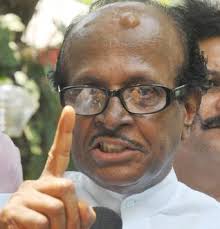
Poojary dares CM to truth test at Kudroli or Dharmasthala over Re 1 rice

[email protected] (News Network)
February 19, 2017

Mangaluru, Feb 18: Sidelined Congress veteran B Janardhana Poojary has now challenged chief minister Siddaramaiah to take a truth test at either Sri Kshetra Dharmasthala or Sri Kshetra Kudroli Gokarnanateshwara that he had not opposed giving rice at Re 1 per kg, which he later made his flagship programme after assuming office.

11poojaryPoojary said that as a finance minister Siddaramaiah had opposed his proposal of distributing rice at Re 1 per kg. "As KPCC president, I suggested the Congress government implement a scheme to distribute rice at Re 1/kg, but it was opposed by Siddaramaiah who was the then finance minister.

Let him take a truth test before the deity at Dharmastala or at Kudroli about this," Poojary said, inviting the chief minister for an 'Aaane Pramaana'.

Poojary said he is ready to accept a show-cause notice from the party high command and won't mind if he's removed from the party. "I'll die happily as a Congressman even if the party expels me.

There is no question of leaving Congress. Let them expel me today, but I'll continue to be a Congressman. I'm not a politician, who jumps from one party to another for power," Poojary said.

Comments

shaji
 - 
Tuesday, 21 Feb 2017

My sincere advice to Hon'ble Mr. Poojary is to take political retirement. In case you cant do any favor to Congress please dont try to hurt it. Congress has given you a lot. Hence, please be grateful to the party and observe silence.

Asif
 - 
Sunday, 19 Feb 2017

umbe bajil sajjige malpere.......... kaled dakkleya

Rikaz
 - 
Sunday, 19 Feb 2017

Sir, you are retarded, please take rest till next election...

Add new comment

  • Coastaldigest.com reserves the right to delete or block any comments.
  • Coastaldigset.com is not responsible for its readers’ comments.
  • Comments that are abusive, incendiary or irrelevant are strictly prohibited.
  • Please use a genuine email ID and provide your name to avoid reject.
Agencies
May 8,2020

Washington D.C., May 8: The prime time for brain development in a child's life is the first year, where the infant spends most of the time asleep. It is the time when neural connections form and sensory memories are encoded.

However, when sleep is disrupted, as occurs more often among children with autism, brain development may be affected, too.

New research led by the University of Washington finds that sleep problems in a baby's first 12 months may not only precede an autism diagnosis but also may be associated with altered growth trajectory in a key part of the brain, the hippocampus.

The study, which was published in the American Journal of Psychiatry, researchers report that in a sample of more than 400 taken of 6- to 12-month-old infants, those who were later diagnosed with autism were more likely to have had difficulty falling asleep.

It also states that this sleep difficulty was associated with altered growth trajectories in the hippocampus.

"The hippocampus is critical for learning and memory, and changes in the size of the hippocampus have been associated with poor sleep in adults and older children.

As many as 80 per cent of the children with autism spectrum disorder have sleep problems," said Annette Estes, director of the UW Autism Center and senior author of the study.

"In our clinical experience, parents have a lot of concerns about their children's sleep, and in our work on early autism intervention, we observed that sleep problems were holding children and families back," added Estes, who is also a UW professor of speech and hearing sciences.

"It could be that altered sleep is part-and-parcel of autism for some children. One clue is that behavioural interventions to improve sleep don't work for all children with autism, even when their parents are doing everything just right. This suggests that there may be a biological component to sleep problems for some children with autism," said Estes.

To consider links among sleep, brain development, and autism, researchers at the IBIS Network looked at MRI scans of 432 infants, surveyed parents about sleep patterns, and measured cognitive functioning using a standardized assessment.

At the outset of the study, infants were classified according to their risk for developing autism: Those who were at higher risk of developing autism -- about two-thirds of the study sample -- had an older sibling who had already been diagnosed.

Infant siblings of children with autism have a 20 per cent chance of developing autism spectrum disorder -- a much higher risk than children in the general population.

In the current study, 127 of the 432 infants were identified as "low risk" at the time the MRI scans were taken because they had no family history of autism.

They later evaluated all the participants at 24 months of age to determine whether they had developed autism. Of the roughly 300 children originally considered "high familial risk," 71 were diagnosed with autism spectrum disorder at that age.

Problems with sleep were more common among the infants later diagnosed with an autism spectrum disorder, as were larger hippocampi. No other subcortical brain structures were affected, including the amygdala, which is responsible for certain emotions and aspects of memory, or the thalamus, a signal transmitter from the spinal cord to the cerebral cortex.

The authors note that while parents reported more sleep difficulties among infants who developed autism compared to those who did not, the differences were very subtle and only observed when looking at group averages across hundreds of infants.

Sleep patterns in the first years of life change rapidly as infants transition from sleeping around the clock to a more adult-like sleep/wake cycle. Until further research is completed, Estes said, it is not possible to interpret challenges with sleep as an early sign of increased risk for autism.


Comments

Add new comment

  • Coastaldigest.com reserves the right to delete or block any comments.
  • Coastaldigset.com is not responsible for its readers’ comments.
  • Comments that are abusive, incendiary or irrelevant are strictly prohibited.
  • Please use a genuine email ID and provide your name to avoid reject.
News Network
March 15,2020

Mysuru, Mar 15: The renowned Mysore Palace will remain closed for tourists for a week from March 15 to 22, in the wake of the coronavirus outbreak, Mysore Palace committee said on Saturday.

The Karnataka government has ordered shutting down for a week all places and activities where people gather in large number including swimming pools, shopping malls, schools, colleges and cinema halls, state Health Minister B Sriramulu said amid the coronavirus threat.

This comes after Chief Minister BS Yediyurappa chaired an emergency meeting with ministers and senior officials on Friday to discuss the situation.

Earlier, schools in the state had announced early summer vacation for their students this academic year as a precautionary measure. Other public places have been shut down in the state amid the coronavirus scare.

The central government had on Thursday said that the death of the 76-year-old man from Kalaburagi in Karnataka was confirmed to be caused due to co-morbidity while he was also tested positive for COVID-19. The man visited Saudi Arabia on January 29 and returned to India a month later on February 29.

Till date, India has reported two deaths and 84 confirmed cases of the deadly coronavirus.

The World Health Organisation (WHO) has declared the coronavirus outbreak a pandemic. The virus, which originated in the Chinese city of Wuhan last year has spread to more than 100 countries worldwide, infecting over 1,30,000 people.

Comments

Add new comment

  • Coastaldigest.com reserves the right to delete or block any comments.
  • Coastaldigset.com is not responsible for its readers’ comments.
  • Comments that are abusive, incendiary or irrelevant are strictly prohibited.
  • Please use a genuine email ID and provide your name to avoid reject.
News Network
February 4,2020

Bengaluru, Feb 4: Karnataka High Court on Monday reserved order on plea, seeking cancellation of bail granted to Nithyananda for skipping the trial and fleeing the country.

After hearing the arguments, the court has reserved the matter for further orders which will be pronounced on February 5.

The plea, which was filed in the high court on January 23, was heard by Justice John Michael Cunha.

The counsel for the complainant Lenin put forth arguments that the self-styled godman Swami Nithyananda had fled the country to escape the trial. "Nityananda has been claiming to be in India in his exemption petitions filed before the trial court but during that time he sought asylum in Ecuador and is having a second passport," said Lenin.

The prosecutor informed the court that they do not need his presence for the trial at this time.

Nithyananda, accused of rape and child abuse, has been absconding since November 2018.

In December 2019, the Ministry of External Affairs said that the passport of Nithyananda was cancelled and a fresh application of the same was denied as he did not get the requisite clearance from police and several criminal cases have been lodged against him.

Police in Ahmedabad had arrested two woman administrators of the ashram, allegedly owned by Nithyananda, and freed two boys who were held captive there.

Two of his disciples, Pranpriya and Priyatattva, were arrested on the basis of a complaint filed by one Janardhan Sharma who alleged that his daughter was held captive in Nithyananda's ashram.

The police took the two women to Nithyananda's ashram in Hathiajan for an investigation and seized laptops, mobile phones among other things.

Comments

Add new comment

  • Coastaldigest.com reserves the right to delete or block any comments.
  • Coastaldigset.com is not responsible for its readers’ comments.
  • Comments that are abusive, incendiary or irrelevant are strictly prohibited.
  • Please use a genuine email ID and provide your name to avoid reject.