



Popular Tamil poet Abdul Rahman passes away

[email protected] (News Network)
June 2, 2017

Chennai, Jun 2: Tamil poet S. Abdul Rahman, popularly known as 'Kavikko,' passed away here in the early hours of Friday after a brief illness. He was 79. He is survived by his son and daughter. The funeral will take place tomorrow, according a family member.Kaviko
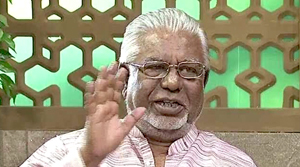
Born in Madurai on November 9, 1937, Abdul Rahman did post-graduation in Tamil before joining the Islamiah College in Vaniyambadi, Vellore district as a teacher. He had subsequently become Head of Tamil Department in the college and held the post nearly for 20 years. Later, he took to writing on a full time basis.

When he got the Sahitya Akademi award in 1999 for his collection of poems, Aalapanai, it was a “poetic irony.” He was, till then, known as a bitter critic of the Akademi for not giving Tamil poets their due.

His criticism was not unjustified then as it took over 30 years for the Akademi to identify a work of Tamil poetry for its award. The last piece of Tamil poetry bagging the award was Vellai Paravai, authored by A. Srinivasa Raghavan, and that was in 1968.

After Abdul Rahman's, three more works of Tamil poetry received the national institution's recognition and one of them was Akayathukku Aduthaveedu, written by Mu. Metha, for 2006.

Vairamuthu, another prominent Tamil poet, was, however, given the Akademi award for his novel, Kallikattu Ithikasam, in 2003.

In an hour-long meeting with this writer some years ago, Abdul Rahman had blamed his literary fraternity for having failed in projecting to the outside world "the unique aspects of Tamil poetry." He had strongly felt that it was due to "our deficiency" that Tamil poetry had not been accorded the importance that it deserved at the national level.

As one who had demonstrated his skill in using the complexities of imagery and symbolism in poetry, Abdul Rahman called himself a neo-classicist. In his later part of life, he devoted time to read the Vedas and Upanishads, “whose literary value,” he said, “is immense.” He acknowledged that many of his expressions and symbols were taken from them.

He was not the one who would ignore lyrics used in Tamil feature films which were also, according to him, one form of poetry. He was of the view of that Kannadasan's best pieces were his film songs.

He received several awards and honours such as the State Government's 'Kalaimamani' title (1989), and 'Agni Akshara' Award (1992).

Abdul Rahman closely identified himself with Dravida Munnetra Kazhagam's president and former Chief Minister M. Karunanidhi, who, he once said, was a “pioneer in adopting the form of poetic prose.”

D. Ravikumar, Tamil poet-writer and Viduthalai Chiruthaigal Katchi general secretary, said "Kavikko" had successfully experimented new forms in Tamil poetry.

Here is a poem of Abdul Rahman in his work, Pyramids in the Desert:'

The leaders also die like all of us

But, the leaders' death alone becomes irreparable loss

Still, the thrones are not kept vacant.

Comments

Add new comment

  • Coastaldigest.com reserves the right to delete or block any comments.
  • Coastaldigset.com is not responsible for its readers’ comments.
  • Comments that are abusive, incendiary or irrelevant are strictly prohibited.
  • Please use a genuine email ID and provide your name to avoid reject.
Agencies
February 25,2020

Agra, Feb 25: The architectural grandeur of 17th century Taj Mahal and the story of its construction by Mughal Emperor Shah Jahan left US President Donald Trump "impressed" during his visit to the famed mausoleum, according to the guide who accompanied him.

Nitin Kumar, an Agra-based guide, said the first word the president said after laying his eyes on the marble marvel was "incredible".

He and First Lady Melania Trump visited on Monday the iconic Taj Mahal in Agra, the second stop on his little less than 36-hour-long trip of India, and marvelled at the Mughal-era mausoleum built as a monument of love.

After Dwight David Eisenhower (1959) and Bill Clinton (2000), he became the third US president to visit the architectural icon.

"I told them the story of the Taj Mahal, the construction, and the story behind it. President Trump got very emotional after knowing the story of Shah Jahan and his wife Mumtaz Mahal. How he was kept under house arrest by his own son Aurangzeb, and buried here at Taj, next to Mumtaz's grave, after his death," Kumar told reporters.

The couple was left speechless on the first sight of the monument, and showed interest when they were told about the history and architecture of the dome, and the design details, Kumar said.

"Melania Trump asked about the mud-pack treatment and was amazed when she got to know the details of the process," he said.

One of the most photographed sites in the world, it is always high on the itinerary of head of states visiting India.

The monument was built over a period of nearly 20 years by Shah Jahan in memory of his wife after her death in 1631.

"The Taj Mahal inspires awe, a timeless testament to the rich and diverse beauty of Indian Culture!' Thank You, India," the US President and First Lady jointly wrote in the visitors' book before signing it.

According to Mohammed Zafar, who lives close to Taj Mahal complex, Nitin has been conducting guided tours for many years. "He was selected for this VVIP visit," he said.

"Many people were taking selfies with him, after the end of the visit. So, many media persons interacted with him. He has got some instant fame of sorts," Zafar said.

Authorities at Archaeological Survey of India had "advanced the dates" for mud-pack treatment for the graves of Shah Jahan and Mumtaz Mahal at Taj Mahal in view of the US President Trump's visit to Taj, a senior official had earlier said.

Comments

Add new comment

  • Coastaldigest.com reserves the right to delete or block any comments.
  • Coastaldigset.com is not responsible for its readers’ comments.
  • Comments that are abusive, incendiary or irrelevant are strictly prohibited.
  • Please use a genuine email ID and provide your name to avoid reject.
News Network
January 20,2020

Davos, Jan 20: India's richest 1 per cent hold more than four-times the wealth held by 953 million people who make up for the bottom 70 per cent of the country's population, while the total wealth of all Indian billionaires is more than the full-year budget, a new study said on Monday.

Releasing the study 'Time to Care' here ahead of the 50th annual meeting of the World Economic Forum (WEF), rights group Oxfam also said the world's 2,153 billionaires have more wealth than the 4.6 billion people who make up 60 per cent of the planet's population.

The report flagged that global inequality is shockingly entrenched and vast and the number of billionaires has doubled in the last decade, despite their combined wealth having declined in the last year.

"The gap between rich and poor can't be resolved without deliberate inequality-busting policies, and too few governments are committed to these," said Oxfam India CEO Amitabh Behar, who is here to represent the Oxfam confederation this year.

The issues of income and gender inequality are expected to figure prominently in discussions at the five-day summit of the WEF, starting Monday. The WEF's annual global risks Report has also warned that the downward pressure on the global economy from macroeconomic fragilities and financial inequality continued to intensify in 2019.

Concern about inequality underlies recent social unrest in almost every continent, although it may be sparked by different tipping points such as corruption, constitutional breaches, or the rise in prices for basic goods and services, as per the WEF report.

Although global inequality has declined over the past three decades, domestic income inequality has risen in many countries, particularly in advanced economies and reached historic highs in some, the Global Risks Report flagged last week.

The Oxfam report further said "sexist" economies are fuelling the inequality crisis by enabling a wealthy elite to accumulate vast fortunes at the expense of ordinary people and particularly poor women and girls.

Regarding India, Oxfam said the combined total wealth of 63 Indian billionaires is higher than the total Union Budget of India for the fiscal year 2018-19 which was at Rs 24,42,200 crore.

"Our broken economies are lining the pockets of billionaires and big business at the expense of ordinary men and women. No wonder people are starting to question whether billionaires should even exist," Behar said.

As per the report, it would take a female domestic worker 22,277 years to earn what a top CEO of a technology company makes in one year.

With earnings pegged at Rs 106 per second, a tech CEO would make more in 10 minutes than what a domestic worker would make in one year.

It further said women and girls put in 3.26 billion hours of unpaid care work each and every day -- a contribution to the Indian economy of at least Rs 19 lakh crore a year, which is 20 times the entire education budget of India in 2019 (Rs 93,000 crore).

Besides, direct public investments in the care economy of 2 per cent of GDP would potentially create 11 million new jobs and make up for the 11 million jobs lost in 2018, the report said.

Behar said the gap between rich and poor cannot be resolved without deliberate inequality-busting policies, and too few governments are committed to these.

He said women and girls are among those who benefit the least from today's economic system.

"They spend billions of hours cooking, cleaning and caring for children and the elderly. Unpaid care work is the 'hidden engine' that keeps the wheels of our economies, businesses and societies moving.

"It is driven by women who often have little time to get an education, earn a decent living or have a say in how our societies are run, and who are therefore trapped at the bottom of the economy,” Behar added.

Oxfam said governments are massively under-taxing the wealthiest individuals and corporations and failing to collect revenues that could help lift the responsibility of care from women and tackle poverty and inequality.

Besides, the governments are also underfunding vital public services and infrastructure that could help reduce women and girls' workload, the report said.

As per the global survey, the 22 richest men in the world have more wealth than all the women in Africa.

Besides, women and girls put in 12.5 billion hours of unpaid care work each and every day -- a contribution to the global economy of at least USD 10.8 trillion a year, more than three times the size of the global tech industry.

Getting the richest one per cent to pay just 0.5 per cent extra tax on their wealth over the next 10 years would equal the investment needed to create 117 million jobs in sectors such as elderly and childcare, education and health.

Governments must prioritise care as being as important as all other sectors in order to build more human economies that work for everyone, not just a fortunate few, Behar said.

Oxfam said its calculations are based on the latest data sources available, including from the Credit Suisse Research Institute's Global Wealth Databook 2019 and Forbes' 2019 billionaires list.

Comments

Add new comment

  • Coastaldigest.com reserves the right to delete or block any comments.
  • Coastaldigset.com is not responsible for its readers’ comments.
  • Comments that are abusive, incendiary or irrelevant are strictly prohibited.
  • Please use a genuine email ID and provide your name to avoid reject.
News Network
June 8,2020

Panaji (Goa)/Bhopal (Madhya Pradesh), Bengaluru(Karnataka)/New Delhi [India], June 8 (ANI): With the government allowing the re-opening of restaurants and eateries from Monday, these establishments re-opened across several states on Monday including in Goa, Madhya Pradesh and Delhi, with necessary precautions in place amid COVID-19 crisis.

Restaurants reopened in Panaji today after relaxations in lockdown.

Speaking to ANI, Goa Hotel and Restaurant Association President, Gaurish Dhond said, "We expect that not more than 25 per cent of restaurants will reopen because our labour force is dependent upon migrant workers who have gone to their homes".

"Every guest will be checked with a thermal gun, we will provide them with a sanitizer and a digital menu most probably. We would like to request our customers to pay online. Residential hotels are also allowed to operate and guidelines have been issued for them," he added.

Bars are not allowed to operate, he added.

While religious places across the country were thrown open today, worship places continued to remain closed in Goa till June 30.

In Bhopal restaurants opened but with fewer customers venturing to eat outside.

Speaking to ANI, C Kumaran, Manager, India Coffee House, New Market said, "We will conduct a temperature check for customers at the entry point. Then the customers will have to wash and sanitize their hands only then they will be allowed to sit inside. Only two persons will be allowed to sit on a four-seat table."

"This restaurant has a seating capacity of around 120 persons which has now been reduced to 50. Even in the kitchen, staff capacity has been reduced to 50 per cent," he added.

Meanwhile, malls re-opened in Bengaluru today, people along with staff members were allowed to enter inside Garuda Mall while maintaining social distancing.

"As per government norms, we are following all the preventive measures. Staff and other people are being sanitized and then only allowed inside the mall. The mall has been deep cleaned. People entering the mall should have Aarogya Setu App installed in their mobile phones if not, they will be sent back," said John Joseph, Manager, Garuda Mall.

Restaurants re-opened in the national capital as Delhi CM Arvind Kejriwal announced yesterday that all restaurants and malls are allowed to resume operations from today.

Comments

Add new comment

  • Coastaldigest.com reserves the right to delete or block any comments.
  • Coastaldigset.com is not responsible for its readers’ comments.
  • Comments that are abusive, incendiary or irrelevant are strictly prohibited.
  • Please use a genuine email ID and provide your name to avoid reject.