Post poll result violence: Muslim youth stabbed by BJP worker in Uppala

[email protected] (CD Network)
May 22, 2016

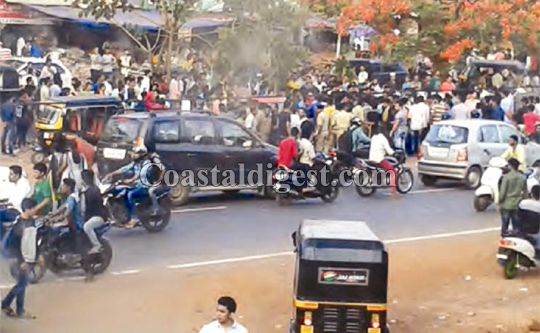
Manjeshwar, May 22: The Sangh Parivar activists, who are indulging in violence across Kasaragod district after the announcement of Assembly poll results earlier this week, attacked a Muslim youth at Uppalla, near here on Saturday.

uppalaviolence

Muneer (24), son of Abdullah, a resident of Uppala, was waylaid and stabbed when he was returning home from Cherugoli village, police sources said. The assailant has been identified as Rajesh, a local BJP activist.

A critically injured Muneer is undergoing treatment at the intensive care unit of a private hospital in Mangaluru.

Enraged over the attack on an innocent youth, the local residents staged protest in Uppala town and damaged to motorbike belonging to the accused.

Police had to resort to baton charge thrice to disperse the mob and bring the situation under control. Security has been stepped up in the area following the violence.

The Sangh Parivar activists had staged violent protests and targeted individuals in Kasargod, Majeshwar, Kanhangad and other parts of Kasaragod district on Thursday after the announcement of poll results.

Kanhangad MLA E Chandrasekharan also suffered injuries on his hand after some BJP workers threw stones at him at Mavungal near Kanhangad when he was taking part in a road show following his victory.

Comments

Mohan Marakada
 - 
Sunday, 22 May 2016

Election over now Skelton of jealous ego heads

Kushwant Bhat
 - 
Sunday, 22 May 2016

Wa Wa Congratulations winners, but RSS Criminal Looters totally defeated no way, they are tried several Hundred short cut roots at least win a seat in Holiest Kasargod, their main agenda was \Divide a particular community vote and Win\" utterly defeated, afterwards no other way to fight, sending \"Rajesh\" like innocent youngster's telling many amny promises, really Rajesh Like Innocent is becoming Victims, you see Now Rajesh Life is gone, If he read this article Understand, Master Minded Criminal 'Surendra\" who organised this type of Terrorism he is safe, but Rajesh in front of Gunpoint. this is the RSS agenda.
Understand you people good for your feature life, Kasargodians Voters knows very well.
Jai Hoo Bharath Math Ki."

Add new comment

  • Coastaldigest.com reserves the right to delete or block any comments.
  • Coastaldigset.com is not responsible for its readers’ comments.
  • Comments that are abusive, incendiary or irrelevant are strictly prohibited.
  • Please use a genuine email ID and provide your name to avoid reject.
News Network
April 19,2020

Bengaluru, Apr 19: Karnataka Deputy Chief Minister CN Ashwath Narayan on Sunday said that "only essential and critical number of" employees of the Information Technology (IT) companies will be allowed to work from offices from April 20 onwards in Bengaluru, while others will have to continue working from home.

"Only essential and critical number of employees required will be allowed to turn up. In the next two days, it will be reviewed and a suitable decision will be taken. 

All the details will be communicated to the IT companies," Narayan said here.

Earlier on Saturday, in a meeting to review COVID-19 situation in Karnataka, it was considered that one-third of the employees of IT and biotechnology companies could be allowed to work from the office premises, while the rest should continue to work from home.

Earlier on April 17, the Deputy CM, after holding a video conference meeting with heads of the IT and biotechnology companies, had told reporters that up to 50 per cent of the workforce would have the opportunity to function from office premises after April 20.

Comments

Add new comment

  • Coastaldigest.com reserves the right to delete or block any comments.
  • Coastaldigset.com is not responsible for its readers’ comments.
  • Comments that are abusive, incendiary or irrelevant are strictly prohibited.
  • Please use a genuine email ID and provide your name to avoid reject.
News Network
August 7,2020

Bengaluru, Aug 7: Amid the rising number of COVID-19 cases in Karnataka, the state's health department issued fresh guidelines for the disposal of bodies of COVID patients.

"Although an increased risk of COVID infection from a dead body to health workers or family members who follow standard precautions while handling the body is unlikely, the lack of scientific data requires the utmost care to avoid the inadvertent spread of COVID-19 during these times," the statement from the health department's press release read, emphasising on the dignity of the dead and the religious and cultural tradition.

The 23-page press release elaborated on guidelines regarding testing, handling of dead bodies and other specificities in relation to the management of COVID-19 bodies.

"Testing should not be insisted in every case of death, but only when they have a recorded history of influenza-like symptoms. The body should be handed over to the family members/ relatives in a dignified manner immediately after swab collection and hospitals should provide handouts with a list of dos and don'ts in English and Kannada laying down relevant information," the statement said.

It added, "At the mortuary, health care workers, mortuary staff and the family of the deceased body shall not come in direct contact with the dead body and must wear full personal protective equipment (PPE). If the family or relative are for any reason unable to cremate or bury the body, the local health authority shall arrange for the dignified last rites as per the religious traditions of the family."

Regarding autopsies (post mortem) on COVID-19 bodies, the state department said that they should be avoided, except in necessary circumstances.

The statement also gave detailed guidelines regarding the appropriate recording of COVID-19 deaths in line with the Indian Council of Medical Research (ICMR) guidelines.

Additionally, the health department made a statement about the admission procedure for COVID positive patients referred by other district administrations saying, "It is now mandatory for all the referrals from the BBMP admission and discharge of COVID positive patients to be done through the online COVID Hospital Bed Management System (CHBMS)."

The state's count of coronavirus cases was 1,51,449 in the past 24 hours.

So far, a total of 2,804 people have died due to COVID-19 in the state, while the average recovery rate in Karnataka is 49.3 per cent.

Comments

Add new comment

  • Coastaldigest.com reserves the right to delete or block any comments.
  • Coastaldigset.com is not responsible for its readers’ comments.
  • Comments that are abusive, incendiary or irrelevant are strictly prohibited.
  • Please use a genuine email ID and provide your name to avoid reject.
Media Release
February 14,2020

Veteran journalist P. Sainath has said that the nation is in a crisis. And this crisis is not limited to just the rural area. It has become a national crisis at various areas such as agriculture, education, economy, job creation etc.

He was delivering the endowment lecture on the topic ‘Indian democracy at the post-liberalization and post-truth era’ at Media Manthan 2020 organized by the PG department of journalism and mass communication at St Aloysius College (Autonomous). 

Mr Sainath said that the many policies adopted in the 90s led to India becoming unusually unequal. Referring to the speech Ambedkar had made at the Constituent Assembly while handing over the draft of the Constitution, Mr Sainath said, “Ambedkar had warned about the weakness of Indian democracy that liberty without equality allows the supremacy of a few over the multitude. Liberty, equality and fraternity must be kept together as we cannot have one without the other.” 

Mr Sainath stated that the agrarian crisis was no longer about the loss of productivity, employment or about farmer suicide; it was a societal, civilizational crisis. Commenting on the lopsided policies such as cow-slaughter ban, he explained how cow slaughter ban had adversely affected many industries due to their interdependency. While Muslims who slaughtered cows were rendered helpless, the cattle traders who were mostly OBCs lost their earnings as the cattle prices crashed. An important industry like Kolhapur sandals industry in Maharashtra went bankrupt as a result of the cow slaughter ban in Maharashtra. He said the policymakers had no idea how the rural industries were interconnected. Demonetisation too devastated the rural economy as 98 percent of rural transactions happen through cash. 

Mr Sainath also spoke about the crisis of inequality which affects the Dalits and the Adivasis far more than anyone else as 90 percent of the rural households take home less than Rs 10,000/- per month. “Women are yet another group whose labour is never counted in the gross domestic product. Women and girls globally do unpaid work which amounts to about 12.5 billion working hours per year. Monetarily speaking, this is worth 10.8 trillion dollars,” Mr Sainath added. 

Speaking about the crisis of jobs Mr Sainath said that major companies were laying off employees just to create more profits for the investors and the adoption of artificial intelligence in the industry would further destroy millions of jobs.

Rector of St Aloysius College Institutions Fr Dionysius Vaz SJ, Principal Dr (Fr) Praveen Martis SJ, HOD of Journalism and Mass Communication department Dr (Fr) Melwyn Pinto SJ were present.

‘Veerappan and Vijay Mallya’s business models are interesting!’

Addressing the gathering during his endowment lecture on Friday, Mr Sainath made an interesting comment on the so called ‘revenue model’. “Whenever I visit IIMs and IITs for lectures on my PARI project, the students there ask me what my revenue model for my project is. I tell them that I do not have a revenue model. In fact, journalism does not begin with a revenue model. Gandhiji, Ambedkar, Bhagat Singh were all great journalists. But they did not have a revenue model,” Mr Sainath said.

On a lighter note, he said that the best revenue model that he liked was that of forest brigand Veerappan and liquor baron Vijay Mallya. “Veerappan ruled the forest for forty years and from the top ministers to the villagers he could dictate terms and liver royally. Similarly, Mallya’s revenue model was to steal the banks and run away abroad and live like a king,” Mr Sainath added.

Journalism is not and can never be a business. It is a calling, he opined. While newspaper can be a business, television can be a business, journalism per se cannot be reduced to a business. “Unfortunately today, journalists are recruited on a contract basis and they have no bargaining power; and there are no unions to fight for their cause. Hence, they are at the mercy of the corporate media houses for their survival and are made to write stories that cannot be called journalism,” Mr Sainath said.

Answering a question as to the pressures he faced as a journalist, he said that external pressures from the government or others could be very well handled. It is the internal pressures from once own media house that journalists find it difficult to manage.


 

Comments

Add new comment

  • Coastaldigest.com reserves the right to delete or block any comments.
  • Coastaldigset.com is not responsible for its readers’ comments.
  • Comments that are abusive, incendiary or irrelevant are strictly prohibited.
  • Please use a genuine email ID and provide your name to avoid reject.