



President, Sonia express concern over lynching incidents

Agencies
July 2, 2017

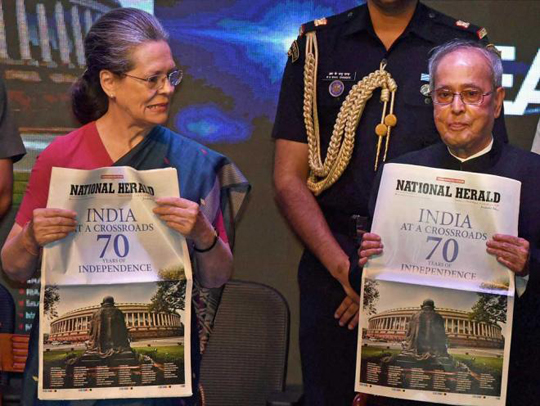
New Delhi, Jul 2: President Pranab Mukherjee joined Congress president Sonia Gandhi in expressing serious concern over growing number of mob lynching cases in India, wondering whether the society is vigilant enough to save the basic tenets of the country.
sonia

“When mob lynching becomes so high and uncontrollable, we have to pause and reflect, are we vigilant enough?,” Mukherjee said at the release of commemorative publication of relaunched National Herald here.

Sonia Gandhi, who spoke at the function, said, "It is being encouraged by a culture of vigilante violence, actively supported by those who are supposed to enforce the law."

Later, Priyanka Gandhi Vadra, daughter of the Congress president, told reporters that "It (incident of lynching) makes my blood boil. It should make blood of every Indian boil."

Mukherjee's comment and Sonia Gandhi's criticism came in the wake of reports about the spiralling violence over beef.

Mukherjee, who retires later this month, said, "When mob frenzy becomes so high, irrational and uncontrollable, we have to pause and reflect. I am not talking of vigilantism, I am talking of are we vigilant enough, proactively to save the basic tenets of our country.”

He said, "I do believe that citizens' and media vigilance can act as the biggest deterrent to forces of darkness and backwardness."

Congress president Sonia Gandhi said India is being marked by increasing threats of 'authoritarianism.'

She said, "Today the tried and tested idea of India has been thrown fundamentally into question by rising intolerance, by malevolent forces. It is being encouraged by a culture of vigilantive violence, actively supported by those who are supposed to enforce the law."

Gandhi further said that National Herald newspaper, which has been revived, is a testament to unity and justice and "not the division and hate that the present times are witnessing.

She said, "We are in a war of ideas, we have reached this war to preserve our ideas, which have built India as a model of democracy diversity and coexistence.if we don't raise our voices, if we do not speak up, our voices will be taken as consent."

A day after nationwide protests against lynchings spilt onto the streets, Modi had on Thursday broke his silence at Sabarmati Ashram in Gujarat and said killing people in the name of gau bhakti (devotion to the cow) is not acceptable.

The PM also said Mahatma Gandhi would not have approved of it and that no person in the country has the right to take the law into his own hands.

However, Modi's warning seemed to have had a little effect as just hours after his speech, Alimuddin, a meat trader, was lynched in Jharkhand’s Ramgarh.

Many cities witnessed protests across various locations under the tagline “Not in My Name” to protest against the lynching of 15-year-old Junaid Khan in a Mathura-bound train last week.

Comments

AK
 - 
Thursday, 6 Jul 2017

Thats VERY VERY GOOD .. Many families will give blessing to siddaramaiah...

Only Drunkards will not be happy with the closer.

Abdullah
 - 
Sunday, 2 Jul 2017

Worst President and opposition party ever faced in India.

Add new comment

  • Coastaldigest.com reserves the right to delete or block any comments.
  • Coastaldigset.com is not responsible for its readers’ comments.
  • Comments that are abusive, incendiary or irrelevant are strictly prohibited.
  • Please use a genuine email ID and provide your name to avoid reject.
News Network
January 1,2020

Kolkata, Jan 1: US-based Bangladeshi author and playwright Sharbari Zohra Ahmed feels that the people of the country of her origin are more alike than different from Indians as they were originally Hindus.

But Bangladeshis now want to forget their Hindu roots, said the author, who was born in Dhaka and moved to the United States when she was just three weeks old.

Ahmed, who is the co-writer of the Season 1 of 'Quantico', a popular American television drama thriller series starring Priyanka Chopra, rues that her identity as a Bengali is getting lost in Bangladesh due to the influence of right-wing religious groups.

"How can Bangladesh deny its Hindu heritage? We were originally Hindus. Islam came later," Ahmed said while speaking to PTI here recently.

"The British exploited us, stole from us and murdered us," she said about undivided India, adding that the colonialists destroyed the thriving Muslin industry in Dhaka.

Ahmed said the question of her belief and identity in Bangladesh, where the state religion is Islam, has prompted her to write her debut novel 'Dust Under Her Feet'.

The British exploitation of India and the country's partition based on religion has also featured in her novel in a big way.

Ahmed calls Winston Churchill, the British prime minister during World War II, a "racist".

"He took the rice from Bengal to feed his soldiers and didn't care when he was told about that.

"During my research, I learnt that two million Bengalis died in the artificial famine that was created by him. When people praise Churchill, it is like praising Hitler to the Jews. He was horrible," she said.

The author said her novel is an effort to tell the readers what actually happened.

"Great Britain owes us three trillion dollars. You have to put in inflation. Yet, they (the British) still have a colonial mentality and white colonisation is on the rise again," Ahmed, who was in the city to promote her novel, said.

The novel is based in Kolkata, then Calcutta, during World War II when American soldiers were coming to the city in large numbers.

The irony was that while these American soldiers were nice to the locals, they used to segregate the so-called "black" soldiers, the novelist said.

"Calcutta was a cosmopolitan and the rest of the world needs to know how the city's people were exploited, its treasures looted, people divided and hatred instilled in them," she said.

"Kolkata was my choice of place for my debut novel since my mother was born here. She witnessed the 'Direct Action Day' when she was a kid and was traumatised. She saw how a Hindu was killed by Muslims near her home in Park Circus area (in the city)," Ahmed said.

Direct Action Day, also known as the Great Calcutta Killings, was a massive communal riot in the city on August 16, 1946 that continued for the next few days.

Thousands of people were killed in the violence that ultimately paved the way for the partition of India.

'Dust Under Her Feet' is set in the Calcutta of the 1940s and Ahmed in her novel examines the inequities wrought by racism and colonialism.

The story is of young and lovely Yasmine Khan, a doyenne of the nightclub scene in Calcutta.

When the US sets up a large army base in the city to fight the Japanese in Burma, Yasmine spots an opportunity.

The nightclub is where Yasmine builds a family of singers, dancers, waifs and strays.

Every night, the smoke-filled club swarms with soldiers eager to watch her girls dance and sing.

Yasmine meets American soldier Lt Edward Lafaver in the club and for all her cynicism, finds herself falling helplessly for a married man who she is sure will never choose her over his wife.

Outside, the city lives in constant fear of Japanese bombardment at night. An attack and a betrayal test Yasmine's strength and sense of control and her relationship with Edward.

Ahmed teaches creative writing in the MFA program in Manhattanville College and is artist-in-residence in Sacred Heart University's graduate film and television programme.

Comments

abdullah
 - 
Wednesday, 1 Jan 2020

Is she trying to take over Shoorpanakhi Taslim Nasreen? 

Add new comment

  • Coastaldigest.com reserves the right to delete or block any comments.
  • Coastaldigset.com is not responsible for its readers’ comments.
  • Comments that are abusive, incendiary or irrelevant are strictly prohibited.
  • Please use a genuine email ID and provide your name to avoid reject.
Agencies
June 29,2020

New Delhi, Jun 29: Fuel prices rose on Monday again after a days pause with oil marketing companies increasing the pump price of petrol by 5 paisa and diesel by 13 paisa per litre in Delhi.

In the national capital, petrol price on Monday stood at Rs 80.43 per litre while that of diesel at Rs 80.53 a litre.

With this increase, fuel prices have moved up on 22 of the last 23 days (with no rise on Sunday). Petrol prices, however, were unchanged for an additional day in between after the daily revision based on dynamic pricing was reinstated by OMCs.

Since the daily price revision resumed on June 7, petrol price has increased Rs 9.17 and diesel rose by Rs 11.14 in the national capital. In the other cities the magnitude of increase was similar.

During the past 23 days, the quantum of price hike gradually declined from around 60 paise raise for a few days, immediately post the resumption of daily price revision, to less than 20 paise during the past few days and now even less than 10 paisa per litre.

In a historic development, the price of diesel surged above that of petrol in the national capital during this period. It continues to remain higher even though on Saturday the quantum of petrol price hike was higher than that of diesel.

Officials in oil marketing companies said that it is hard to predict which of the two fuels will be priced higher in the Capital as the gap between the two is almost negligible. But petrol prices have shown more volatility in international markets that may take it ahead once again in coming days.

Apart from Delhi, the retail prices of petrol and diesel have followed the traditional path in other metros with petrol being priced at a premium of between Rs 5 and 8 per litre. The difference between the auto fuel prices in Delhi and other metros is because of the taxation structure.

While both petrol and diesel are at similar levels of taxes (state and centre) in Delhi, it is higher for petrol in many other Indian cities.

Globally diesel is priced a tad higher than petrol. In India too, the base price of diesel is slightly higher than petrol but taxation at central and state levels changed the complexion of retail prices.

If the price of petroleum products and crude hold their positions in global markets, then petrol and diesel prices rise may stop for a longer period and we may even see marginal fall in prices.

Fuel prices have been increasing since June 7 when oil companies began the daily price revision mechanism after a hiatus of 82 days during the lockdown.

Comments

Add new comment

  • Coastaldigest.com reserves the right to delete or block any comments.
  • Coastaldigset.com is not responsible for its readers’ comments.
  • Comments that are abusive, incendiary or irrelevant are strictly prohibited.
  • Please use a genuine email ID and provide your name to avoid reject.
News Network
January 28,2020

Panaji, Jan 28: Bureaucrat-turned-activist Kannan Gopinathan on Tuesday said even some "RSS people" are convinced the Citizenship Amendment Act is a bad law but are keeping quiet as the NDA government at the Centre is their own baby.

Speaking in Panaji, he further said the Narendra Modi government was behaving like a "drunken teenager" which needs to be questioned or else it will end up destroying homes.

"I was detained twice in UP, kept the whole day, because they (government) do not want the questioning (of CAA). I have met so many RSS people, they also understand this...if you have this conversation, they also understand the government has done something (wrong) and they have been asked to support it," he claimed.

He said the line of thought among these RSS people (he met) was "just support it (CAA)" as they don't want an altercation because the "government is their baby".

"He (government) is not a normal baby, he is a drunken teenager. He should be asked questions because when he starts destroying, he does not destroy somebody else's home but your own home," Gopinathan said.

He also hit out at those who have been claiming that the people protesting against the CAA are unaware about the law and have not even read it.

Gopinathan claimed if one had asked supportive MPs about the CAA on the day it was passed in Parliament, several of them would not have been able to speak on it as "they would not have known what was passed, because they were not given time (to go through the bill)".

He said, earlier, such legislation was passed after several rounds of consultation but "now, by night, it becomes an Act", adding (now) "everything is a surgical strike".

Gopinathan, in a possible reference to the National Register of Citizens exercise carried out in Assam, also claimed "thousands of people are in detention centres".

"It is your fundamental right to peacefully assemble without arms, Article 19 (1) (D) (of the Constitution)," he said at a function organised by a group opposed to CAA.

Gopinathan said people "always felt they were in a democracy" because they never tried to fly, when in reality "you are in a cage".

"The moment you want to fly you realise you are in a cage," he said, adding that "we have to question, we have to ask ourselves where are we going".

"When you don't allow a person to speak against an incorrect legislation, then what is democracy? What is freedom of expression?" Gopinathan questioned.

Gopinathan, a 2012 batch AGMUT cadre Indian Administrative Service officer, was the secretary, Power Department of the Union Territories of Daman and Diu, and Dadra and Nagar Haveli when he resigned on August 21 last year.

At the time, he had claimed the people of Jammu and Kashmir were being denied freedom of expression following abrogation of Article 370 by the Centre.

Comments

Add new comment

  • Coastaldigest.com reserves the right to delete or block any comments.
  • Coastaldigset.com is not responsible for its readers’ comments.
  • Comments that are abusive, incendiary or irrelevant are strictly prohibited.
  • Please use a genuine email ID and provide your name to avoid reject.