



President, Sonia express concern over lynching incidents

Agencies
July 2, 2017

New Delhi, Jul 2: President Pranab Mukherjee joined Congress president Sonia Gandhi in expressing serious concern over growing number of mob lynching cases in India, wondering whether the society is vigilant enough to save the basic tenets of the country.
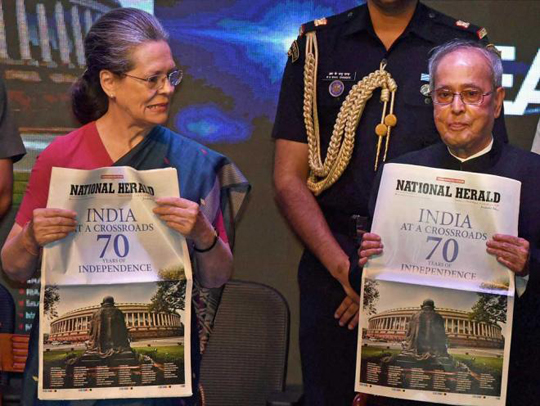
sonia

“When mob lynching becomes so high and uncontrollable, we have to pause and reflect, are we vigilant enough?,” Mukherjee said at the release of commemorative publication of relaunched National Herald here.

Sonia Gandhi, who spoke at the function, said, "It is being encouraged by a culture of vigilante violence, actively supported by those who are supposed to enforce the law."

Later, Priyanka Gandhi Vadra, daughter of the Congress president, told reporters that "It (incident of lynching) makes my blood boil. It should make blood of every Indian boil."

Mukherjee's comment and Sonia Gandhi's criticism came in the wake of reports about the spiralling violence over beef.

Mukherjee, who retires later this month, said, "When mob frenzy becomes so high, irrational and uncontrollable, we have to pause and reflect. I am not talking of vigilantism, I am talking of are we vigilant enough, proactively to save the basic tenets of our country.”

He said, "I do believe that citizens' and media vigilance can act as the biggest deterrent to forces of darkness and backwardness."

Congress president Sonia Gandhi said India is being marked by increasing threats of 'authoritarianism.'

She said, "Today the tried and tested idea of India has been thrown fundamentally into question by rising intolerance, by malevolent forces. It is being encouraged by a culture of vigilantive violence, actively supported by those who are supposed to enforce the law."

Gandhi further said that National Herald newspaper, which has been revived, is a testament to unity and justice and "not the division and hate that the present times are witnessing.

She said, "We are in a war of ideas, we have reached this war to preserve our ideas, which have built India as a model of democracy diversity and coexistence.if we don't raise our voices, if we do not speak up, our voices will be taken as consent."

A day after nationwide protests against lynchings spilt onto the streets, Modi had on Thursday broke his silence at Sabarmati Ashram in Gujarat and said killing people in the name of gau bhakti (devotion to the cow) is not acceptable.

The PM also said Mahatma Gandhi would not have approved of it and that no person in the country has the right to take the law into his own hands.

However, Modi's warning seemed to have had a little effect as just hours after his speech, Alimuddin, a meat trader, was lynched in Jharkhand’s Ramgarh.

Many cities witnessed protests across various locations under the tagline “Not in My Name” to protest against the lynching of 15-year-old Junaid Khan in a Mathura-bound train last week.

Comments

AK
 - 
Thursday, 6 Jul 2017

Thats VERY VERY GOOD .. Many families will give blessing to siddaramaiah...

Only Drunkards will not be happy with the closer.

Abdullah
 - 
Sunday, 2 Jul 2017

Worst President and opposition party ever faced in India.

Add new comment

  • Coastaldigest.com reserves the right to delete or block any comments.
  • Coastaldigset.com is not responsible for its readers’ comments.
  • Comments that are abusive, incendiary or irrelevant are strictly prohibited.
  • Please use a genuine email ID and provide your name to avoid reject.
News Network
June 30,2020

New Delhi, Jun 30: The Home Ministry on Monday issued guidelines for 'Unlock 2.0' phase across country between July 1 and July 31. The report stated that COVID-19 lockdown shall continue to remain in force in containment zones till July 31. In containment zones, only essential activities to be allowed. The government's guidelines come on a day when Maharashtra and Tamil Nadu extended lockdowns in their respective states to July 31.

Unlock 2.0 Guidelines:

•   Schools, colleges, educational institutes wil remain closed till July 31. Online/distance learning shall continue to be permitted and shall be encouraged

•   Lockdown shall continue to remain in force in containment zones till July 31st.  In containment zones, only essential activities to be allowed.

•   Night Curfew shall continue to remain in force, between 10:00 pm and 5:00 am, except for essential activities and other relaxations.

•   Social/ political/ sports/ entertainment/ academic/ cultural/ religious functions and other large congregations remain prohibited.

•   International air travel, except as allowed by MHA, will also remain barred.

•   Shops depending upon their area, can have more than 5 persons at a time. However, they have to maintain adequate physical distance.

•   Training institutions of the central and state governments will be allowed to function with effect from July 15 and SOP in this regard will be issued by the Department of Personnel and Training.

Meanwhile, Union Home Secretary Ajay Bhalla wrote to Chief Secretaries of all states and UTs, urging them to ensure compliance of Unlock 2 guidelines and direct all concerned authorities for their strict implementation.

Comments

Add new comment

  • Coastaldigest.com reserves the right to delete or block any comments.
  • Coastaldigset.com is not responsible for its readers’ comments.
  • Comments that are abusive, incendiary or irrelevant are strictly prohibited.
  • Please use a genuine email ID and provide your name to avoid reject.
News Network
June 19,2020

Jun 19: Billionaire Mukesh Ambani on Friday announced that his oil-to-telecom conglomerate Reliance Industries is now net debt-free after raising a record Rs 1.69 lakh crore from global investors and a rights issue in under two months.

Reliance raised Rs 1.15 lakh crore from global tech investors by selling a little less than a quarter of the firm's digital arm, Jio Platforms Ltd, and another Rs 53,124.20 crore through a rights issue in the past 58 days.

Taken together with last year's sale of 49 per cent stake in fuel retailing venture to BP Plc of UK for Rs 7,000 crore, the total fund raised is in excess of Rs 1.75 lakh crore, the company said in a statement.

Reliance had a net debt of Rs 1,61,035 crore as on March 31, 2020. "With these investments, RIL has become net debt-free," it said.

"I have fulfilled my promise to the shareholders by making Reliance net debt-free much before our original schedule of March 31, 2021," Ambani said.

Jio Platforms - which houses the country's youngest but largest telecom firm Reliance Jio, raised Rs 1,15,693.95 crore from leading global investors including Facebook, Silver Lake, Vista Equity Partners, General Atlantic, KKR, Mubadala, ADIA, TPG, L Catterton and PIF since April 22, 2020.

Saudi Arabian sovereign wealth fund PIF buying 2.32 per cent stake in the unit for Rs 11,367 crore on June 18 "marks the end of Jio Platforms' current phase of induction of financial partners," the statement said.

Alongside, Reliance launched India's biggest right issue, which was subscribed to 1.59 times.

Though the rights issue size was Rs 53,124 crore, the company has got only 25 per cent of the money as the remaining is to be paid only next fiscal.

Ambani had at the company's annual general meeting on August 12, 2019, announced a roadmap for Reliance to become a net debt-free company before March 31, 2021.

"We have a very clear roadmap to becoming a zero net-debt company within the next 18 months that is by March 31, 202," he had said last year highlighting strong interest from strategic and financial investors in consumer businesses, Jio and Reliance Retail.

In the statement on Friday, he said he was both delighted and humbled to announce the fulfillment of the promise.

"Exceeding the expectations of our shareholders and all other stakeholders, again and yet again, is in the very DNA of Reliance," he said.

"Therefore, on the proud occasion of becoming a net debt-free company, I wish to assure them that Reliance in its Golden Decade will set even more ambitious growth goals, and achieve them," he added.

He said over the past few weeks, phenomenal interest was received from the global financial investor community in partnering with Jio.

"As our fundraising milestone from financial investors is achieved, we sincerely thank the marquee group of financial partners and warmly welcome them into Jio Platforms," he said.

"I also express my heartfelt gratitude to all the retail and institutional investors, both domestic and foreign, for their overwhelming participation in our record-setting Rights Issue," he added.

Comments

Add new comment

  • Coastaldigest.com reserves the right to delete or block any comments.
  • Coastaldigset.com is not responsible for its readers’ comments.
  • Comments that are abusive, incendiary or irrelevant are strictly prohibited.
  • Please use a genuine email ID and provide your name to avoid reject.
Agencies
June 6,2020

United Nations, Jun 6: The coronavirus disease has not "exploded" in India, but the risk of that happening remains as the country moves towards unlocking its nationwide lockdown that was imposed in March to contain the Covid-19, according to a top WHO expert.

WHO Health Emergencies Programme Executive Director Michael Ryan on Friday said the doubling time of the coronavirus cases in India is about three weeks at this stage.

“So the direction of travel of the epidemic is not exponential but it is still growing,” he said, adding that the impact of the pandemic is different in different parts of India and varies between urban and rural settings.

“In South Asia, not just in India but in Bangladesh and...in Pakistan, other countries in South Asia, with large dense populations, the disease has not exploded. But there is always the risk of that happening,” Ryan said in Geneva.

He stressed that as the disease generates and creates a foothold in communities, it can accelerate at any time as has been seen in a number of settings.

Ryan noted that measures taken in India such as the nationwide lockdown have had an impact in slowing transmission but the risk of an increase in cases looms as the country opens up.

“The measures taken in India certainly had an impact in dampening transmission and as India, as in other large countries, open up and as people begin to move again, there's always a risk of the disease bouncing back up,” he said.

He added that there are specific issues in India regarding the large amount of migration, the dense populations in the urban environment and the fact that many workers have no choice but to go to work every day.

India went past Italy to become the sixth worst-hit nation by the COVID-19 pandemic.

India saw a record single-day jump of 9,887 coronavirus cases and 294 deaths on Saturday, pushing the nationwide infection tally to 2,36,657 and the death toll to 6,642, according to the health ministry.

The lockdown in India, was first clamped on March 25 and spanned for 21 days, while the second phase of the curbs began on April 15 and stretched for 19 days till May 3. The third phase of the lockdown was in effect for 14 days and ended on May 17. The fourth phase ended on May 31.

The country had registered 512 coronavirus infection cases till March 24.

The nation-wide lockdown in containment zones will continue till June 30 in India but extensive relaxations in a phased manner from June 8 are listed in the Union home ministry's fresh guidelines on tackling the Covid-19 pandemic issued last week.

WHO Chief Scientist Soumya Swaminathan said the over 200,000 current coronavirus cases in India, a country of over 1.3 billion people, "look big but for a country of this size, it's still modest.”

She stressed that it is important for India to keep track of the growth rate, the doubling time of the virus and to make sure that that number doesn't get worse.

She said that India is a “heterogeneous and huge country” with very densely populated cities and much lower density in some rural areas and varying health systems in different states and these offer challenges to the control of Covid-19.

Swaminathan added that as the lockdown and restrictions are lifted, it must be ensured that all precautions are taken by people.

“We've been making this point repeatedly that really if you want behaviour change at a large level, people need to understand the rationale for asking them to do certain things (such as) wearing masks,” she said.

In many urban areas in India, it's impossible to maintain physical distancing, she said adding that it then becomes very important for people to wear appropriate face coverings when they are out, in office settings, in public transport and educational institutions.

“As some states are thinking about opening, every institution, organisation, industry and sector needs to think about what are the measures that need to be put in place before you can allow a functioning and it may never be back to normal.”

She said that in many professions working from home can be encouraged but in several jobs, people have to go to work and in such cases measures must be put in place that allow people to protect themselves and others.

“I think communication and behaviour change is a very large part of this whole exercise,” she added.

Comments

Add new comment

  • Coastaldigest.com reserves the right to delete or block any comments.
  • Coastaldigset.com is not responsible for its readers’ comments.
  • Comments that are abusive, incendiary or irrelevant are strictly prohibited.
  • Please use a genuine email ID and provide your name to avoid reject.