


President, Sonia express concern over lynching incidents

Agencies
July 2, 2017

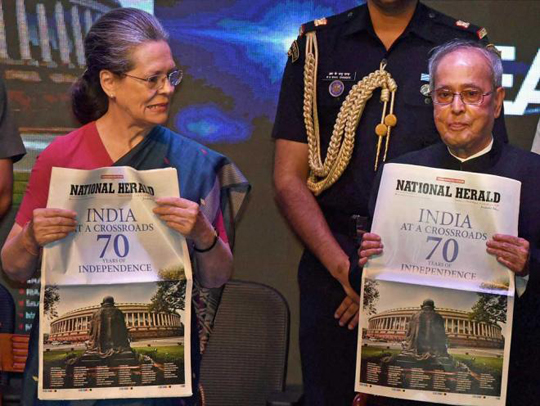
New Delhi, Jul 2: President Pranab Mukherjee joined Congress president Sonia Gandhi in expressing serious concern over growing number of mob lynching cases in India, wondering whether the society is vigilant enough to save the basic tenets of the country.
sonia

“When mob lynching becomes so high and uncontrollable, we have to pause and reflect, are we vigilant enough?,” Mukherjee said at the release of commemorative publication of relaunched National Herald here.

Sonia Gandhi, who spoke at the function, said, "It is being encouraged by a culture of vigilante violence, actively supported by those who are supposed to enforce the law."

Later, Priyanka Gandhi Vadra, daughter of the Congress president, told reporters that "It (incident of lynching) makes my blood boil. It should make blood of every Indian boil."

Mukherjee's comment and Sonia Gandhi's criticism came in the wake of reports about the spiralling violence over beef.

Mukherjee, who retires later this month, said, "When mob frenzy becomes so high, irrational and uncontrollable, we have to pause and reflect. I am not talking of vigilantism, I am talking of are we vigilant enough, proactively to save the basic tenets of our country.”

He said, "I do believe that citizens' and media vigilance can act as the biggest deterrent to forces of darkness and backwardness."

Congress president Sonia Gandhi said India is being marked by increasing threats of 'authoritarianism.'

She said, "Today the tried and tested idea of India has been thrown fundamentally into question by rising intolerance, by malevolent forces. It is being encouraged by a culture of vigilantive violence, actively supported by those who are supposed to enforce the law."

Gandhi further said that National Herald newspaper, which has been revived, is a testament to unity and justice and "not the division and hate that the present times are witnessing.

She said, "We are in a war of ideas, we have reached this war to preserve our ideas, which have built India as a model of democracy diversity and coexistence.if we don't raise our voices, if we do not speak up, our voices will be taken as consent."

A day after nationwide protests against lynchings spilt onto the streets, Modi had on Thursday broke his silence at Sabarmati Ashram in Gujarat and said killing people in the name of gau bhakti (devotion to the cow) is not acceptable.

The PM also said Mahatma Gandhi would not have approved of it and that no person in the country has the right to take the law into his own hands.

However, Modi's warning seemed to have had a little effect as just hours after his speech, Alimuddin, a meat trader, was lynched in Jharkhand’s Ramgarh.

Many cities witnessed protests across various locations under the tagline “Not in My Name” to protest against the lynching of 15-year-old Junaid Khan in a Mathura-bound train last week.

Comments

AK
 - 
Thursday, 6 Jul 2017

Thats VERY VERY GOOD .. Many families will give blessing to siddaramaiah...

Only Drunkards will not be happy with the closer.

Abdullah
 - 
Sunday, 2 Jul 2017

Worst President and opposition party ever faced in India.

Add new comment

  • Coastaldigest.com reserves the right to delete or block any comments.
  • Coastaldigset.com is not responsible for its readers’ comments.
  • Comments that are abusive, incendiary or irrelevant are strictly prohibited.
  • Please use a genuine email ID and provide your name to avoid reject.
News Network
June 22,2020

New Delhi, Jun 22: The Delhi Police Monday urged the Delhi High Court to grant them a day’s more time for seeking instructions on a plea by Jamia student Safoora Zargar, who was pregnant and arrested under the anti-terror law --UAPA--, seeking bail in a case related to communal violence in northeast Delhi during protests against the Citizenship Amendment Act in February.

Justice Rajiv Shakdher, who conducted the hearing through video conferencing, allowed the request after Zargar’s counsel said she has no objection to it and listed the matter for Tuesday.

Zargar, M Phil student of Jamia Millia Islamia University, is more than four months pregnant.

During the hearing, Solicitor General Tushar Mehta, representing the Delhi Police, sought a day’s time to take instructions on the issue and said it will be in “larger interest” if he is given indulgence.

Additional Solicitor General (ASG) Aman Lekhi also joined Mehta and said they are ready with the arguments on merits of the case but they do not intend to proceed on merits at this stage.

Advocate Nitya Ramakrishnan, appearing for Zargar, said the woman is in a delicate state and is in a fairly advanced stage pregnancy and if the police need time to respond to the plea, she be granted interim bail for the time being.

The high court asked Solicitor General (SG) Tushar Mehta to come back with instructions on Tuesday.

The police has also filed a status report in response to the bail plea.

Jamia Coordination Committee member Zargar, who was arrested by the Special Cell of Delhi Police on April 10, has challenged in the high court the June 4 order of the trial court denying her bail in the case.

The hearing in the high court also witnessed exchange of words between Mehta, Lekhi on one side and Delhi government standing counsel (criminal) Rahul Mehra who objected the appearance of the two senior law officers on behalf of Delhi Police in the case.

Mehra contended that unlike another North East Delhi violence matter in which requisite approval was sought by the Delhi Police to be represented by a team of lawyers led by the Solicitor General, no such procedure was followed in this case.

"They know that my view in such cases will be more humanitarian and not as per their whims and fancies. I am not supposed to be the mouth piece of the Delhi Police, I am an officer of the court," he said.

Lekhi shot back "a client chooses the lawyer and a lawyer cannot impose himself on the client.

He said this controversy would deviate the court from the issue in hand and Mehra's objection can be kept aside in this case.

The high court concluded the hearing, asking the counsel for Delhi Police to sort out their battles by tomorrow.

 The trial court, in its order, had said “when you choose to play with embers, you cannot blame the wind to have carried the spark a bit too far and spread the fire.”

It had said that during the course of investigation a larger conspiracy was discernible and if there was prima facie evidence of conspiracy, acts and statements made by any one of the conspirators, it is admissible against all.

The trial court had said that even if there was no direct act of violence attributable to the accused (Zargar), she cannot shy away from her liability under the provisions of the Unlawful Activities (Prevention) Act (UAPA).

However, the trial court had asked the concerned jail superintendent to provide adequate medical aid and the assistance to Zargar.

The police had earlier claimed that Zargar allegedly blocked a road near Jaffrabad metro station during the anti-CAA protests and instigated people that led to the riots in the area.

It further claimed that she was allegedly part of the “premediated conspiracy” to incite communal riots in northeast Delhi in February.

Communal clashes had broken out in northeast Delhi on February 24 after violence between citizenship law supporters and protesters spiralled out of control leaving at least 53 people dead and scores injured.

Comments

Add new comment

  • Coastaldigest.com reserves the right to delete or block any comments.
  • Coastaldigset.com is not responsible for its readers’ comments.
  • Comments that are abusive, incendiary or irrelevant are strictly prohibited.
  • Please use a genuine email ID and provide your name to avoid reject.
News Network
January 20,2020

Davos, Jan 20: India's richest 1 per cent hold more than four-times the wealth held by 953 million people who make up for the bottom 70 per cent of the country's population, while the total wealth of all Indian billionaires is more than the full-year budget, a new study said on Monday.

Releasing the study 'Time to Care' here ahead of the 50th annual meeting of the World Economic Forum (WEF), rights group Oxfam also said the world's 2,153 billionaires have more wealth than the 4.6 billion people who make up 60 per cent of the planet's population.

The report flagged that global inequality is shockingly entrenched and vast and the number of billionaires has doubled in the last decade, despite their combined wealth having declined in the last year.

"The gap between rich and poor can't be resolved without deliberate inequality-busting policies, and too few governments are committed to these," said Oxfam India CEO Amitabh Behar, who is here to represent the Oxfam confederation this year.

The issues of income and gender inequality are expected to figure prominently in discussions at the five-day summit of the WEF, starting Monday. The WEF's annual global risks Report has also warned that the downward pressure on the global economy from macroeconomic fragilities and financial inequality continued to intensify in 2019.

Concern about inequality underlies recent social unrest in almost every continent, although it may be sparked by different tipping points such as corruption, constitutional breaches, or the rise in prices for basic goods and services, as per the WEF report.

Although global inequality has declined over the past three decades, domestic income inequality has risen in many countries, particularly in advanced economies and reached historic highs in some, the Global Risks Report flagged last week.

The Oxfam report further said "sexist" economies are fuelling the inequality crisis by enabling a wealthy elite to accumulate vast fortunes at the expense of ordinary people and particularly poor women and girls.

Regarding India, Oxfam said the combined total wealth of 63 Indian billionaires is higher than the total Union Budget of India for the fiscal year 2018-19 which was at Rs 24,42,200 crore.

"Our broken economies are lining the pockets of billionaires and big business at the expense of ordinary men and women. No wonder people are starting to question whether billionaires should even exist," Behar said.

As per the report, it would take a female domestic worker 22,277 years to earn what a top CEO of a technology company makes in one year.

With earnings pegged at Rs 106 per second, a tech CEO would make more in 10 minutes than what a domestic worker would make in one year.

It further said women and girls put in 3.26 billion hours of unpaid care work each and every day -- a contribution to the Indian economy of at least Rs 19 lakh crore a year, which is 20 times the entire education budget of India in 2019 (Rs 93,000 crore).

Besides, direct public investments in the care economy of 2 per cent of GDP would potentially create 11 million new jobs and make up for the 11 million jobs lost in 2018, the report said.

Behar said the gap between rich and poor cannot be resolved without deliberate inequality-busting policies, and too few governments are committed to these.

He said women and girls are among those who benefit the least from today's economic system.

"They spend billions of hours cooking, cleaning and caring for children and the elderly. Unpaid care work is the 'hidden engine' that keeps the wheels of our economies, businesses and societies moving.

"It is driven by women who often have little time to get an education, earn a decent living or have a say in how our societies are run, and who are therefore trapped at the bottom of the economy,” Behar added.

Oxfam said governments are massively under-taxing the wealthiest individuals and corporations and failing to collect revenues that could help lift the responsibility of care from women and tackle poverty and inequality.

Besides, the governments are also underfunding vital public services and infrastructure that could help reduce women and girls' workload, the report said.

As per the global survey, the 22 richest men in the world have more wealth than all the women in Africa.

Besides, women and girls put in 12.5 billion hours of unpaid care work each and every day -- a contribution to the global economy of at least USD 10.8 trillion a year, more than three times the size of the global tech industry.

Getting the richest one per cent to pay just 0.5 per cent extra tax on their wealth over the next 10 years would equal the investment needed to create 117 million jobs in sectors such as elderly and childcare, education and health.

Governments must prioritise care as being as important as all other sectors in order to build more human economies that work for everyone, not just a fortunate few, Behar said.

Oxfam said its calculations are based on the latest data sources available, including from the Credit Suisse Research Institute's Global Wealth Databook 2019 and Forbes' 2019 billionaires list.

Comments

Add new comment

  • Coastaldigest.com reserves the right to delete or block any comments.
  • Coastaldigset.com is not responsible for its readers’ comments.
  • Comments that are abusive, incendiary or irrelevant are strictly prohibited.
  • Please use a genuine email ID and provide your name to avoid reject.
News Network
July 24,2020

New Delhi, Jul 24: The Delhi High Court on Friday asked the ICMR to come out with a clarification that mobile number, government-issued identity card, photographs or even a residential proof ought not to be insisted upon for Covid-19 test of mentally ill homeless persons.

According to an Indian Council of Medical Research (ICMR) advisory of June 19, every person who was to be tested for Covid-19 has to provide a government-issued identity proof and should have a valid phone number for tracing and tracking the individual and his/her contacts.

A bench of Chief Justice D N Patel and Justice Prateek Jalan said that ICMR should issue a clarification by way of a circular or an official order that the identity proof, address proof and mobile number are not required for testing mentally ill homeless persons.

The high court said a camp can be organised for testing such persons as is being done across Delhi for others.

"Guidelines have to be given by you (ICMR). You put it in black and white for the states'' benefit. You only need to clarify in two-three lines that mobile number, address proof and identity cards are not required for testing mentally ill homeless persons," it said.

"Use your powers for the public at large. Once you do so (issue the clarification), all states will comply," the bench added.

Additional Solicitor General Chetan Sharma, appearing for ICMR, sought time to take instructions from the government regarding the observations made by the bench.

The high court, thereafter, listed the matter for further hearing on August 7.

The bench was hearing a PIL moved by advocate Gaurav Kumar Bansal seeking directions to ICMR and Delhi government to issue guidelines for Covid-19 testing of mentally ill homeless persons in the national capital.

Coronavirus India update: State-wise total number of confirmed cases, deaths on July 24

The high court on July 9 had asked the ICMR to consider the plight of the mentally ill homeless persons and see whether they can be tested without insisting upon a mobile number, government issue identity card and residential address proof.

The bench had said to ICMR that many homeless mentally ill persons are institutionalised or in shelter homes and therefore, traceable, so there was no need for their identity proof or phone numbers to test them for Covid-19.

In response to the court''s query, ICMR has filed an affidavit stating that the purpose behind the submission of government identity card and telephone number was to ensure proper tracking and treatment of positive cases and their contacts as ''Test/Track/Treat'' is the best strategy for control of Covid-19 pandemic. 

It further said that since health was a state subject, the concerned state health authority may consider adopting a suitable protocol to ensure that the strategy of ''Test/Track/Treat'' is followed and the grievance raised in the PIL is also addressed.

ICMR, in its affidavit, has said that it has only advised facilitating contact tracing as well as tracking of the Covid-19 infected patients.

"The modalities regarding the contact tracing as well as tracking of the Covid-19 infected patients completely falls under the domain of IDSP. NCDC and state health authorities. 

"ICMR is a research organization and the contact tracing, as well as tracking of the Covid-19 infected patients, is not under the domain of ICMR," it has said in its affidavit.

Bansal has claimed in his petition that the Delhi government has not taken seriously the lack of guidelines with respect to Covid-19 testing of mentally ill homeless persons.

Coronavirus Worldometer | 15 countries with the highest number of cases, deaths due to the Covid-19 pandemic

He has said the high court had on June 9 directed it to address the grievances raised by him in another PIL with regard to mentally ill homeless persons in accordance with law, rules, regulations and government policy.

He said that on June 13 he also sent a representation to the Chief Secretary of Delhi government for providing treatment to mentally ill homeless persons in the national capital who have no residence proof. 

However, nothing was done by the Delhi government, he had told the court.

Comments

Add new comment

  • Coastaldigest.com reserves the right to delete or block any comments.
  • Coastaldigset.com is not responsible for its readers’ comments.
  • Comments that are abusive, incendiary or irrelevant are strictly prohibited.
  • Please use a genuine email ID and provide your name to avoid reject.