


President, Sonia express concern over lynching incidents

Agencies
July 2, 2017

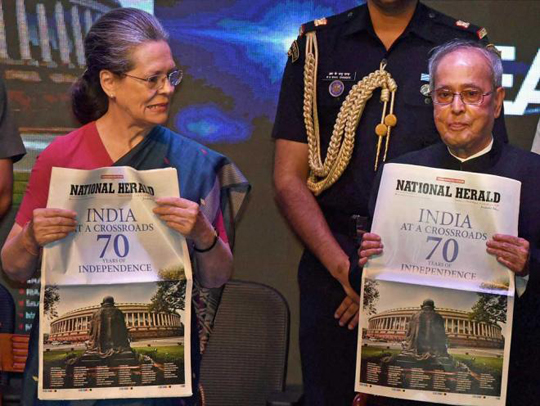
New Delhi, Jul 2: President Pranab Mukherjee joined Congress president Sonia Gandhi in expressing serious concern over growing number of mob lynching cases in India, wondering whether the society is vigilant enough to save the basic tenets of the country.
sonia

“When mob lynching becomes so high and uncontrollable, we have to pause and reflect, are we vigilant enough?,” Mukherjee said at the release of commemorative publication of relaunched National Herald here.

Sonia Gandhi, who spoke at the function, said, "It is being encouraged by a culture of vigilante violence, actively supported by those who are supposed to enforce the law."

Later, Priyanka Gandhi Vadra, daughter of the Congress president, told reporters that "It (incident of lynching) makes my blood boil. It should make blood of every Indian boil."

Mukherjee's comment and Sonia Gandhi's criticism came in the wake of reports about the spiralling violence over beef.

Mukherjee, who retires later this month, said, "When mob frenzy becomes so high, irrational and uncontrollable, we have to pause and reflect. I am not talking of vigilantism, I am talking of are we vigilant enough, proactively to save the basic tenets of our country.”

He said, "I do believe that citizens' and media vigilance can act as the biggest deterrent to forces of darkness and backwardness."

Congress president Sonia Gandhi said India is being marked by increasing threats of 'authoritarianism.'

She said, "Today the tried and tested idea of India has been thrown fundamentally into question by rising intolerance, by malevolent forces. It is being encouraged by a culture of vigilantive violence, actively supported by those who are supposed to enforce the law."

Gandhi further said that National Herald newspaper, which has been revived, is a testament to unity and justice and "not the division and hate that the present times are witnessing.

She said, "We are in a war of ideas, we have reached this war to preserve our ideas, which have built India as a model of democracy diversity and coexistence.if we don't raise our voices, if we do not speak up, our voices will be taken as consent."

A day after nationwide protests against lynchings spilt onto the streets, Modi had on Thursday broke his silence at Sabarmati Ashram in Gujarat and said killing people in the name of gau bhakti (devotion to the cow) is not acceptable.

The PM also said Mahatma Gandhi would not have approved of it and that no person in the country has the right to take the law into his own hands.

However, Modi's warning seemed to have had a little effect as just hours after his speech, Alimuddin, a meat trader, was lynched in Jharkhand’s Ramgarh.

Many cities witnessed protests across various locations under the tagline “Not in My Name” to protest against the lynching of 15-year-old Junaid Khan in a Mathura-bound train last week.

Comments

AK
 - 
Thursday, 6 Jul 2017

Thats VERY VERY GOOD .. Many families will give blessing to siddaramaiah...

Only Drunkards will not be happy with the closer.

Abdullah
 - 
Sunday, 2 Jul 2017

Worst President and opposition party ever faced in India.

Add new comment

  • Coastaldigest.com reserves the right to delete or block any comments.
  • Coastaldigset.com is not responsible for its readers’ comments.
  • Comments that are abusive, incendiary or irrelevant are strictly prohibited.
  • Please use a genuine email ID and provide your name to avoid reject.
News Network
January 23,2020

Mumbai, Jan 23: Rashmi Sahijwala never expected to start working at the age of 59, let alone join India’s gig economy—now she is part of an army of housewives turning their homes into “cloud kitchens” to feed time-starved millennials.

Asia’s third-largest economy is battling a slowdown so sharp it is creating a drag on global growth, the International Monetary Fund said Monday, but there are some bright spots.

The gig economy, aided by cheap mobile data and abundant labour, has flourished in India, opening up new markets across the vast nation.

Although Indian women have long battled for access to education and employment opportunities, the biggest hurdle for many is convincing conservative families to let them leave home.

But new apps like Curryful, Homefoodi, and Nanighar are tapping the skills of housewives to slice, dice and prepare meals for hungry urbanites from the comfort of their homes.

The so-called cloud kitchens—restaurants that have no physical presence and a delivery-only model—are rising in popularity as there is a boom in food delivery apps such as Swiggy and Zomato.

“We want to be the Uber of home-cooked food,” said Ben Mathew, who launched Curryful in 2018, convinced that housewives were a huge untapped resource.

His company—which employs five people for the app’s daily operations—works with 52 women and three men, and the 31-year-old web entrepreneur hopes to get one million female chefs on-board by 2022.

“We usually train them in processes of sanitisation, cooking, prep time and packaging... and then launch them on the platform,” Mathew told news agency.

One of the first housewives to join Curryful in November 2018 shortly after its launch, Sahijwala was initially apprehensive, despite having four decades of experience in the kitchen.

But backed by her children, including her son who gave her regular feedback about her proposed dishes, she took the plunge.

Since then, she’s undergone a crash course in how to run a business, from creating weekly menus to buying supplies from wholesale markets to cut costs.

The learning curve was steep and Sahijwala switched from cooking everything from scratch to preparing curries and batters for breads in advance to save time and limit leftovers.

She even bought a massive freezer to store fruits and vegetables despite her husband’s reservations about the cost.

“I told him that I am a professional now,” she told news agency.

‘Internet restaurants’

Kallol Banerjee, co-founder of Rebel Foods which runs 301 cloud kitchens backing up 2,200 “internet restaurants”, was among the first entrepreneurs to embrace the concept in 2012.

“We could do more brands from one kitchen and cater to different customer requirements at multiple price points,” Banerjee told AFP.

The chefs buy the ingredients, supply the cookware and pay the utility bills.

The apps—which make their money through charging commission, such as more than 18 percent per order for Curryful—offer training and supply the chefs with containers and bags to pack the food in.

Curryful chef Chand Vyas, 55, spent years trying to set up a lunch delivery business but finally gave up after failing to compete with dabbawalas, Mumbai’s famously efficient food porters.

Today Vyas works seven hours a day, five days a week in her kitchen, serving up a bevy of Indian vegetarian staples, from street food favourites to lentils and rice according to the app’s weekly set menus.

“I don’t understand marketing or how to run a business but I know how to cook. So, the current partnership helps me focus on just that while Curryful takes care of the rest,” Vyas told AFP.

She pockets up to $150 (Rs 10,000 approx) a month after accounting for the commissions and costs, but hopes to earn more as the orders increase.

In contrast, a chef at a bricks-and-mortar restaurant takes home a monthly wage of between $300 (Rs 20,000 approx) and $1,000 (Rs 70,000) approx for working six days a week.

With India’s cloud kitchen sector expected to reach $1.05 billion by 2023, according to data platform Inc42, other companies are also keen to get a slice of the action.

Swiggy, for example, has invested 2.5 billion rupees ($35.3 million) in opening 1,000 cloud kitchens across the nation.

Back in her Mumbai kitchen, Sahijwala is elated to have embarked on a career at an age when her contemporaries are eyeing retirement.

Over the past year, she has seen her profit grow to $200 (Rs 15,000 approx) a month, but more importantly, she said, “My passion has finally found an outlet.

“I am just glad life has given me this chance.”

Comments

Add new comment

  • Coastaldigest.com reserves the right to delete or block any comments.
  • Coastaldigset.com is not responsible for its readers’ comments.
  • Comments that are abusive, incendiary or irrelevant are strictly prohibited.
  • Please use a genuine email ID and provide your name to avoid reject.
News Network
June 16,2020

New Delhi, Jun 16: Jet fuel or ATF price on Tuesday was hiked by 16.3 per cent while petrol price was increased by 47 paise per litre and that of diesel by a record 93 paise on the back of firming international oil rates.

Aviation turbine fuel (ATF) price was hiked by ₹5,494.5 per kilolitre (kl), or 16.3 per cent, to ₹39,069.87 per kl in the national capital, according to a price notification by state-owned oil marketing companies.

This is the second straight increase in ATF price this month. Rates were hiked by a record 56.5 per cent (₹12,126.75 per kl) on June 1.

Simultaneously, petrol and diesel prices were hiked for the 10th day in a row.

Petrol price in Delhi was hiked to ₹76.73 per litre from ₹76.26, while diesel rates were increased to ₹75.19 a litre from ₹74.26, the price notification said.

In 10 hikes, petrol price has gone up by ₹5.47 per litre and diesel by Rs 5.8 a litre.

Rates have been increased across the country and vary from state to state depending on the incidence of local sales tax or VAT.

The hike in diesel rates is the highest daily increase since the state-owned fuel retailers started daily revision in rates in May 2017.

Hike for 10th consecutive day

Tuesday’s increase in petrol and diesel price marks the 10th straight day of rise in rates since oil companies on June 7 restarted revising prices in line with costs, after ending an 82-day hiatus.

The freeze in rates was imposed in mid-March soon after the government hiked excise duty on petrol and diesel to shore up additional finances.

Oil PSUs Indian Oil Corp (IOC), Bharat Petroleum Corp Ltd (BPCL) and Hindustan Petroleum Corp Ltd (HPCL) instead of passing on the excise duty hikes to customers adjusted them against the fall in the retail rates that was warranted because of fall in international oil prices.

The June 1 hike in jet fuel price had come after seven consecutive reductions in rates since February. ATF price in Delhi before the reduction cycle began in February was ₹64,323.76 per kilolitre, which got reduced to ₹21,448.62 last month.

Industry officials said the hike was necessitated because benchmark international rates have bounced back from a two-decade low.

While ATF prices are revised on 1st and 16th of every month, petrol and diesel prices are revised on a daily basis.

Oil companies used to revise ATF prices on the first of every month, but adopted fortnightly revisions on March 21 to pass on the benefit of falling international oil prices to airlines.

Comments

Add new comment

  • Coastaldigest.com reserves the right to delete or block any comments.
  • Coastaldigset.com is not responsible for its readers’ comments.
  • Comments that are abusive, incendiary or irrelevant are strictly prohibited.
  • Please use a genuine email ID and provide your name to avoid reject.
News Network
May 26,2020

New Delhi. May 26: 6,535 more coronavirus cases have been reported in India in the last 24 hours, taking the total number of COVID-19 cases in the country to 1,45,380, informed Union Ministry of Health and Family Welfare on Tuesday.

Out of the total, at present, there are 80,722 active cases in the country. So far, 60,490 people have been cured/discharged and 4167 have died due to the lethal infection.

According to the data compiled by the Centre, Maharashtra has so far recorded the maximum number of cases of COVID-19 across the country with 52,667 people.

The tally of cases in Tamil Nadu has risen to 17,082. While Gujarat has recorded 14,460 cases of the infection so far.

There are 14,073 cases of coronavirus in the national capital.

Comments

Add new comment

  • Coastaldigest.com reserves the right to delete or block any comments.
  • Coastaldigset.com is not responsible for its readers’ comments.
  • Comments that are abusive, incendiary or irrelevant are strictly prohibited.
  • Please use a genuine email ID and provide your name to avoid reject.