


President, Sonia express concern over lynching incidents

Agencies
July 2, 2017

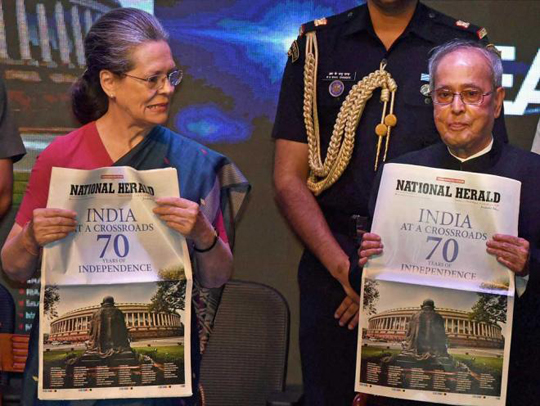
New Delhi, Jul 2: President Pranab Mukherjee joined Congress president Sonia Gandhi in expressing serious concern over growing number of mob lynching cases in India, wondering whether the society is vigilant enough to save the basic tenets of the country.
sonia

“When mob lynching becomes so high and uncontrollable, we have to pause and reflect, are we vigilant enough?,” Mukherjee said at the release of commemorative publication of relaunched National Herald here.

Sonia Gandhi, who spoke at the function, said, "It is being encouraged by a culture of vigilante violence, actively supported by those who are supposed to enforce the law."

Later, Priyanka Gandhi Vadra, daughter of the Congress president, told reporters that "It (incident of lynching) makes my blood boil. It should make blood of every Indian boil."

Mukherjee's comment and Sonia Gandhi's criticism came in the wake of reports about the spiralling violence over beef.

Mukherjee, who retires later this month, said, "When mob frenzy becomes so high, irrational and uncontrollable, we have to pause and reflect. I am not talking of vigilantism, I am talking of are we vigilant enough, proactively to save the basic tenets of our country.”

He said, "I do believe that citizens' and media vigilance can act as the biggest deterrent to forces of darkness and backwardness."

Congress president Sonia Gandhi said India is being marked by increasing threats of 'authoritarianism.'

She said, "Today the tried and tested idea of India has been thrown fundamentally into question by rising intolerance, by malevolent forces. It is being encouraged by a culture of vigilantive violence, actively supported by those who are supposed to enforce the law."

Gandhi further said that National Herald newspaper, which has been revived, is a testament to unity and justice and "not the division and hate that the present times are witnessing.

She said, "We are in a war of ideas, we have reached this war to preserve our ideas, which have built India as a model of democracy diversity and coexistence.if we don't raise our voices, if we do not speak up, our voices will be taken as consent."

A day after nationwide protests against lynchings spilt onto the streets, Modi had on Thursday broke his silence at Sabarmati Ashram in Gujarat and said killing people in the name of gau bhakti (devotion to the cow) is not acceptable.

The PM also said Mahatma Gandhi would not have approved of it and that no person in the country has the right to take the law into his own hands.

However, Modi's warning seemed to have had a little effect as just hours after his speech, Alimuddin, a meat trader, was lynched in Jharkhand’s Ramgarh.

Many cities witnessed protests across various locations under the tagline “Not in My Name” to protest against the lynching of 15-year-old Junaid Khan in a Mathura-bound train last week.

Comments

AK
 - 
Thursday, 6 Jul 2017

Thats VERY VERY GOOD .. Many families will give blessing to siddaramaiah...

Only Drunkards will not be happy with the closer.

Abdullah
 - 
Sunday, 2 Jul 2017

Worst President and opposition party ever faced in India.

Add new comment

  • Coastaldigest.com reserves the right to delete or block any comments.
  • Coastaldigset.com is not responsible for its readers’ comments.
  • Comments that are abusive, incendiary or irrelevant are strictly prohibited.
  • Please use a genuine email ID and provide your name to avoid reject.
News Network
January 30,2020

Jan 30: BJP leader and West Bengal party head, Dilip Ghosh has yet again made a controversial statement. He said that one has to go to jail in order to gain respect or become a political leader.

"You will not be a leader if you don't go to jail, if Police don't take you, then you must go there yourself. If they don't give you any scope, you do something to go to jail, only then will people respect you. There is no place for soft people in politics," ANI quoted Ghosh as saying.

Earlier, Ghosh had triggered a controversy by saying that anti-CAA protestors in Assam and Uttar Pradesh were shot dead "like dogs", and similar punishment should be given to protestors in Bengal.

Comments

Add new comment

  • Coastaldigest.com reserves the right to delete or block any comments.
  • Coastaldigset.com is not responsible for its readers’ comments.
  • Comments that are abusive, incendiary or irrelevant are strictly prohibited.
  • Please use a genuine email ID and provide your name to avoid reject.
News Network
May 20,2020

May 20: Prime Minister K P Sharma Oli on Tuesday asserted that Lipulekh, Kalapani and Limpiyadhura belong to Nepal and vowed to "reclaim" them from India through political and diplomatic efforts, as his Cabinet endorsed a new political map showing the three areas as Nepalese territory.

Addressing Parliament, Oli said the territories belong to Nepal “but India has made it a disputed area by keeping its Army there”. “Nepalis were blocked from going there after India stationed its Army,” he said.

“India has deployed its troops in Kalapani since 1962 and our rulers in the past hesitated to raise the issue,” he said, asserting, “We will reclaim and get them back.”

The prime minister asserted that the Nepal government will make political and diplomatic efforts to reclaim the territory.

Oli also expressed the hope that India will “follow the path of truth, shown by Satya Meva Jayate, which is mentioned in the Ashoka Chakra, the national symbol of India”.

The prime minister’s remarks came a day after the Cabinet headed by him endorsed a new political map showing Lipulekh, Kalapani and Limpiyadhura under Nepal’s territory.

Foreign Minister Pradeep Kumar Gyawali said the official map of Nepal will soon be made public by the Ministry of Land Management. The move announced by Gyawali came weeks after he said that efforts were on to resolve the border issue with India through diplomatic initiatives.

Nepal''s ruling Nepal Communist Party lawmakers have also tabled a special resolution in Parliament demanding return of Kalapani, Limpiyadhura and Lipulekh to Nepal.

The Lipulekh pass is a far western point near Kalapani, a disputed border area between Nepal and India. Both India and Nepal claim Kalapani as an integral part of their territory - India as part of Uttarakhand’s Pithoragarh district and Nepal as part of Dharchula district.

Gyawali last week summoned the Indian Ambassador Vinay Mohan Kwatra and handed over a diplomatic note to him to protest against the construction of a key road connecting the Lipulekh pass with Dharchula in Uttarakhand.

India has said that the recently-inaugurated road section in Pithoragarh district in Uttarakhand lies completely within its territory. Indian Army chief Gen MM Naravane last week said that there were reasons to believe that Nepal objected to India''s newly-inaugurated road linking Lipulekh Pass with Dharchula in Uttarakhand at the behest of "someone else", in an apparent reference to a possible role by China on the matter.

He said there was no dispute whatsoever between India and Nepal in the area and road laid was very much within the Indian side.

The 80-KM-long strategically crucial road at a height of 17,000 KM along the border with China in Uttarakhand was thrown open by Defence Minister Rajnath Singh earlier this month.

Nepal has raised objection to the inauguration of the road, saying the "unilateral act" was against the understanding reached between the two countries on resolving the border issues. China on Tuesday said the Kalapani border issue is between India and Nepal as it hoped that the two neighbours could refrain from "unilateral actions" and properly resolve their disputes through friendly consultations.

After the endorsement of Nepal’s new map senior ruling party leader and member of Nepal Communist Party Standing Committee Ganesh Shah said the new move may escalate unnecessary tension between Nepal and India at a time when the country is fighting the coronavirus.

"The Nepal government should soon start a dialogue with India to resolve the matter through political and diplomatic moves," he said.

The new map includes 335-km land area including Limpiyadhura in the Nepalese territory.

The new map was drawn on the basis of the Sugauli Treaty of 1816 signed between Nepal and then the British India government and other relevant documents, which suggests Limpiyadhura, from where the Kali river originated, is Nepal''s border with India, The Kathmandu Post quoted an official at the Ministry of Land Reform and Management as saying.

India and Nepal are at a row after the Indian side issued a new political map incorporating Kalapani and Lipulekh on its side of the border in October last year.

The tension further escalated after India inaugurated the road link connecting Kailash Mansarovar, a holy pilgrimage site situated at Tibet, China, that passes through the territory belonging to Nepal.

Comments

Add new comment

  • Coastaldigest.com reserves the right to delete or block any comments.
  • Coastaldigset.com is not responsible for its readers’ comments.
  • Comments that are abusive, incendiary or irrelevant are strictly prohibited.
  • Please use a genuine email ID and provide your name to avoid reject.
News Network
June 13,2020

New Delhi, Jun 13: Veteran Urdu poet Anand Mohan Zutshi 'Gulzar' Dehlvi passed away on Friday afternoon, five days after he recovered from COVID-19.

He died at his Noida home, and was a month shy of turning 94.

"His corona test came negative on June 7 and we brought him home. Today he had lunch and at around 2.30pm he passed away," his son Anoop Zutshi told PTI.

"He was quite old, and the infection had left him very weak. So doctors are thinking it was possible a cardiac arrest," he added.

A freedom fighter and a premier 'inquilabi' poet, Dehlvi was admitted to a private hospital on June 1 after testing positive for coronavirus.

Born in old Delhi's Gali Kashmeerian in 1926, he was also the editor of 'Science ki Duniya', the first Urdu science magazine published by the Government of India in 1975.

Remembering her fond memories of Dehlvi, historian-writer Rana Safvi recalled seeing the poet at most 'mushairas' in Delhi.

"I cannot express how big a loss it is. We used to see him at every 'mushaira' in Delhi. It's a big loss to Delhi and the world of poetry," Safvi said.

She also took to Twitter to express her condolences.

"Sad to hear about Gulzar Dehlvi saheb's demise. He was the quintessential Dilli waala. May he rest in peace," she tweeted.

According to Delhi-based poet and lawyer Saif Mahmood, Dehlvi was "the presiding bard of Delhi", following in the footsteps of iconic poets like Mirza Ghalib, and Mir Taqi Mir.

His death is the "end of an era", he said.

"No one knew the nooks and crannies of Mir and Ghalib's Delhi like him. Gulzar saheb claimed that his father, Allama Pandit Tribhuvan Nath Zutshi 'Zaar Dehlvi', was a disciple of the renowned poet Daagh Dehlvi," he said, while reminiscing his meeting with Dehlvi three years back.

The poet had recited a still unpublished 'sher' (couplet) then, Mahmood said, which seems more relevant now in the aftermath of his demise.

"Mere baad aane waalon, meri baat yaad rakhna/ mere naqsh-e-pa se behtar, koi raasta nahin hai". (Those who come after, remember what I say/ there’s no better way than to follow my footprints).

"He was a true exemplar of not just the Urdu language but also of the Urdu culture. In fact he was a living and breathing form of Urdu tehzeeb," Mahmood said.

Comments

Add new comment

  • Coastaldigest.com reserves the right to delete or block any comments.
  • Coastaldigset.com is not responsible for its readers’ comments.
  • Comments that are abusive, incendiary or irrelevant are strictly prohibited.
  • Please use a genuine email ID and provide your name to avoid reject.