


President, Sonia express concern over lynching incidents

Agencies
July 2, 2017

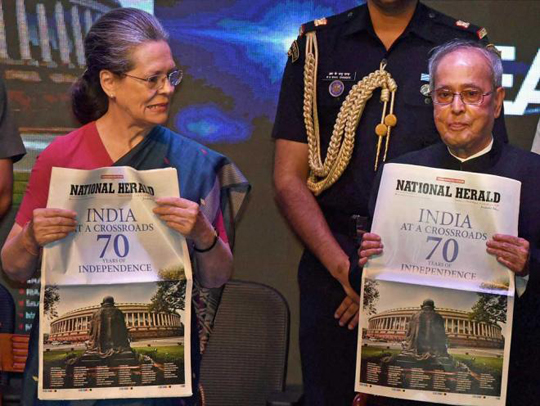
New Delhi, Jul 2: President Pranab Mukherjee joined Congress president Sonia Gandhi in expressing serious concern over growing number of mob lynching cases in India, wondering whether the society is vigilant enough to save the basic tenets of the country.
sonia

“When mob lynching becomes so high and uncontrollable, we have to pause and reflect, are we vigilant enough?,” Mukherjee said at the release of commemorative publication of relaunched National Herald here.

Sonia Gandhi, who spoke at the function, said, "It is being encouraged by a culture of vigilante violence, actively supported by those who are supposed to enforce the law."

Later, Priyanka Gandhi Vadra, daughter of the Congress president, told reporters that "It (incident of lynching) makes my blood boil. It should make blood of every Indian boil."

Mukherjee's comment and Sonia Gandhi's criticism came in the wake of reports about the spiralling violence over beef.

Mukherjee, who retires later this month, said, "When mob frenzy becomes so high, irrational and uncontrollable, we have to pause and reflect. I am not talking of vigilantism, I am talking of are we vigilant enough, proactively to save the basic tenets of our country.”

He said, "I do believe that citizens' and media vigilance can act as the biggest deterrent to forces of darkness and backwardness."

Congress president Sonia Gandhi said India is being marked by increasing threats of 'authoritarianism.'

She said, "Today the tried and tested idea of India has been thrown fundamentally into question by rising intolerance, by malevolent forces. It is being encouraged by a culture of vigilantive violence, actively supported by those who are supposed to enforce the law."

Gandhi further said that National Herald newspaper, which has been revived, is a testament to unity and justice and "not the division and hate that the present times are witnessing.

She said, "We are in a war of ideas, we have reached this war to preserve our ideas, which have built India as a model of democracy diversity and coexistence.if we don't raise our voices, if we do not speak up, our voices will be taken as consent."

A day after nationwide protests against lynchings spilt onto the streets, Modi had on Thursday broke his silence at Sabarmati Ashram in Gujarat and said killing people in the name of gau bhakti (devotion to the cow) is not acceptable.

The PM also said Mahatma Gandhi would not have approved of it and that no person in the country has the right to take the law into his own hands.

However, Modi's warning seemed to have had a little effect as just hours after his speech, Alimuddin, a meat trader, was lynched in Jharkhand’s Ramgarh.

Many cities witnessed protests across various locations under the tagline “Not in My Name” to protest against the lynching of 15-year-old Junaid Khan in a Mathura-bound train last week.

Comments

AK
 - 
Thursday, 6 Jul 2017

Thats VERY VERY GOOD .. Many families will give blessing to siddaramaiah...

Only Drunkards will not be happy with the closer.

Abdullah
 - 
Sunday, 2 Jul 2017

Worst President and opposition party ever faced in India.

Add new comment

  • Coastaldigest.com reserves the right to delete or block any comments.
  • Coastaldigset.com is not responsible for its readers’ comments.
  • Comments that are abusive, incendiary or irrelevant are strictly prohibited.
  • Please use a genuine email ID and provide your name to avoid reject.
News Network
February 9,2020

Mumbai, Feb 9: Given the slow progress on the ongoing Rs 38,000-crore capacity expansion at the four largest metro airports, and also the surging traffic, the snaky queues will continue at least till 2023, warns a report.

The four largest airports -- New Delhi, Mumbai, Bengaluru and Hyderabad -- handle more than half of the traffic and are operating at 130 per cent of their installed capacity. These airports are under a record Rs 38,000-crore capex but the capacity will not come up before end-2023, says a Crisil report.

“With the dip in traffic growth largely behind, we expect congestion at the top four airports of New Delhi, Mumbai, Bengaluru and Hyderabad, which handle more than half of the load, to continue till about FY23,” says the report.

Already these airports are operating at over 130 percent of installed capacity, and the ongoing healthy traffic growth this operating rate is expected to rise further in the next 12 months.

“Operationalising of capacities in the following two fiscals will bring down utilisation levels albeit still high at over 90 per cent by fiscal 2023 and that is despite an unprecedented Rs 38,000 crore capex being undertaken by the operators of these airports over five fiscals 2020-24,” says the report.

Despite this unprecedented capex that is debt-funded, ratings are likely to be stable given the strong cash flows expected due to healthy traffic growth, low project risks associated with the capex and improving regulatory environment, notes the report.

“Capacity at these four airports will increase a cumulative 65 per cent to 228 million annually (from 138 million now) by fiscal 2023. However, traffic is expected to grow strong at up to 10 per cent per annum over the same period. Since additional capacities will become operational in phases only by fiscal 2023, high passenger growth will add to congestion till then,” warn the report.

High utilisation will ride on pent-up demand (accumulated in 2019 as traffic was impacted with the grounding of Jet Airways) and one-off issues with new aircraft of certain airlines.

Further impetus will also come from improving connectivity to lower-tier cities and reducing fare difference between air and rail. Increasing footfalls at airports provide a leg-up to non-aero streams such as advertising, rentals, food and beverage and parking, which comprise around half of the revenue of airports already.

These are expected to grow strongly at over 10-12 per cent, also supported by higher monetisation avenue coming along with current capex. The other half of revenue (aero revenue) is an entitlement approved by the regulator, providing a pre-determined, fixed return over the asset base and a pass-through of costs.

Aero revenue is also expected to get a bump up during fiscals 2022-24, when a new tariff order for airports is likely. Overall aggregate cash flows are likely to double by fiscal 2024 and provide a healthy cushion against servicing of debt contracted for capex, the report concludes.

Comments

Add new comment

  • Coastaldigest.com reserves the right to delete or block any comments.
  • Coastaldigset.com is not responsible for its readers’ comments.
  • Comments that are abusive, incendiary or irrelevant are strictly prohibited.
  • Please use a genuine email ID and provide your name to avoid reject.
News Network
March 19,2020

New Delhi, Mar 19: Lawyer of Mukesh Singh, who is one of the four death row convicts in the Nirbhaya gang-rape and murder case, on Thursday mentioned a petition before the Registrar of the Supreme Court seeking an urgent hearing in the matter.

Advocate Manohar Lal Sharma, through the petition, sought directions to bring call record, documents and reports of his client through any probe agency and passed appropriate directions and measure to ensure justice in the matter.

The petition, however, has not sought a stay on the execution, which is scheduled for the morning of March 20. The petition is likely to be taken up for hearing today.

Earlier today, the apex court dismissed the curative petition of Pawan Gupta, another convict in the matter, who claimed juvenility at the time of the crime.

This comes as the four convicts -- Mukesh Singh, Akshay Singh Thakur, Vinay Sharma and Pawan Gupta -- are scheduled to be hanged at 5.30 am on March 20.

Meanwhile, several other petitions are also pending in the matter in different courts.

The case pertains to the brutal gang-rape and killing of a 23-year-old paramedical student in a moving bus on the night of December 16, 2012, by six people including a juvenile in the national capital. The woman had died at a Singapore hospital a few days later.

Comments

Add new comment

  • Coastaldigest.com reserves the right to delete or block any comments.
  • Coastaldigset.com is not responsible for its readers’ comments.
  • Comments that are abusive, incendiary or irrelevant are strictly prohibited.
  • Please use a genuine email ID and provide your name to avoid reject.
Agencies
March 12,2020

The Ministry of Health and Family Welfare has prepared a draft for guidelines for home quarantine, as well as for the use of masks by public, in view of coronavirus.

What to do in Home Quarantine?

The government says, for those taking refuge to home quarantine should stay in a well-ventilated single-room preferably with an attached or separate toilet. It adds that if another family member needs to stay in the same room, it's advisable to maintain a distance of at least 1 metre between the two.

The government advised, coronavirus patients to stay away from elderly people, pregnant women, children and persons with co-morbidities within the household as their immune system may be low. The health minister also suggested to restrict the patient's movement within the house. "Under no circumstances attend any social/religious gathering e.g. wedding, condolences, etc, said the guideline.

It also instructed the corona virus infected person to avoid sharing household items like dishes, drinking glasses, cups, eating utensils, towels, bedding, or other items with others at home. The guideline also demanded that even though home quarantine, the patient should wear a surgical mask at all times. "The mask should be changed every 6-8 hours and disposed off. Disposable masks are never to be reused, it added.

"Masks used by patients/ caregivers/ close contacts during home care should be disinfected using ordinary bleach solution (5 per cent) or sodium hypochlorite solution (1%) and then disposed of either by burning or deep burial," instructs the government.

Even for family members of a patient, the health ministry clearly instructs to use disposable gloves when cleaning the surfaces or handling soiled linen. No visitors, under any circumstances will be allowed, said the guideline.

"In case the person being quarantined becomes symptomatic, all his close contacts will be home quarantined (for 14 days) and followed up for an additional 14 days or till the report of such case turns out negative on lab testing," states the draft.

How to wear & dump masks?

There is a specific and elaborate do's and don'ts also released by the ministry. For those unsure in which mask to choose, it says, "Medical masks of different sizes and shapes are available in the market. The common ones are flat pleated masks of woven fabric which covers the nose and mouth and affixed behind the head with straps/ elastic fasteners. There are also conical or duck bill shaped masks with valves (or without valves) that fit in the contour of face over the nose and mouth, but are costlier."

However, the ministry warns, medical masks should not be used by healthy persons who are not having any symptoms "because it creates a false sense of security". Instead, it suggests to refrain from touching face, mouth, nose and eyes as well as washing hands regularly with soap for 20 seconds each time.

However, when a person develops a cough or fever, the suspected patient needs to switch to medical masks. "Use of medical three layer masks when ill, will prevent your infection from spreading to others. However you also need to wash your hands frequently to avoid spreading infection to others," read the guideline.

Even if one is not tested positive but showing symptoms, they are advised to wear masks while visiting a healthcare facility. "Close family contacts of such suspect/confirmed cases undergoing home care should also use Triple layer medical mask," it warns.

The ministry has also given point by point guideline on how to use a mask like to make sure that they are facing down while unfolding or for that matter to ensure there are no gaps on either side of the mask.

It even warns, "Fit flexible nose piece (a metallic strip that can easily be located) over nose-bridge" to ensure no one else are infected. The government also warns against simple dumping of the masks once used. Instead one should disinfect "using ordinary bleach solution (5 per cent) or sodium hypochlorite solution (1 per cent) and then disposed of either by burning or deep burial," says the Health Ministry.

COVID-19 emerged in early December 2019 in China's Wuhan province and has now spread to over 100 countries. As on March 9, 2020, India has reported 42 cases mostly among those who had travelled from affected countries.

However the government says, "It causes a minor illness in majority of patients with symptoms of fever and or cough. A small proportion of such persons may progress to severe disease with difficulty in breathing."

Comments

Add new comment

  • Coastaldigest.com reserves the right to delete or block any comments.
  • Coastaldigset.com is not responsible for its readers’ comments.
  • Comments that are abusive, incendiary or irrelevant are strictly prohibited.
  • Please use a genuine email ID and provide your name to avoid reject.