



'Presidential debate showes two visions of US'

October 11, 2016

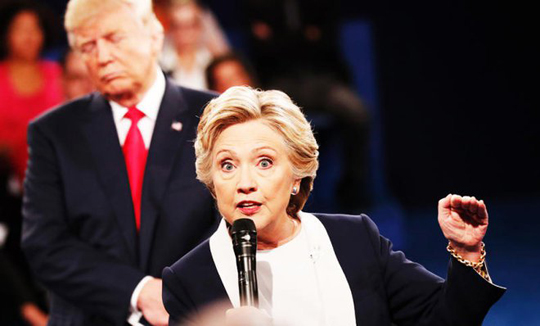
Jeddah, Oct 11: The second US presidential debate on Sunday between Donald Trump and Hillary Clinton left Arab analysts astonished “as it displayed two different Americas.”
us

Jordan's former Information Minister Saleh Al-Qallab said Clinton performed well.

“She made some very good points against Trump, and if she wins — and I hope she does — it will be good for Syria and the entire Middle East,” he told Arab News from Amman on Tuesday.
Al-Qallab felt Trump seems to incline toward Russian President Vladimir Putin when it comes to Syria.

“To me, there were clear signs during the course of the debate that Trump wants to hedge his bets on Russia ... He is going over to Russia,” he said. “No worry, he is not going to win.”

Al-Qallab said the world is once again divided between the East and the West, just like it was during the Cold War.

Clinton was “very clear” in her opposition to Russia. “She is not going to be like US President Barack Obama who turned out to be very, very weak,” he said. “Clinton is not going to treat Russia like Obama did. She is going to be tough.”

Al-Qallab's verdict: “Clinton won. Trump fought hard, but in the end, he was defeated.”

Joyce Karam, Al-Hayat's Washington bureau chief, told Arab News that there were two visions of America on display on Sunday night, “one of Trump and the other of Clinton.”

She felt Trump “did better stylistically” when compared to the first debate. “However, that was not enough for him to deliver the knockout blow to Clinton,” she said. “He needed a knockout to rebalance his position in the race.”

She said there were stark differences between the two nominees on the many issues that endanger the US and the rest of the world. “Take the Middle East, for example, and look how they are viewing what is happening in Syria,” she said. “It was astonishing to see Trump actually describing the bombardment and the razing of Aleppo as fighting ISIS.”

She was equally shocked by Trump's defending Russia in the hacking controversy.

“This comes two days after the US intelligence had officially confirmed that Russia is involved in the hacking,” she said.

“When they asked him about Syria, and the need to meet Russian provocations with US strength and military force, as advocated by his running mate (Mike Pence), Trump said, ‘I haven't spoken to him recently. Right now, Syria is fighting ISIS.'”

For Karam, that was a revealing moment of the debate. “This shows how stubborn Trump is and how detached he is from the foreign policy reality and national security interests of the United States.”

According to her, people are surprised that a US presidential nominee should be in the same camp as Assad and Russia “at a time when the US has just launched an investigation into Russian war crimes in Aleppo.”

She said if Trump actually wins, that could lead to the US going into the Russian-Iranian camp over Syria. “That would be unprecedented in US foreign policy.”

She admitted that Trump did criticize the Iran nuclear deal. “But then there is no consistency in his foreign policy outlook. He says a lot of things that could ring well with his voters, but there is no real strategy, no clear outlook on how he defines US national security in the Middle East.”

Karam's verdict: “It was actually a draw. I don't think anybody emerged as a winner on Sunday night.”

Maha Akeel, a Jeddah-based Saudi journalist, said she did not like either candidate.

“But, if I have to choose, it would be Clinton because she is tough, experienced, smart and knows the issues, and you can tell that from her answers,” she said.

If she makes history as the first female US president “this will be good for women and girls around the world, especially since she is an advocate of women's rights and empowerment,” said Akeel.

Akeel's verdict: “I am not sure, but Trump did better this time.”

Alaa Abdel Ghani, former deputy editor-in-chief of Ahram Weekly, described the debate as “dirty.”

“We watched the debate with amusement and also disbelief as one candidate tells the other that if he becomes the president, he would put the other in jail. We have not seen anything like this before,” he told Arab News from Cairo. “I don't think it ever happened in US election history.

He rued the fact that nobody talked about the real issues that concern ordinary Americans, such as economy and health care.

“This was supposed to be a debate in which the people of the United States were supposed to participate; they were supposed to ask questions and seek answers. But since the focus was too much on the past history of Bill Clinton and his liaison with other women, and the infamous Trump tape, there was very little time for people to ask questions about their future and the future of America,” he said.

Ghani's verdict: “No clear winner.”

Comments

Add new comment

  • Coastaldigest.com reserves the right to delete or block any comments.
  • Coastaldigset.com is not responsible for its readers’ comments.
  • Comments that are abusive, incendiary or irrelevant are strictly prohibited.
  • Please use a genuine email ID and provide your name to avoid reject.
Agencies
January 10,2020

New York, Jan 10: The US's National Transportation Safety Board (NTSB) announced that it has accepted an invitation from Tehran to participate in its investigation into the crash of a Ukrainian plane amid speculations that an Iranian missile might have brought down the plane.

The federal agency said in a statement on Thursday that the Iran Civil Aviation Organization has notified them that they could take part in the investigation of the plane crash that occurred shortly after taking off from Tehran on Wednesday, killing all 176 people on board, reports the Efe news.

"The NTSB has designated an accredited representative to the investigation of the crash," said the independent US government agency tasked with investigating transport accidents.

Since the aircraft was a US-made Boeing 737-800, international regulations allow Washington to be a part of the accident investigation.

However, it remains unclear to what extent the NTSB representative will be able to play an active role in the probe, as US sanctions complicate cooperation with Iran, and the two countries have no diplomatic relations.

The NTSB announcement came hours after US intelligence sources told several media outlets that the Kiev-bound Ukrainian International Airlines (UIA) flight 752 could have been accidentally shot down by an Iranian missile.

Canadian Prime Minister Justin Trudeau later confirmed that his government had "evidence" indicating that the aircraft "was shot down by an Iranian surface to air missile", although he added it may have been unintentional.

The accident occurred on the same day after Iran launched more than a dozen ballistic missiles at two US military bases in Iraq, in retaliation for the killing of Iranian Major General Qasem Soleimani in an American drone attack in Baghdad on January 3.

However, the Iranian authorities have denied that they had accidentally shot down the plane and claimed the accusations were a part of a psychological warfare campaign against Tehran.

Iranian foreign ministry spokesman Abbas Mousavi said they welcomed the presence of experts from countries whose citizens have died in the tragic accident, and requested Trudeau and any other government to provide any information they had regarding the crash.

Comments

Add new comment

  • Coastaldigest.com reserves the right to delete or block any comments.
  • Coastaldigset.com is not responsible for its readers’ comments.
  • Comments that are abusive, incendiary or irrelevant are strictly prohibited.
  • Please use a genuine email ID and provide your name to avoid reject.
News Network
May 25,2020

Karachi, May 25: The pilot of the Pakistan International Airlines (PIA)'s crashed plane ignored three warnings from the air traffic controllers about the aircraft's altitude and speed before the landing, saying he was satisfied and would handle the situation, according to a report on Monday.

The national flag carrier's PK-8303 tragedy on Friday, in which 97 people were killed and two miraculously survived, is one of the most catastrophic aviation disasters in the country's history.

The Airbus A-320 from Lahore to Karachi was 15 nautical miles from the Jinnah International Airport, flying at an altitude of 10,000 feet above the ground instead of 7,000 when the Air Traffic Control (ATC) issued its first warning to lower the plane's altitude, Geo News quoted an ATC report as saying.

Instead of lowering the altitude, the pilot responded by saying that he was satisfied. When only 10 nautical miles were left till the airport, the plane was at an altitude of 7,000 feet instead of 3,000 feet, it said.

The ATC issued a second warning to the pilot to lower the plane's altitude. However, the pilot responded again by stating that he was satisfied and would handle the situation, saying he was ready for landing, the report said.

The report said that the plane had enough fuel to fly for two hours and 34 minutes, while its total flying time was recorded at one hour and 33 minutes.

Pakistani investigators are trying to find out if the crash is attributable to a pilot error or a technical glitch.

According to a report prepared by the country's Civil Aviation Authority (CAA), the plane's engines had scraped the runway thrice on the pilot's first attempt to land, causing friction and sparks recorded by the experts.

When the aircraft scraped the ground on the first failed attempt at landing, the engine's oil tank and fuel pump may have been damaged and started to leak, preventing the pilot from achieving the required thrust and speed to raise the aircraft to safety, the report said.

The pilot made a decision "on his own" to undertake a "go-around" after he failed to land the first time. It was only during the go-around that the ATC was informed that landing gear was not deploying, it said.

"The pilot was directed by the air traffic controller to take the aircraft to 3,000 feet, but he managed only 1,800. When the cockpit was reminded to go for the 3,000 feet level, the first officer said 'we are trying'," the report said.

Experts said that the failure to achieve the directed height indicates that the engines were not responding. The aircraft, thereafter, tilted and crashed suddenly.

The flight crashed at the Jinnah Garden area near Model Colony in Malir on Friday afternoon, minutes before its landing in Karachi's Jinnah International Airport. Eleven people on the ground were injured.

The probe team, headed by Air Commodore Muhammad Usman Ghani, President of the Aircraft Accident and Investigation Board, is expected to submit a full report in about three months.

According to the PIA's engineering and maintenance department, the last check of the plane was done on March 21 this year and it had flown from Muscat to Lahore a day before the crash.

In the wake of the COVID-19 pandemic, the Pakistan government had allowed the limited domestic flight operations from five major airports - Islamabad, Karachi, Lahore, Peshawar and Quetta - from May 16.

After the plane tragedy, the PIA has called off its domestic operation.

Comments

Add new comment

  • Coastaldigest.com reserves the right to delete or block any comments.
  • Coastaldigset.com is not responsible for its readers’ comments.
  • Comments that are abusive, incendiary or irrelevant are strictly prohibited.
  • Please use a genuine email ID and provide your name to avoid reject.
Agencies
February 29,2020

Doha, Feb 29: The United States signed a landmark deal with the Taliban on Saturday, laying out a timetable for a full troop withdrawal from Afghanistan within 14 months as it seeks an exit from its longest-ever war.

President Donald Trump urged the Afghan people to embrace the chance for a new future, saying the deal held out the possibility of ending the 18-year conflict.

"If the Taliban and the government of Afghanistan live up to these commitments, we will have a powerful path forward to end the war in Afghanistan and bring our troops home," he said on the eve of the event in Doha.

Secretary of State Mike Pompeo arrived in the Qatari capital to witness the signing of the accord, while Defence Secretary Mark Esper was in Kabul for a separate joint declaration with the Afghan government.

The agreement is expected to lead to a dialogue between the Kabul government and the Taliban that, if successful, could ultimately see the Afghan war wind down.

But the position of the Afghan government, which has been excluded from direct US-Taliban talks, remains unclear and the country is gripped by a fresh political crisis amid contested election results.

The United States and its allies will withdraw all their forces from Afghanistan within 14 months if the Taliban abide by the Doha agreement, Washington and Kabul said in a joint statement.

After an initial reduction of troops to 8,600 within 135 days of Saturday's signing, the US and its partners "will complete the withdrawal of their remaining forces from Afghanistan within 14 months... and will withdraw all their forces from remaining bases", the declaration stated.

The Doha accord was drafted over a tempestuous year of dialogue marked by the abrupt cancellation of the effort by Trump in September.

The signing comes after a week-long, partial truce that has mostly held across Afghanistan, aimed at building confidence between the warring parties and showing the Taliban can control their forces.

NATO Secretary General Jens Stoltenberg heralded the agreement as a "first step to lasting peace".

"The way to peace is long and hard. We have to be prepared for setbacks, spoilers, there is no easy way to peace but this is an important first step," the Norwegian former prime minister told reporters in Kabul.

Since the US-led invasion that ousted the Taliban after the September 11, 2001 attacks, America has spent more than $1 trillion in fighting and rebuilding in Afghanistan.

About 2,400 US soldiers have been killed, along with unknown tens of thousands of Afghan troops, Taliban fighters and Afghan civilians.

The insurgents said they had halted all hostilities Saturday in honour of the agreement.

"Since the deal is being signed today, and our people are happy and celebrating it, we have halted all our military operations across the country," Taliban spokesman Zabihullah Mujahid told AFP.

Close to 30 nations were represented at Saturday's signing in the Qatari capital.

While Kabul will not be represented at the Doha ceremony, set for 1245 GMT, it will send a six-person taskforce to the Qatari capital to make initial contact with the Taliban political office, established in 2013.

Any insurgent pledge to guarantee Afghanistan is never again used by jihadist movements such as Al-Qaeda and the Islamic State group to plot attacks abroad will be key to the deal's viability.

The Taliban's sheltering of Al-Qaeda was the main reason for the US invasion following the 9/11 attacks.

The group, which had risen to power in the 1990s in the chaos of civil war, suffered a swift defeat at the hands of the US and its allies. They retreated before re-emerging to lead a deadly insurgency against the new government in Kabul.

After the NATO combat mission ended in December 2014, the bulk of Western forces withdrew from the country, leaving it in an increasingly precarious position.

While Afghans are eager to see an end to the violence, experts say any prospective peace will depend on the outcome of talks between the Taliban and the Kabul government.

But with President Ashraf Ghani and rival Abdullah Abdullah at loggerheads over contested election results, few expect the pair to present a united front, unlike the Taliban, who would then be in a position to take the upper hand in negotiations.

Comments

Add new comment

  • Coastaldigest.com reserves the right to delete or block any comments.
  • Coastaldigset.com is not responsible for its readers’ comments.
  • Comments that are abusive, incendiary or irrelevant are strictly prohibited.
  • Please use a genuine email ID and provide your name to avoid reject.