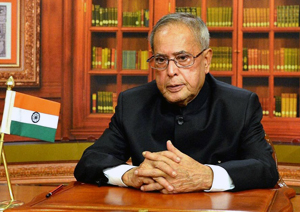
President's rule imposed in Uttarakhand

March 27, 2016

New Delhi, Mar 27: Uttarakhand was today brought under President's rule by the Centre on grounds of "breakdown of governance" in a controversial decision which comes in the wake of a political crisis triggered by a rebellion in the ruling Congress.president

President Pranab Mukherjee signed the proclamation under Art 356 of the Constitution dismissing the Congress government headed by Harish Rawat and placing the Assembly under suspended animation this morning on the recommendation of the Union Cabinet.
The Cabinet had held an emergency meeting here last night presided over by Prime Minister Narendra Modi, who had cut short a visit to Assam to return to the capital for the purpose.

The Cabinet considered several reports received from Governor K K Paul, who had described the political situation as volatile and expressed apprehensions over possible pandemonium during the scheduled trial of strength in the state Assembly tomorrow.

Finance Minister Arun Jaitley is believed to have briefed the President late last night explaining the rationale for the Cabinet's recommendation.

The dismissal of the Rawat government now renders tomorrow's confidence vote infructuous.

It also came amidst reports that Speaker Govind Singh Kunjwal had disqualified 9 rebel Congress MLAs that would have enabled Rawat to sail through in the trust vote.

The Congress denounced the decision calling it a "murder of democracy" and said it showed that BJP did not believe in democracy.

The political crisis in the state arose after the controversial circumstances in which the Appropriation Bill was declared passed in the Assembly by the Speaker with the BJP and the rebel Congress claiming that a division of votes pressed by them was not allowed.

They alleged that the Bill was defeated in the voice vote by a majority of the members present but the Speaker did not test it in a proper division of votes.

The opposition claimed that it had a majority of 35 MLAs, including 9 rebels, in the House that day out of 67 MLAs present. The BJP said the 35 MLAs had written to the Speaker in advance that they would be voting against the bill but the Speaker had refused to take it into his consideration.

Last night, the Union Cabinet met amidst reports that the Speaker had disqualified the rebel Congress MLAs that would would have helped the beleaguered government.

Apprehending imposition of President's rule, the Congress had attacked the BJP saying it was resorting to the extreme step as its earlier moves had failed.

Comments

Abdullah
 - 
Sunday, 27 Mar 2016

The president Pranab Mukerjee working as a RSS agent.

Add new comment

  • Coastaldigest.com reserves the right to delete or block any comments.
  • Coastaldigset.com is not responsible for its readers’ comments.
  • Comments that are abusive, incendiary or irrelevant are strictly prohibited.
  • Please use a genuine email ID and provide your name to avoid reject.
Agencies
February 5,2020

New Delhi, Feb 5: Delhi High Court on Wednesday stated that that death warrant of all convicts in the Nirbhaya gangrape and murder case should be executed together.

The Delhi prison rules do not state whether when the mercy petition of one convict is pending, the execution of the other convicts can take place and from the trial court to Supreme Court all convicts have been held by a common order and a common judgment, Justice Suresh Kumar Kait observed while passing the order.

High Court dismissed the Central government and Tihar Jail authorities plea challenging the Patiala House court's order, which stayed the execution of the four convicts in the case. It also observed that the convicts indulged in a heinous offence of a bone-chilling rape and murder of a girl and that criminal appeals by all convicts were dismissed by the courts.

Moreover, the court observed that the review petitions were filed after long wait and convicts are taking shelter of Article 21 which is available to them till their last breath.

A single-judge bench of Justice Suresh Kumar Kait had on Sunday kept the order reserved in the matter after special hearing of two days.

Earlier, Solicitor General Tushar Mehta, appearing on behalf of the Centre, alleged that the convicts were deliberately delaying the execution, adding that any delay in death sentence will have a dehumanising effect on the convicts.

A Delhi court last week stayed till further orders the execution of the four convicts -- Akshay Thakur, Mukesh Singh, Pawan Gupta, and Vinay Sharma -- which was earlier scheduled to take place on February 1.

The case pertains to the gang-rape and brutal murder of a 23-year-old paramedical student in a moving bus on the night of December 16, 2012, by six people, including a juvenile, in Delhi. The woman had died at a Singapore hospital a few days later.

One of the five adults accused, Ram Singh, had allegedly committed suicide in the Tihar Jail during the trial of the case.

Comments

Add new comment

  • Coastaldigest.com reserves the right to delete or block any comments.
  • Coastaldigset.com is not responsible for its readers’ comments.
  • Comments that are abusive, incendiary or irrelevant are strictly prohibited.
  • Please use a genuine email ID and provide your name to avoid reject.
Agencies
May 23,2020

New Delhi, May 23: The nationwide lockdown will no longer help India in its fight against COVID-19, and in its place community-driven containment, isolation and quarantine strategies have to be brought into play, leading virologist Shahid Jameel said.

The recipient of Shanti Swarup Bhatnagar Prize for Science and Technology also stressed that testing should be carried out vigorously to identify coronavirus hotspots and isolate those areas.

"Our current testing rate at 1,744 tests per million population is one of the lowest in the world. We should deploy both antibody tests and confirmatory PCR tests. This will tell us about pockets of ongoing infection and past (recovered) infection. This will provide data to open up gradually and let economic activity resume," Jameel told PTI in an interview.

He stressed that testing has to be dynamic to continuously monitor red, orange and green zones and change these based on that data.

About community transmission of COVID-19 in India, Jameel said the country reached that stage long ago.

"We reached community transmission a long time ago. It's just that the health authorities are not admitting it. Even ICMR's own study of SARI (severe acute respiratory illness) showed that about 40 per cent of those who tested positive for SARS-CoV-2 did not have any history of overseas travel or contact to a known case. If this is not community transmission, then what is?" he posed.

Lockdown bought India time in its fight against coronavirus, but continuing it is unlikely to yield any further dividend, Jameel said.

"Instead, community-driven local lockdowns, isolations and quarantines have to come into play. Building trust is most important so that people follow rules. A public health problem cannot be dealt with as a law-and-order problem."

The nationwide lockdown, initially imposed from March 25 to April 14, has been extended thrice and will continue at least till May 31. The virus has claimed 3,720 lives and infected over 1.25 lakh people in the country so far.

Jameel has expertise in the fields of molecular biology, infectious diseases, and biotechnology. He is the CEO of Wellcome Trust/Department of Biotechnology's India Alliance and is best known for extensive research in Hepatitis E virus and HIV.

He said COVID-19 will eventually be controlled through herd immunity, which is acquired in two ways – when a sufficient fraction of the population gets infected and recovers, and with vaccination.

"It is estimated that for SARS-CoV-2 at least 60 per cent of the population would have to be infected and recovered, or vaccinated. This will happen over the course of the next few years," Jameel said.

Herd immunity is reached when the majority of a population becomes immune to an infectious disease, either because they have become infected and recovered, or through vaccination. When that happens, the disease is less likely to spread to people who aren't immune, because there just aren't enough infectious carriers.

"India has 1.38 billion people, a population density of about 400/sq km and a healthcare system ranked at 143 in the world. If we allow 60 per cent people to get infected quickly in the hopes of herd immunity, that would mean 830 million infections," Jameel said.

"If 15 per cent need hospitalization that means about 125 million isolation beds (we have 0.3 million). If five per cent need oxygen and ventilatory support, this amounts to about 42 million oxygen support and ICU beds; we have 0.1 million oxygen support beds and 34,000 ICU beds. This would overwhelm the healthcare system causing mayhem," he said.

Jameel said if the population level mortality is 0.5 per cent that would mean 40 lakh deaths. "Are we prepared to pay this price for herd immunity in the short term? Clearly not," he said.

He said it is unlikely that a vaccine would be available by the end of the year.

"Even then, we don't know yet how long it would give protection – weeks, months, one year, a few years? I don't think we will return to pre-coronavirus days for at least the next 3-5 years. This is also a chance to evaluate if we want to return to those unsustainable, environment-damaging ways. COVID-19 is a timely warning to reform our way of living," he said.

Jameel said it is hard to predict but plausible that COVID-19 would return in second or third wave.

"Later waves come when we don't understand the disease and become lax. A comparison to Spanish Flu is not entirely valid because in 1918 no one knew what caused it. No one had seen a virus till the mid-1930s as the electron microscope needed to view those was invented in 1931," he said.

"Today we know a lot more about the pathogen, its genetic makeup, how it transmits and how to prevent it. We need to be sensible and follow expert advice," he said.

If there is any scientific evidence linking deforestation, rapid urbanisation, climate change with pandemics like COVID-19, he said zoonotic viruses -- those that jump from animals to humans -- happen so when wild animal–human contacts increase.

"Deforestation destroys animal habitats bringing them closer to humans. When you cut forests, bats come to roost on trees closer to human habitations. Their viruses in secretions/stool get transmitted to domestic animals and on to humans. This happened clearly with Nipah virus outbreak in Malaysia in 1997-98 from fruit bats to pigs to humans," he said.

"COVID-19 possibly arose in wet animal markets due to dietary habits that bring all kinds of live and dead wild animals in close contact with humans," Jameel added.


Comments

Add new comment

  • Coastaldigest.com reserves the right to delete or block any comments.
  • Coastaldigset.com is not responsible for its readers’ comments.
  • Comments that are abusive, incendiary or irrelevant are strictly prohibited.
  • Please use a genuine email ID and provide your name to avoid reject.
Agencies
July 30,2020

New Delhi, Jul 30: Even as COVID-19 cases continue to surge in various parts of India, more than 1 million people have recovered and discharged till now, informed Rajesh Bhushan, Secretary, Ministry of Health, here on Thursday.

"More than 1 million people have recovered from COVID-19 in the country. This landmark recovery has been achieved because of the selfless work and dedication of our doctors, nurses and frontline workers," Bhushan said at a press conference.

Giving the number of cured persons, Bhushan said, "More than 1,020,000 patients have recovered. They have been discharged. It is a great achievement."

He said, "The recovery rate has shown positive trends. It was 7.85 per cent in April and today it is 64.4 per cent, which is another heartening news which tells us that whatever battle is put by the Union government in collaboration with state governments is showing results."

"Sixteen states of the country have a recovery rate that is more than the national average. Of these, Delhi has a recovery rate of 88 per cent, Ladakh 80 per cent, Haryana 78 per cent, Assam 76 per cent, Telangana 74 per cent, Tamil Nadu & Gujarat 73 per cent, Rajasthan 70 per cent, Madhya Pradesh 69 per cent and Goa 68 per cent," Bhushan said.

He said effective clinical management lead to a decrease in case fatality rate. In June it was 3.33 per cent and now 2.21 per cent.

Bhushan said the case fatality rate in India today is 2.21 per cent and it's among the lowest in the world. Twenty-four states and Union Territories have lesser fatality rate than that of the country.

Herd immunity in a country of the size and population of India can not be a strategic option. It can only be achieved through immunisation.

"Over 18,190,000 tests have been conducted in the country including RT-PCR and rapid antigen tests. There has been a week-on-week increase in average tests per day. India is conducting 324 test per 10 lakhs population per day," Bhushan said.

He added, three vaccine candidates, are in phase 3 clinical trial. These three are in the US, UK and China. In India, two indigenously developed vaccine candidates are in phase I and II of clinical trials. 

Trial of the first vaccine involves 1,150 subjects at eight sites, second on 1,000 subjects at five sites.

Comments

Add new comment

  • Coastaldigest.com reserves the right to delete or block any comments.
  • Coastaldigset.com is not responsible for its readers’ comments.
  • Comments that are abusive, incendiary or irrelevant are strictly prohibited.
  • Please use a genuine email ID and provide your name to avoid reject.