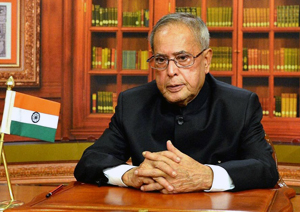
President's rule imposed in Uttarakhand

March 27, 2016

New Delhi, Mar 27: Uttarakhand was today brought under President's rule by the Centre on grounds of "breakdown of governance" in a controversial decision which comes in the wake of a political crisis triggered by a rebellion in the ruling Congress.president

President Pranab Mukherjee signed the proclamation under Art 356 of the Constitution dismissing the Congress government headed by Harish Rawat and placing the Assembly under suspended animation this morning on the recommendation of the Union Cabinet.
The Cabinet had held an emergency meeting here last night presided over by Prime Minister Narendra Modi, who had cut short a visit to Assam to return to the capital for the purpose.

The Cabinet considered several reports received from Governor K K Paul, who had described the political situation as volatile and expressed apprehensions over possible pandemonium during the scheduled trial of strength in the state Assembly tomorrow.

Finance Minister Arun Jaitley is believed to have briefed the President late last night explaining the rationale for the Cabinet's recommendation.

The dismissal of the Rawat government now renders tomorrow's confidence vote infructuous.

It also came amidst reports that Speaker Govind Singh Kunjwal had disqualified 9 rebel Congress MLAs that would have enabled Rawat to sail through in the trust vote.

The Congress denounced the decision calling it a "murder of democracy" and said it showed that BJP did not believe in democracy.

The political crisis in the state arose after the controversial circumstances in which the Appropriation Bill was declared passed in the Assembly by the Speaker with the BJP and the rebel Congress claiming that a division of votes pressed by them was not allowed.

They alleged that the Bill was defeated in the voice vote by a majority of the members present but the Speaker did not test it in a proper division of votes.

The opposition claimed that it had a majority of 35 MLAs, including 9 rebels, in the House that day out of 67 MLAs present. The BJP said the 35 MLAs had written to the Speaker in advance that they would be voting against the bill but the Speaker had refused to take it into his consideration.

Last night, the Union Cabinet met amidst reports that the Speaker had disqualified the rebel Congress MLAs that would would have helped the beleaguered government.

Apprehending imposition of President's rule, the Congress had attacked the BJP saying it was resorting to the extreme step as its earlier moves had failed.

Comments

Abdullah
 - 
Sunday, 27 Mar 2016

The president Pranab Mukerjee working as a RSS agent.

Add new comment

  • Coastaldigest.com reserves the right to delete or block any comments.
  • Coastaldigset.com is not responsible for its readers’ comments.
  • Comments that are abusive, incendiary or irrelevant are strictly prohibited.
  • Please use a genuine email ID and provide your name to avoid reject.
Agencies
July 12,2020

Jaipur/New Delhi, Jul 12: The crisis in Rajasthan Congress has deepened with state Chief Minister Ashok Gehlot and his deputy Sachin Pilot at loggerheads.

While Gehlot is blaming BJP for trying to destabilise the state government by poaching MLAs, Pilot is camping in Delhi to speak to the party leadership regarding the political turmoil in the state.

According to sources, Pilot has sought an appointment with party's interim president Sonia Gandhi but time for the meeting has not yet been given by her. Although Pilot met another party leader to apprise him about the situation in the state and spelled out his grievance.

As of now, many MLAs, who are believed to be in the Pilot camp, are also in Delhi to meet the party leadership. According to sources, the deputy chief minister has the support of nearly 30 Congress MLAs along with many independent legislators.

It is important to note that the controversy broke out in Rajasthan after Special Operation Group (SOG) sent a notice to Sachin Pilot to record his statement in the case registered by SOG in the alleged poaching of Congress MLAs in the state. The clash between Gehlot and Pilot is also over the post of PCC Chief as Gehlot Camp wants that 'One Leader One Post' formula to be implemented in Rajasthan. Currently, Sachin Pilot is heading the PCC besides holding the Deputy CM post.

Sources close to Sachin Pilot have informed that the young leader is upset with the notice issued to him. He believes it is aimed to record his phone calls and keep him under surveillance. Many of Pilot's supporters feel indignation and told Pilot that they cannot work with Ashok Gehlot. Also, Pilot is unlikely to attend the meeting called by Gehlot today, according to sources.

While the top leadership of the party is keeping mum, sources say it is keeping a watch on the development. General Secretary KC Venugopal has taken up the matter of the rift with the party's top brass with them not happy about it.

Rajasthan AICC Incharge Avinash Pandey told media persons: "Everything is under control. Few MLAs had issues and after discussion, they have returned back to Jaipur and others are also in touch. BJP's attempt of destabilising the government will not be successful in Rajasthan and government is stable."

Gehlot also held a meeting with ministers last night in Jaipur.  According to Gehlot camp, the top leadership is apprised of the development of the poaching attempt in the state. Amid Political Crisis Rajasthan CM Ashok Gehlot called a meeting of Ministers and all Cong MLAs tonight at his residence.

The Rajasthan crisis has alerted the other senior leaders of the party who have opined that the Madhya Pradesh incident should not get repeated in Rajasthan.

Former Union Minister and Rajya Sabha MP Kapil Sibbal tweeted, "Worried for our party. Will we wake up only after the horses have bolted from our stables?"

Comments

Add new comment

  • Coastaldigest.com reserves the right to delete or block any comments.
  • Coastaldigset.com is not responsible for its readers’ comments.
  • Comments that are abusive, incendiary or irrelevant are strictly prohibited.
  • Please use a genuine email ID and provide your name to avoid reject.
News Network
May 28,2020

May 28: Abdul Kareem was forced out of school and into a life of odd jobs like repairing bicycles before he finally managed to pull his family out of abject poverty transporting goods across Delhi in a mini truck.

The job, and the slim financial security that came with it, was the first stepping stone to a better life.

All that is now gone as India reels under the economic impact of its protracted coronavirus lockdown. Mr Kareem's out of a job and stranded in his village in Uttar Pradesh with his wife and two children. Their minuscule savings from his Rs 9,000 a month job have been exhausted, and the money he saved for books and school uniforms is spent.

"I don't know what the job situation will be in Delhi once we go back," Mr Kareem said. "We can't stay hungry so I will do whatever I find."

At least 49 million people across the world are expected to plunge into "extreme poverty" -- those living on less than $1.90 per day -- as a direct result of the pandemic's economic destruction and India leads that projection, with the World Bank estimating some 12 million of its citizens will be pushed to the very margins this year.

Some 122 million Indians were forced out of jobs last month alone, according to estimates from the Center for Monitoring Indian Economy, a private sector think tank. Daily wage workers and those employed by small businesses have taken the worst hit. These include hawkers, roadside vendors, workers employed in the construction industry and many who eke out a living by pushing handcarts and rickshaws.

For Prime Minister Narendra Modi, who came to power in 2014 promising to lift the poorest citizens out of poverty, the fallout from the lockdown brings with it significant political risk. He won an even larger second term majority last year on the strength of his government's popular social programs that directly targeted the poor, such as the provision of cooking gas cylinders, power and public housing. The breadth and depth of this renewed economic pain will only increase the pressure on his government as it works to steer the country's economy back on track.

"Much of the Indian government's efforts to mitigate poverty over the years could be negated in a matter of just a few months," said Ashwajit Singh, managing director of IPE Global, a development sector consultancy that advises several multinational aid agencies. Noting that he did not expect unemployment rates to improve this year, Singh said: "More people could die from hunger than the virus."

Desperate Times

Mr Singh points to a United Nations University study estimating 104 million Indians could fall below the World Bank-determined poverty line of $3.2 a day for lower-middle-income countries. This will take the proportion of people living in poverty from 60% -- or 812 million currently, to 68% or 920 million -- a situation last seen in the country more than a decade ago, he said.

A World Bank report found the country had been making significant progress and was close to losing its status as the country with the most poor citizens. The impact of PM Modi's lockdown risks reversing those gains.

The World Bank and the CMIE estimates were published in late April and early May respectively. Since then the situation has only become grimmer, with harrowing images of people making desperate attempts to reach their villages, on crowded buses, the flatbeds of trucks and even on foot or on bicycles dominating media coverage.

The Rustandy Center for Social Sector Innovation at the University of Chicago Booth School of Business analyzed the unemployment data from the CMIE, collected through surveys covering about 5,800 homes across 27 states in April.

Researchers found rural areas were the hardest hit, and the economic misery was the result of the lockdown, rather than the spread of infections in the hinterland. More than 80% of households had experienced a drop income and many won't survive much longer without aid, they wrote in a report.

The government has promised cheap credit to farmers, direct transfer of money to the poor and eased access to food security programs -- but these help people who have some documentation, which many of the poorest don't. With millions of impoverished people now in transit across the country, the food security situation is dire -- news reports are emerging of people foraging through piles of rotting fruit or eating leaves.

Shattered Economy

The economy was already growing at its slowest pace in over a decade when the virus struck. The lockdown, which came into effect on March 25, has hammered it, stalling business activity and putting a lid on consumption, pushing the economy to what may be its first full-year contraction in more than four decades.

It's dire enough to warrant the country exiting its lockdown, as it has been doing incrementally since May 4, even as its infections are surging. India is now Asia's virus hotspot with infections crossing 151,000 according to data from Johns Hopkins University.

PM Modi, who has come under criticism for the pain inflicted on the poor, has said his government will spend $265 billion or about 10% of its GDP to help Asia's third-largest economy weather the pandemic's fallout. But experts say only a part of it is direct fiscal stimulus, and probably smaller than the total damage done to the economy during the lockdown period.

"What is especially worrying is the government's response," said Reetika Khera, an economics professor at the Indian Institute of Technology in Delhi. "The epidemic will magnify existing -- and already high -- inequalities in India."

Still, the economic measures aren't going to kick in for some time and industry will likely struggle to restart because of the flight of labour from industrial hubs.

And as the harsh summer unfolds more pain lies in store in the villages now dealing with returning migrant workers.

"There are no factories or industries here, there are just hills," said Surendra Hadia Damor, who had walked nearly 100 km from Ahmedabad, Gujarat, before a voluntary organisation drove him to his village in the neighboring state of Rajasthan. "We can survive for a month or two and then try and find a job nearby -- we will see what happens."


Comments

Add new comment

  • Coastaldigest.com reserves the right to delete or block any comments.
  • Coastaldigset.com is not responsible for its readers’ comments.
  • Comments that are abusive, incendiary or irrelevant are strictly prohibited.
  • Please use a genuine email ID and provide your name to avoid reject.
News Network
April 7,2020

New Delhi, April 7: The government continued to take steps to contain the spread of coronavirus including a strategy of cluster containment as the cases continued to rise and Tuesday saw single-day largest jump of 722 positive cases.

The total number of positive cases reached 4,789 on Tuesday, the 14th day of lockdown.

According to the latest update of the Health Ministry, there are 4,312 active cases, 352 persons have been cured or discharged (one migrated) and 124 have died.

Maharashtra has the largest number of positive cases at 868 and also accounts for the largest number of deaths at 48. Tamil Nadu has 621 confirmed cases.

Thirteen persons have died in Madhya Pradesh and the same number in Gujarat.
The 21-day lockdown was announced on March 24 by Prime Minister Narendra Modi.

At the regular media briefing at 4 pm, Lav Aggarwal, Joint Secretary in the Health Ministry, said that the government is adopting a strategy for cluster containment.

"This strategy is producing positive results, especially in Agra, Gautam Buddh Nagar, Pathanamthitta, Bhilwara and East Delhi," he said.

Aggarwal said that a recent study by the Indian Council of Medical Research (ICMR) has shown that a person infected with coronavirus can infect 406 others in just 30 days if he does not follow the lockdown and social distancing norms.

He said no decision has been taken on extending the lockdown and urged against any speculation.

He said latest technology was being used for management of COVID-19 and there was real-time tracking of ambulances.

The official said the dedicated facilities for COVID-19 are divided into three parts -- COVID Care Centre, Dedicated COVID Health Centre and Dedicated COVID Hospitals.

He said that COVID Care Centres were for treating mild, very mild and likely to be COVID-19 patients. Hostels, hotels, school, and stadium can be used for this. "We have asked states to map it with COVID Care Hospitals and COVID Health Centre so that patients can be shifted if needed," he said.

The official said that COVID Health Centres were for treating COVID-19 patients of clinically moderate level of seriousness. "For this, fully functional hospitals will be used. A dedicated block of a fully functional hospital can also be used for this. The hospitals must have beds with oxygen support," he said.

Aggarwal said that dedicated COVID Hospitals were meant for severe and critical cases and these must be fully-equipped with ICUs and ventilators.
New coronavirus cases were reported on Tuesday from several states including Maharashtra, Madhya Pradesh, West Bengal, and Tamil Nadu.

The Ministry of Environment, Forest and Climate Change has issued an advisory about containing coronavirus in national parks, sanctuaries and tiger reserves in view of the spread of COVID-19 and a report about tiger being infected in New York. The Central Zoo Authority has also advised zoos in India to remain on high alert.

Here's a quick read on the COVID-19 related updates

1. The Indian Railways has prepared 40,000 isolation beds in 2,500 coaches and this work is ongoing in 133 locations across the country.

2. Madhya Pradesh Chief Minister Shivraj Singh Chouhan said he was willing to extend the lockdown in the state after the completion of 21-day period to save lives.

3. The government is monitoring the movement of pharmaceuticals closely and the movement of pharmaceuticals through trucks has stabilised in the country.

4. Under the 'Lifeline Udan' initiative, 152 flights have transported over 200 tonnes of cargo till April 6.

5. According to ICMR, testing of 1,07,006 people has been carried out till date and 136 government labs and 59 private labs are conducting tests in the country.

6. The Home Ministry said that the status of essential goods and services was by and large satisfactory in the country. Home Minister Amit Shah has issued directives to the states to ensure there is no hoarding or black marketing in any corner of the country.

7. The number of corona positive cases in Uttar Pradesh has reached 314. Of these, 168 patients are connected to Tablighi Jamaat, state Chief Minister Yogi Adityanath said on Tuesday.

8. The government has lifted restrictions on export of 24 pharmaceutical ingredients and medicines made from them.

9. Union Defence Minister Rajnath Singh said the Group of Ministers had "an extensive discussion on the prevailing situation post the lockdown" in the country. They also appreciated the Cabinet's decision to cut MP's salary for a year.

10. Central Zoo Authority has advised zoos in the country to remain on highest alertness, watch animals on 24X7 basis, using CCTV for any abnormal behavior or symptoms.

Comments

Add new comment

  • Coastaldigest.com reserves the right to delete or block any comments.
  • Coastaldigset.com is not responsible for its readers’ comments.
  • Comments that are abusive, incendiary or irrelevant are strictly prohibited.
  • Please use a genuine email ID and provide your name to avoid reject.