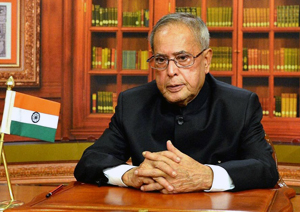
President's rule imposed in Uttarakhand

March 27, 2016

New Delhi, Mar 27: Uttarakhand was today brought under President's rule by the Centre on grounds of "breakdown of governance" in a controversial decision which comes in the wake of a political crisis triggered by a rebellion in the ruling Congress.president

President Pranab Mukherjee signed the proclamation under Art 356 of the Constitution dismissing the Congress government headed by Harish Rawat and placing the Assembly under suspended animation this morning on the recommendation of the Union Cabinet.
The Cabinet had held an emergency meeting here last night presided over by Prime Minister Narendra Modi, who had cut short a visit to Assam to return to the capital for the purpose.

The Cabinet considered several reports received from Governor K K Paul, who had described the political situation as volatile and expressed apprehensions over possible pandemonium during the scheduled trial of strength in the state Assembly tomorrow.

Finance Minister Arun Jaitley is believed to have briefed the President late last night explaining the rationale for the Cabinet's recommendation.

The dismissal of the Rawat government now renders tomorrow's confidence vote infructuous.

It also came amidst reports that Speaker Govind Singh Kunjwal had disqualified 9 rebel Congress MLAs that would have enabled Rawat to sail through in the trust vote.

The Congress denounced the decision calling it a "murder of democracy" and said it showed that BJP did not believe in democracy.

The political crisis in the state arose after the controversial circumstances in which the Appropriation Bill was declared passed in the Assembly by the Speaker with the BJP and the rebel Congress claiming that a division of votes pressed by them was not allowed.

They alleged that the Bill was defeated in the voice vote by a majority of the members present but the Speaker did not test it in a proper division of votes.

The opposition claimed that it had a majority of 35 MLAs, including 9 rebels, in the House that day out of 67 MLAs present. The BJP said the 35 MLAs had written to the Speaker in advance that they would be voting against the bill but the Speaker had refused to take it into his consideration.

Last night, the Union Cabinet met amidst reports that the Speaker had disqualified the rebel Congress MLAs that would would have helped the beleaguered government.

Apprehending imposition of President's rule, the Congress had attacked the BJP saying it was resorting to the extreme step as its earlier moves had failed.

Comments

Abdullah
 - 
Sunday, 27 Mar 2016

The president Pranab Mukerjee working as a RSS agent.

Add new comment

  • Coastaldigest.com reserves the right to delete or block any comments.
  • Coastaldigset.com is not responsible for its readers’ comments.
  • Comments that are abusive, incendiary or irrelevant are strictly prohibited.
  • Please use a genuine email ID and provide your name to avoid reject.
News Network
May 10,2020

Thiruvananthapuram , May 10: Issuing latest order in view of coronavirus outbreak, the Kerala government has ordered complete shut down on all Sundays.

"With a view to prevent the spread of COVID-19, improve the quality of life, reduce the carbon emissions, protect the environment and greenery of the State, the following protocol would be observed on Sundays across the State. Sundays will be observed as total shut down days until further orders," the order read.

Following activities will be permissible on Sundays:

A) Shops selling essential items

B) Collection and distribution of milk

C) Supply of Newspaper, media, hospitals, medical stores, medical labs and related institutions

D) No social gathering is permitted except for marriages and funerals

E) Departments, agencies and activities connected with the containment of COVID-19

F) Movement of goods vehicles

G) Agencies in the field of waste disposal

H) All manufacturing and processing activities of continuous nature and ongoing construction activities will be permitted

I) Take away counters of the hotel from 8 a.m to 9 p.m, online delivery up to 10 pm

J) Walking and cycling will be permitted.

K) In addition, the following roads mentioned in Annexure will be closed for motorised traffic except for movement of essential goods and emergency vehicles from 5 am to 10 am. During this time, non-motorised traffic such as walking and cycling will be permitted.

L) Movement of persons on Sundays are allowed only for health emergencies, Government servants on emergency duties and persons engaged in activities connected with Covid-19 containment, persons involved in the activities from (a) to (k) above, priests and other religious persons responsible for conducting rituals in worship places.

M) Any other movement of persons, if any in exigencies, shall only be with the travel passes obtained from District Collector or Police authorities concerned.

Comments

Add new comment

  • Coastaldigest.com reserves the right to delete or block any comments.
  • Coastaldigset.com is not responsible for its readers’ comments.
  • Comments that are abusive, incendiary or irrelevant are strictly prohibited.
  • Please use a genuine email ID and provide your name to avoid reject.
News Network
April 24,2020

New Delhi, Apr 24: The trajectory of COVID-19 cases could have plateaued and might even fall for some weeks after the lockdown is lifted but India is likely to see a second wave in late July or August with a surge in the number of cases during the monsoon, say scientists.

The timing of the peak will depend on how India is able to control physical distancing and on the level of infection spreads after restrictions are relaxed, they said.

It looks apparent that the trajectory of daily new cases has reached a plateau and eventually it will take a downward fall, maybe for some weeks or even months, Samit Bhattacharya, associate professor at the Department of Mathematics, Shiv Nadar University, said.

Still, we may get a surge of new cases of the same coronavirus and this will be considered a second wave, Bhattacharya explained.

The second epidemic may come back in late July or August in the monsoon, although the peak timing will depend on how we control social distancing during that time, he said.

Rajesh Sundaresan, professor at Bengaluru's Indian Institute of Science (IISc), agreed.

“Once we return to normal activity levels, there is a chance that infection may begin to rise again. China is seeing this to some extent post easing of some restrictions on travel,” Sundaresan, corresponding author of a working paper by researchers at IISc and the Tata Institute of Fundamental Research (TIFR) in Mumbai, said.

On March 25, when the number of coronavirus cases was 618 with 13 deaths, the government announced a nationwide lockdown that was later extended to May 3.

On Friday, the death toll due to COVID-19 rose to 718 and the number of cases to 23,077, according to the Union Health Ministry.

In good news, officials said this week that the doubling rate of cases has slowed down in the period, going from 3.4 days before lockdown to 7.5 days, with 18 states doing better than the national average. The recovery rate has also almost doubled in the last 10 days.

"Looking at the new cases in the past few days, it seems the growth of new daily infection is much slower than earlier. This apparently indicates that we might have reached at the plateau of the growth curve, Bhattacharya said.

He noted that recent studies in China and Europe observed that the infection might relapse in those people who have already recovered from earlier phases.

So, there is no evidence that the earlier infection may help acquire immunity against the second infection. And in that way, the entire population may be vulnerable to the second wave to some extent, said the scientist.

In their study unveiled this week, IISc and TIFR researchers analysed the impact of strategies such as case isolation, home quarantine, social distancing and various post-lockdown restrictions on COVID-19 that might remain in force for some time.

The study modelled on Bengaluru and Mumbai suggests the infection is likely to have a second wave and the public health threat will remain, unless steps are taken to aggressively trace, localise, isolate the cases, and prevent influx of new infections.

The new levels and the peaking times for healthcare demand depend on the levels of infection spreads in each city at the time of relaxation of restrictions, they said.

The lockdown is currently upon us. It has given us valuable time. Let us test, trace, quarantine, isolate, practice better hygiene, search for a vaccine, etc. We should do these anyway, and these are being done. When and how to lift the lockdown is going to be a difficult decision to make, said Sundaresan.

It's clear that it's going to be phased. What our team is focusing on is to come up with tools to help the decision makers assess the public health impact of various choices, he said.

According to the experts, infectious diseases spread via contact between infectious and susceptible people. In the absence of any control measures, an outbreak will grow as long as the average number of people infected by each infectious person is more than one.

Once enough people are immune there will be fewer people susceptible to the infection and the outbreak will die.

However, when an outbreak is brought under control by social distancing and other interventions, it is possible only a small proportion of the population will have been infected and gained immunity, they said.

This means enough susceptible people may remain to fuel a second wave if controls are relaxed and infection is reintroduced.

Until the vaccine comes on the market, we have to remain alert Once sporadic cases occur here and there in the country, we immediately need to implement quarantine or social distancing locally for the people in that region, and also need to perform tests to identify positive cases irrespective of showing symptoms, Bhattacharya explained.

Note that these monsoon months are also flu season in many places of India. So, we should not ignore the early signs of the flu symptoms. Irrespective of symptoms, we need to increase tests in the hotspots to identify people and contain the surge, he said.

Sundaresan added that the timeline for a second wave will depend on a lot of circumstances which may change as the time passes.

Significant testing may have been underway, there may be behavioural changes with people becoming more careful about their hygiene, wearing masks may become more common, etc. All these responses may help restrict the second wave, he said.

A study published in The Lancet journal earlier this month modelled the potential adverse consequences of premature relaxation of interventions, and found it might lead to a second wave of infections.

The finding is critical to governments globally, because it warns against premature relaxation of strict interventions, the researchers said.

While interventions to control the spread of SARS-CoV-2 are in place, countries will need to work toward returning to normalcy; thus, knowledge of the effect of each intervention is urgently required, they said in the study.

According to a recent analysis by the Harvard Chan School of Public Health, the best strategy to ease the critical care burden and loss of life from COVID-19 might be on-again, off-again social distancing.

In the absence of such interventions, surveillance and intermittent distancing may need to be maintained into 2022, which would present a substantial social and economic burden, the researchers wrote.p


Comments

Add new comment

  • Coastaldigest.com reserves the right to delete or block any comments.
  • Coastaldigset.com is not responsible for its readers’ comments.
  • Comments that are abusive, incendiary or irrelevant are strictly prohibited.
  • Please use a genuine email ID and provide your name to avoid reject.
News Network
June 10,2020

New Delhi, Jun 10: India on Wednesday reported a spike of 9,985 more COVID-19 cases in the last 24 hours, taking the country's COVID-19 count to 2,76,583, according to the Union Ministry of Health and Family Welfare.

279 deaths were reported in the last 24 hours taking the total death toll to 7,745.

The total number of active cases has reached 1,33,632 while 1,35,205 patients have recovered. While one person has migrated.

With 90,787 cases, Maharashtra reported the highest number of coronavirus cases in the country followed by Tamil Nadu with 34,914 cases.

According to the Indian Council of Medical Research (ICMR), 1,45,216 samples were tested in the last 24 hours while overall 50,61,332 samples have been tested so far.

Comments

Add new comment

  • Coastaldigest.com reserves the right to delete or block any comments.
  • Coastaldigset.com is not responsible for its readers’ comments.
  • Comments that are abusive, incendiary or irrelevant are strictly prohibited.
  • Please use a genuine email ID and provide your name to avoid reject.