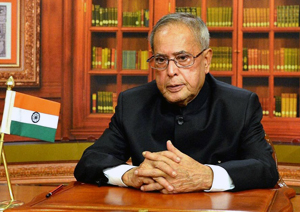
President's rule imposed in Uttarakhand

March 27, 2016

New Delhi, Mar 27: Uttarakhand was today brought under President's rule by the Centre on grounds of "breakdown of governance" in a controversial decision which comes in the wake of a political crisis triggered by a rebellion in the ruling Congress.president

President Pranab Mukherjee signed the proclamation under Art 356 of the Constitution dismissing the Congress government headed by Harish Rawat and placing the Assembly under suspended animation this morning on the recommendation of the Union Cabinet.
The Cabinet had held an emergency meeting here last night presided over by Prime Minister Narendra Modi, who had cut short a visit to Assam to return to the capital for the purpose.

The Cabinet considered several reports received from Governor K K Paul, who had described the political situation as volatile and expressed apprehensions over possible pandemonium during the scheduled trial of strength in the state Assembly tomorrow.

Finance Minister Arun Jaitley is believed to have briefed the President late last night explaining the rationale for the Cabinet's recommendation.

The dismissal of the Rawat government now renders tomorrow's confidence vote infructuous.

It also came amidst reports that Speaker Govind Singh Kunjwal had disqualified 9 rebel Congress MLAs that would have enabled Rawat to sail through in the trust vote.

The Congress denounced the decision calling it a "murder of democracy" and said it showed that BJP did not believe in democracy.

The political crisis in the state arose after the controversial circumstances in which the Appropriation Bill was declared passed in the Assembly by the Speaker with the BJP and the rebel Congress claiming that a division of votes pressed by them was not allowed.

They alleged that the Bill was defeated in the voice vote by a majority of the members present but the Speaker did not test it in a proper division of votes.

The opposition claimed that it had a majority of 35 MLAs, including 9 rebels, in the House that day out of 67 MLAs present. The BJP said the 35 MLAs had written to the Speaker in advance that they would be voting against the bill but the Speaker had refused to take it into his consideration.

Last night, the Union Cabinet met amidst reports that the Speaker had disqualified the rebel Congress MLAs that would would have helped the beleaguered government.

Apprehending imposition of President's rule, the Congress had attacked the BJP saying it was resorting to the extreme step as its earlier moves had failed.

Comments

Abdullah
 - 
Sunday, 27 Mar 2016

The president Pranab Mukerjee working as a RSS agent.

Add new comment

  • Coastaldigest.com reserves the right to delete or block any comments.
  • Coastaldigset.com is not responsible for its readers’ comments.
  • Comments that are abusive, incendiary or irrelevant are strictly prohibited.
  • Please use a genuine email ID and provide your name to avoid reject.
News Network
May 6,2020

New Delhi, May 6: Taking a cue from states, the Centre announced one of the steepest hikes in duties on petrol and diesel in the recent past, by raising it by Rs 10 and Rs 13 per litre, respectively, in a notification issued late on Tuesday.

Retail prices, however, will see no change as the price hike will be absorbed by oil marketing companies against the fall in crude prices.

Road and infrastructure cess was hiked by Rs 8 for petrol and diesel and the special additional excise duty (SAED) was hiked by Rs 2 per litre and Rs 5 per litre, respectively. While the road cess will only go into the Centre’s coffers, the hike on account of SAED will be passed on to states via devolution at 42 per cent. Hence, the states will get only Rs 0.84 per litre in case of petrol and Rs 2.1 in case of diesel.

The decision comes after several states increased the value added tax (VAT) on petrol and diesel making use of the lower price regime. The Delhi government on Tuesday increased VAT on petrol and diesel to 30 per cent each, from 27 and 16.75, respectively. As a result, the price of petrol in Delhi increased by Rs 1.67 to Rs 71.26 a litre and diesel by Rs 7.10 to Rs 69.29 in Delhi on Tuesday.

Amid falling international crude oil prices, the Centre introduced an enabling provision in March to raise excise duty on petrol and diesel by Rs 8 per litre in the Finance Act. The government had on March 14 raised excise duty on petrol and diesel by? 3 per litre each, which was to help raise an additional ?39,000 crore in revenue annually.

This duty hike included Rs 2 a litre increase in SAED and Rs 1 in road and infrastructure cess. It raised SAED to Rs 10 for petrol and Rs 4 for diesel. The limit has now been increased to Rs 18 a litre in case of petrol and Rs 12 in case of diesel by way of amendment of the Eighth Schedule of the Finance Act.

Economists said the move would impact retail inflation by over half a percentage point at least. “With lower consumption, there was loss of revenue for Centre and states, who earn Rs 6 trillion annually or Rs 50,000 crore monthly from fuel. Amid lockdown in April, the collection must have come down to just Rs 5,000 crore, and this will hold for May.

This means that Centre and states have lost 20 per cent of annual revenue from fuel. Hence, they have hiked duties to recover losses,” said Madan Sabnavis, chief economist, CARE Ratings. He added that the hike will impact inflation by at least 0.6-0.7 percentage points.

According to industry experts, an estimate of the additional government revenue cannot be made as the consumption of petrol and diesel has dropped to 40 per cent of what it was before the lockdown. The duty hike comes following a drop in international crude oil prices in April, owing to lower consumption figures globally. At 11.50 pm on Tuesday, Brent was priced at $30.67 a barrel, while West Texas Intermediate (WTI) crude was seen at $24.36 a barrel. On Monday, the Indian basket of crude oil was priced at $23.38 a barrel, after touching a 15-year low last month.

Comments

Add new comment

  • Coastaldigest.com reserves the right to delete or block any comments.
  • Coastaldigset.com is not responsible for its readers’ comments.
  • Comments that are abusive, incendiary or irrelevant are strictly prohibited.
  • Please use a genuine email ID and provide your name to avoid reject.
News Network
January 20,2020

New Delhi, Jan 20: Union Finance Minister Nirmala Sitharaman on Sunday said the kind of cleaning in the system that the BJP-led government had to carry out after coming to power in 2014 was "unbelievable" and it undertook the exercise without any grudge or worry.

Between 2014-16, there were a lot of questions as to why reforms did not come fast and there were comments that the government was incapable of bringing them, she said delivering the Nani Palkhivala Memorial lecture on "Road Map to $5 Trillion Economy" here.

Pointing out that there were allegations and criticism that the government wants to do something but it did not, Sitharaman said, "I am fully willing to buy that." She recalled that Prime Minister Narendra Modi often said he did not believe in incremental changes and the country needed good transformational change. The stage in which India is today, it cannot have little marginal increments, but good transformational change.

"But still one might say in the last five years the government never did. That can be a critical analysis and I am fully willing to buy that. Because post-2014 the kind of cleaning up the government had to do was unbelievable and we undertook that exercise without a grudge without a worry.. we had to do it and it is part of the game," she said. Elaborating, Sitharaman said states have their own views on Land Acquisition Bill and the government could not have done anything because land, after all, is with them.

Commenting on the topic 'Road Map to $5 trillion economy,' she said quoting Prime Minister Narendra Modi's comments, the government would take the route "Sarkar ka abhaav nahi hona chahiye, prabhaav hona chahiye aur dabaav nahi hona chahiye."

"Abhaav and dabaav both of which are not desirable, abhaav is the inadequacy or lack of adequate presence or shortfall. You do not need a shortfall. You need a government where it should be present, where it is expected to function.", she said.

"So there should not be abhaav. Dabaav (meaning pressure) is not something you want from the government. So, you want Prabhaav. It is broadly an influence, facilitation, broadly the philosophy with which it is mandated, she said.

Noting that the government has got the mandate through the election, she said, "The mandate was spelt out in so many different ways in its manifesto. So the route towards $5 trillion is this."

"We have to be there to facilitate. We have to be there to make it easy. We have to be where you need us, where there is no policy (reforms from the government)," she said.

On the Insolvency and Bankruptcy Code (IBC) implemented by the government, the union minister said the approach of the IBC was not to shut business. "IBC takes on the approach in having some kind of resolution where all people who exploited the company do not come back through the "back door," she said.

IBC was done through better management so that the institution is alive and kicking. It is something which she wanted to carry forward from Modi 1.0 to 2.0. "The point I am trying to make on this road to $5 trillion economy is that it is not just an abstraction, this is not how I want India to be. But in micro-level too, we are coming in response to every stakeholder," she said.

Comments

Well Wisher
 - 
Tuesday, 21 Jan 2020

LOL. Do not say anything, else she will get angry.

Add new comment

  • Coastaldigest.com reserves the right to delete or block any comments.
  • Coastaldigset.com is not responsible for its readers’ comments.
  • Comments that are abusive, incendiary or irrelevant are strictly prohibited.
  • Please use a genuine email ID and provide your name to avoid reject.
News Network
February 1,2020

When it comes to the economy, dark days do loom large over India. May it be growth (lowest since 2008), inflation (highest in the last six years), or revenue collection (lowest in 10 years), the Indian economy is faltering. Hence, there is little leeway that can be assumed in the incumbent Union Budget 2020 (the first of the decade) if the economy needs to be boosted.

While presenting the decade's first Budget for India, finance minister Nirmala Sitharaman said on Saturday in Parliament:

Taxation

•             AADHAR based tax verification introduced

•             Review of customs duty exemptions in September 2020

•             GST refund process simplified

•             Electronic invoice implementation in phases

•             New digital scheme for tax litigation

•             PAN to be instantly allotted online against Aadhar

•             Vivaad se Vishwas Scheme: Defaulter to pay only disputed tax and no penalty or interest by 31 March 2020, post which additional amount can be paid till June 2020

•             Measure to promote affordable housing - tax holiday extended for developers

•             Concession on real estate transactions

•             Turnover threshold for audit raised to Rs 5 crore from 1 crore

•             Company audit requirements eased

•             Taxes on ESOPs (employee stock ownership) in start-ups deferred by 5 years

•             100% per cent tax exemption

•             Corporate Tax at 15%

•             Dividend Distribution Tax removed, dividend taxed only for recipients

•             No tax for 0-5 lakh

•             30% above 15 lakh

•             25% for income between Rs 12.5-15 lakh

•             20% for income between Rs 10-12.5 lakh

•             15% for income between Rs 7.5-10 lakh

•             10% for income between Rs 5-7.5 lakh, against the prevailing 20%

•             A new, optional simplified personal income tax regime for those not seeking exemptions


Major steps and initiatives taken by the government in finance

•             3.8 percent fiscal deficit estimated

•             GDP nominal growth expected at 10 per cent

•             Govt to sell part of holding LIC via IPO (initial public offering)- partial LIC disinvestment

•             Partial credit guarantee for NBFCs

•             New law for netting of financial contracts

•             Mechanism to end liquidity crisis

•             NRIs (non resident Indians) can invest in certain govt securities


Aspirational India: Caring society

•             App-based invoice financing loans for MSMEs

•             Amendment to Factoring Regulation Act to aid MSMEs

•             Pension Fund Regulatory and Development Authority (PFRDI) Act amendments

•             No criminal liabilities for civil acts

•             Auto-enrolment in universal pension scheme

•             5958 cr allocated for Ladakh

•             30757 cr allocated for J&K

•             Insurance for depositors raised to 5 lakh from 1 lakh

•             Robust mechanisms in place to monitor all PSU banks

•             Depositors’ money safe

•             100 cr for hosting G20 in 2022

•             National Recruitment Agency to be set up

•             Tax payers’ charter to be enshrined in statutes

•             Amendments for Companies Act

•             Tax payer charter proposed to free citizens from tax harassment

•             Businesses should have confidence that system is fair

•             4400 crore allocation for clean air and climate change policy

•             Aim to reduce carbon footprint - Warning to old thermal plants

•             Committed to preserve environment, tackle climate change

•             23150 crore for culture ministry

•             2500 crore for tourism sector

•             Institute of Heritage and Conservation to come up soon

•             Aim to set up more museums

•             5 archaeological sites to be made iconic

•             Proposal to end manual scavenging

•             53700 crore for welfare of STs

•             85000 crore for SCs and OBCs for 2021

•             35600 crore for nutritional schemes

•             Gross enrollment ratio of girls higher than boys in elementary level

•             Beti Bachao, Beti Padhao - tremendous results


Aspirational India: Infrastructure and economic development

•             Further reforms for transparent price discovery for natural gas

•             22000 crore for power sector

•             8000 crore for quantum technology in next 6 years

•             Two national level science schemes

•             Expand Jan Aushadhi Scheme

•             1 lakh gram panchayats to be connected via Bharat Net

•             6000 crore for Bharat Net

•             Data Centre parks to be set up across the country

•             National Gas Grid to be expanded

•             Reforms to help stressed DISCOMS (distribution companies)

•             Delhi-Mumbai Expressway by 2023

•             100 more airports by 2024

•             Plans to energise economic activity along river banks

•             Need to enhance sea ports

•             High Speed Mumbai-Ahmedabad train

•             More Tejas-type trains

•             4 station redevelopment projects under PP model

•             2000 km of strategic highways to be built, 11000 km of track electrification

•             Accelerated development of highways

•             National Logistics Policy to be released soon

•             Big push on infrastructure - 100 lakh crore

•             National Technical Textiles Mission to be set up

•             1480 crore outlay for textile sector

•             27300 crore for industrial development by 2021

•             Digital refund of duties for exporters

•             Boost domestic manufacturing - electronic equipment, mobile phone, medical devices

•             5 new smart cities in collaboration with states

•             Investment clearance cell to be set up for end to end facilitation

•             Entrepreneurship has been the strength of India


Aspirational India: Education and skills

•             High need for medical teachers and paramedics

•             Internships for engineers in panchayats

•             Rs 99300 cr for education sector

•             Large hospitals to be encouraged to start PG courses

•             Attach medical colleges to district hospitals

•             National police university to be set up

•             IND-SAT programme for overseas students for studying in India

•             New courses in 159 universities by 2026

•             Focus on education for jobs

•             Propose a fresh education policy

•             Urban local bodies should give opportunities to new engineers

•             Education needs more finances


Aspirational India: Healthcare

•             AI (artificial intelligence) to be used for Ayushman Bharat Scheme

•             69000 crore for health sector

•             Propose to set up more hospitals

•             Holistic vision for national healthcare


Aspirational India: Agriculture, Irrigation and rural development

•             Need to liberalise farm markets

•             108 million metric tonne milk production by 2021

•             2.83 lakh cr allocation for agriculture and irrigation

•             Propose raising fish production to 200 lakh tonne

•             Zero budget national farming

•             NABARD refinance scheme to be expanded

•             Village credit card scheme

•             Agriculture credit target for 2020 set at Rs 15 lakh crore

•             Village storage scheme for farmers, zero budget natural farming

•             Dhanya Lakshmi scheme for women in villages

•             Krishi Udaan by civil aviation ministry for air transport of such commodities over longer distances

•             Indian railways to set up 'kisan rail'

•             Govt to provide help to geo-tag warehouses

•             Financial inclusion has helped raise farm incomes

•             Plan for 100 water stressed districts

•             Scheme for 20 lakh farmers to set up solar pumps

•             Doubling farm income - model agricultural land leasing act, balanced use of fertilisers, solar pumps for 20 lakh farmers


Budget 2020 and its three focuses

•             Budget's first focus is 'Aspirational India'. Second focus: economic development for all. Third focus: building a caring society.

•             FDI at 284 billion dollars, achieved 7.84% growth

•             GST formalised the economy

•             Efficiency gained in logistics

•             16 lakh new tax payers added

•             Fundamentals of economy hold strong

•             Scaled up implementation of pro-poor schemes


Key challenges FM faces

•             India needs to grow by 9 per cent to 10 per cent a year to become the $5 trillion economy by 2024, as projected by the government. The government is now forecasting growth will come in at 5 per cent

•             The IMF, which had originally predicted 6.1 per cent growth for India in 2019, has revised that downwards to 4.8 per cent

•             The government’s likely to miss its fiscal deficit target for the current fiscal year of 3.3 per cent and hike its target to as much as 4 per cent for the next financial year

•             India will struggle to achieve 5 per cent GDP growth in 2020 - Economist Steve Hanke, Johns Hopkins University

•             Investment is forecast to grow at less than 1 per cent -- the lowest since 2004-05

•             India's unemployment rate rose to 7.5 per cent during September-December 2019 quarter, according to data released by think-tank Centre for Monitoring Indian Economy


 

Comments

Add new comment

  • Coastaldigest.com reserves the right to delete or block any comments.
  • Coastaldigset.com is not responsible for its readers’ comments.
  • Comments that are abusive, incendiary or irrelevant are strictly prohibited.
  • Please use a genuine email ID and provide your name to avoid reject.