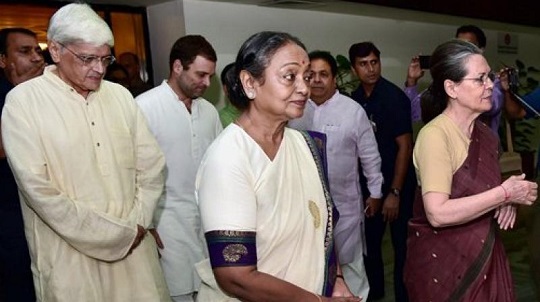
Prez poll is fight against 'divisive, communal vision': Sonia

Agencies
July 16, 2017

New Delhi, Jul 16: A day before the presidential election, Congress chief Sonia Gandhi today described the electoral contest as a fight against a "narrow-minded, divisive and communal vision".

sonai

Addressing opposition leaders in the presence of their presidential and vice presidential nominees - Meira Kumar and Gopal Krishna Gandhi respectively, she said, in these contests, the numbers may be against them but "the battle must be fought and fought hard".

"We cannot and must not let India be hostage to those who wish to impose upon it a narrow-minded, divisive and communal vision," she said.

According to the text of her speech, she said, "We must stand more aware than ever of who we are, what we fought for in our independence struggle and what future we want for ourselves.

"We must have confidence in the values we believe in. This election represents a clash of ideas, a conflict of disparate values. The election demands a vote of conscience to preserve the India that the Mahatma and that illustrious generation of freedom fighters, joined by thousands upon thousands of ordinary men and women, fought for," she said.

She said the presence of representatives from different parties to support Kumar and Gopal Gandhi confirms that "the fight for an inclusive, tolerant and pluralistic India is being truly waged". The vice presidential poll will be held on August 5.

Comments

Add new comment

  • Coastaldigest.com reserves the right to delete or block any comments.
  • Coastaldigset.com is not responsible for its readers’ comments.
  • Comments that are abusive, incendiary or irrelevant are strictly prohibited.
  • Please use a genuine email ID and provide your name to avoid reject.
News Network
May 28,2020

Pulwama, May 28: A major incident of a vehicle-borne IED blast was averted by the timely input and action by Pulwama Police, Central Reserve Police Force (CRPF) and Army, the Jammu and Kashmir Police said.

According to sources, Pulwama Police got credible information last night about a terrorist moving with an explosive-laden car ready to blast at some location. They took out various parties of police and security forces and covered all possible routes keeping themselves and the police and security forces away from the road at safer locations.

The suspected vehicle came and a few rounds were fired towards it. A little ahead this vehicle was abandoned and the driver escaped in the darkness. On close look, the vehicle was seen to be carrying heavy explosives in a drum on the rear seat. Possibly more explosive would be fitted elsewhere in the vehicle, sources added.

The vehicle was kept under watch for the night. People in nearby houses were evacuated and the vehicle exploded in situ by the Bomb Disposal Squad as moving the vehicle would have involved serious threat, sources said.

The vehicle reportedly sports a number plate of a scooter registered somewhere in Kathua district of Jammu zone, sources added.

Comments

Add new comment

  • Coastaldigest.com reserves the right to delete or block any comments.
  • Coastaldigset.com is not responsible for its readers’ comments.
  • Comments that are abusive, incendiary or irrelevant are strictly prohibited.
  • Please use a genuine email ID and provide your name to avoid reject.
Agencies
June 22,2020

Mumbai, Jun 22: After downgrading India's outlook to negative from stable, Fitch Ratings on Monday revised the outlook on nine Indian banks to negative.

The outlook on the Long-Term Issuer Default Ratings (IDR) was revised to negative from stable due to the banks' high dependence on the Centre to re-capitalise them.

Accordingly, the IDR outlook of the Export-Import Bank of India, the State Bank of India, the Bank of Baroda, the Bank of Baroda (New Zealand), the Bank of India, the Canara Bank, the Punjab National Bank, ICICI Bank and Axis Bank Ltd have been downgraded to negative.

"At the same time, Fitch has affirmed IDBI Bank Limited's (IDBI) IDR while maintaining the outlook at negative," Fitch said in a statement.

The rating actions follow Fitch's revision of the outlook on the 'BBB-' rating on India to negative from stable on June 18, due to the impact of the escalating coronavirus pandemic on India's economy.

"The IDRs for all the above Indian banks are support-driven and anchored to their respective SRFs," the statement said.

"They are based on Fitch's assessment of high to moderate probability of extraordinary state support for these banks, which takes into account our assessment of the sovereign's ability and propensity to provide extraordinary support."

According to the statement, the negative outlook on India's sovereign rating reflects an increasing strain on the state's ability to provide extraordinary support, due to the sovereign's limited fiscal space and the significant deterioration in fiscal metrics due to challenges from the COVID-19 pandemic.

"The rating action does not affect the banks' Viability Rating (VR). EXIM does not have a VR as its role as a policy bank makes an assessment of its standalone credit profile less meaningful."

Comments

Add new comment

  • Coastaldigest.com reserves the right to delete or block any comments.
  • Coastaldigset.com is not responsible for its readers’ comments.
  • Comments that are abusive, incendiary or irrelevant are strictly prohibited.
  • Please use a genuine email ID and provide your name to avoid reject.
News Network
January 6,2020

Jan 6: India’s Finance Ministry has delivered a challenge to its revenue collectors: meet tax targets despite $20 billion of corporate tax cuts.

Through a video conference on Dec. 16, officials were exhorted to meet the direct tax mop-up target of 13.4 trillion rupees ($187 billion), a government official told reporters. Collection in the eight months to November grew at 5% from a year earlier, against the desired 17%.

The missive shows Prime Minister Narendra Modi’s urgent need to buoy public finances in a slowing economy where April-November tax collections were half the amount budgeted. Authorities withheld some payments to states and have capped ministries’ expenditure as the fiscal deficit ballooned beyond the target.

The government’s efforts to maintain its deficit goal goes against advice from some quarters, including central bank Governor Shaktikanta Das, who urged more spending to spur economic growth.

It’s uncertain though how much room Modi’s administration has to boost expenditure, given that it may already be borrowing as much as 540 billion rupees through state-run companies, a figure that isn’t reflected on the federal balance sheet. Uncertainty about public finances pushed up sovereign yields in November and December, compelling Das to announce unconventional policies to keep costs in check.

“This is not a time to conceal the fiscal deficit by off-budget borrowing or deferring payments,” said Indira Rajaraman, an economist and a former member of the Reserve Bank of India’s board. “If they were to stick to the target, that would be catastrophic because there is so much pump-priming that is needed right now.”

GDP grew 4.5% in the quarter ended September, the slowest pace in more than six years as both consumption and investments cooled in Asia’s third-largest economy. Only government spending supported the expansion, piling pressure on Modi to keep stimulating.

S&P Global Ratings warned in December it may downgrade India’s sovereign ratings if economic growth doesn’t recover. Government support seems to be waning now, with ministries asked to cap spending in the final quarter of the financial year at 25% of the amount budgeted rather than 33% allowed earlier. This new rule will hamstring sectors including agriculture, aviation and coal, where not even half of annual targets have been disbursed.

As the federal government runs short of money, it’s been delaying payouts to state administrations.

Private hospitals have threatened to suspend cash-less services to government employees over non-payment of dues, while a builder informed the stock exchange about delayed rental payments from no less than the tax office itself.

India is considering a litigation-settlement plan that will allow companies to exit lingering tax disputes by paying a portion of the money demanded by the government, the Economic Times newspaper reported Saturday.

The move will help improve the ease of doing business besides unlocking a part of the almost 8 trillion rupees ($111 billion) caught up in these disputes. The step, which is being considered as part of the annual budget, could also bridge India’s fiscal gap.

Finance Minister Nirmala Sitharaman has refused to comment on the deficit goal before the official budget presentation due Feb. 1.

A deviation from target, if any, “will need to be balanced with a credible consolidation plan further-out,” said Radhika Rao, an economist at DBS Group Holdings Ltd. in Singapore.


Comments

Add new comment

  • Coastaldigest.com reserves the right to delete or block any comments.
  • Coastaldigset.com is not responsible for its readers’ comments.
  • Comments that are abusive, incendiary or irrelevant are strictly prohibited.
  • Please use a genuine email ID and provide your name to avoid reject.