


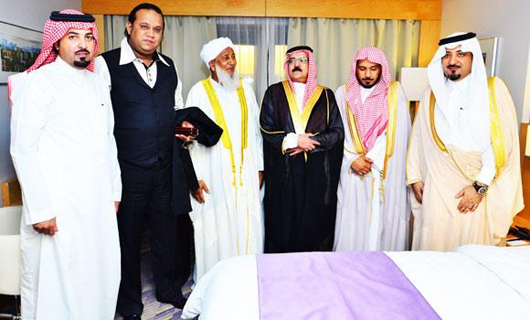
Prince Saud upbeat on Saudi-Indian ties

July 15, 2014

Prince Saud

Jeddah, Jul 15: Prince Saud bin Musaed bin Abdul Aziz, president of the Gammon Group, has highlighted the strong relationship between Saudi Arabia and India.

“We hope the Saudi-Indian relations would reach greater heights in the coming years,” he said while addressing an iftar party organized by the group.

He said many major Indian companies are interested in doing business in Saudi Arabia to make use of the growing investment opportunities in the Kingdom.

“Last year, more than 35,000 Saudis visited India for education and medical treatment,” the prince said, while commending the role played by Indian expatriate workers in boosting the Kingdom’s development in various sectors.

Shaikh Mohammed Rafik, chairman of Gammon Group, said more than 20 international companies, including those from India, Canada, Australia, Malaysia and China, have agreed to establish their plants in the new industrial city being developed by Gammon in Jazan.

“We are looking for investors in areas required by the Kingdom, including automobiles. We are in talks with a South Korean company to establish an automobile plant in Jazan,” Rafik told Arab News.

The new industrial city is expected to draw investments worth SR75 billion, the chairman said, adding that it would create about 100,000 jobs. He commended Prince Turki bin Mohammed bin Nasser, director of international trade at the Ministry of Commerce and Industry, for his efforts to speed up establishment of the industrial city.

He added that Prince Turki has been authorized by the government to develop the city by bringing in foreign investors to build the city’s entire infrastructure facilities, such as roads, bridges, commercial centers, power plants, water treatment plants, oil refinery and petrochemical plants.

“If major companies are ready to invest and transfer their technology, the government will pay them 75 percent of their project cost in soft loans for 20 years,” Rafik told Arab News.

The iftar party was attended by prominent personalities, including Indian Consul General B.S. Mubarak, British Consul General Mohammed Shaukat, South African Consul General Ebrahim Edries, Khaled Almaeena, former editor in chief of Saudi Gazette, Tariq Mishkhas, editor in chief of Urdu News and Malayalam News, Dr. Faiz Al-Abideen, CEO of Gammon Group, A.P. Abubacker Musliyar, general secretary of All-India Jameyat Al-Ulema, and Syed Bashirali Shihab Thangal.

Comments

Dorthea
 - 
Saturday, 19 Mar 2016

Right here is the right web site for everyone
who wishes to find out about this topic. You realize a whole lot its almost hard to argue with you (not that I actually will
need to…HaHa). You certainly put a new spin on a topic which has
been discussed for decades. Great stuff, just wonderful!

My web page; Lettie Bouley: http://gdzieulokowacoszczednosci.medicsen.eu

Add new comment

  • Coastaldigest.com reserves the right to delete or block any comments.
  • Coastaldigset.com is not responsible for its readers’ comments.
  • Comments that are abusive, incendiary or irrelevant are strictly prohibited.
  • Please use a genuine email ID and provide your name to avoid reject.
News Network
April 9,2020

Apr 9: The UAE Cabinet, chaired by His Highness Sheikh Mohammed bin Rashid Al Maktoum, Vice President and Prime Minister of the UAE and Ruler of Dubai, adopted a resolution to grant paid leave to select categories of employees at the federal government.

This move is part of a series of precautionary measures and procedures taken by the UAE government to bring the Covid-19 pandemic under control.

The resolution stipulates that married employees of the federal government may take fully paid leave to take care of their children below the age of 16. The age condition shall not apply to people of determination, as well as in cases where a spouse is subject to self-isolation or quarantine that requires no contact with family members, upon a decision from the Ministry of Health and Prevention.

The resolution also applies to employees whose spouses work in vital health-related occupations, such as doctors, nurses, paramedics and other medical jobs that require exposure to infected people, as well as employees of quarantine centres, throughout the emergency period witnessed by the country.

Pursuant to the resolution, the relevant ministry or federal authority may ask employees holding essential technical occupations to work remotely instead of taking leave.

The resolution was issued in line with the UAE government's keenness to support employees and provide them with a safe and healthy working environment, as well as to protect the health and safety of government employees and their families, during the current crisis that requires greater efforts, additional working hours, and in some cases, exposure to infected people.

Comments

Add new comment

  • Coastaldigest.com reserves the right to delete or block any comments.
  • Coastaldigset.com is not responsible for its readers’ comments.
  • Comments that are abusive, incendiary or irrelevant are strictly prohibited.
  • Please use a genuine email ID and provide your name to avoid reject.
Agencies
April 27,2020

Riyad, Apr 27: The Saudi-led Arab Coalition supporting Yemen’s UN-recognized government on Monday urged all parties to end any escalation of hostilities and return to the status that existed before the Southern Transitional Council (STC) declared self-rule.

In a statement carried by the Saudi Press Agency (SPA), the coalition emphasized “the need to cancel any step that violates the Riyadh agreement and work to accelerate its implementation.” 

On Sunday, the United Arab Emirates-backed STC scrapped a peace deal with the internationally recognized government of President Abed Rabbo Mansour Hadi.

Accusing the government of corruption and mismanagement, the separatists said they would “self-govern” the key southern port city of Aden and other southern provinces.

Yemen’s Foreign Minister Mohammed Al-Hadhrami described the move as a “resumption of its (STC’s) armed insurgency and rejection and complete withdrawal from the Riyadh agreement.” 

Authorities in Yemen’s southern provinces of Hadramawt, Abyan, Shabwa, Al-Mahra and the remote island of Socotra also rejected the separatist group’s claim to self-rule.

The government said local and security authorities in the five provinces dismissed the move as a “clear and definite coup.” 

Some of the provinces issued their own statements condemning it.

The coalition appealed to all parties to “give priority to the interests of the Yemeni people over any other interests”. 

It also urged the parties involved not to lose their focus on working to achieve the goal of restoring the state, ending the Houthi “coup” and “countering terrorist organizations”.

“The Coalition has and will continue to undertake practical and systematic steps to implement the Riyadh Agreement between the parties to unite Yemeni ranks, restore state institutions and combat the scourge of terrorism,” the statement said. “The responsibility rests with the signatories to the Agreement to undertake national steps toward implementing its provisions, which were signed and agreed upon with a time matrix for implementation.”

The STC has been part of the coalition-backed forces fighting the Iran-backed Houthi militia, which seized control of the Yemeni capital Sanaa and other provinces in 2014.

The Houthi “coup” has led to the formation of the Saudi-led coalition, which had since driven away the Houthis from the south and other provinces. President Hadi’s government has made Aden as its temporary seat.

Comments

Add new comment

  • Coastaldigest.com reserves the right to delete or block any comments.
  • Coastaldigset.com is not responsible for its readers’ comments.
  • Comments that are abusive, incendiary or irrelevant are strictly prohibited.
  • Please use a genuine email ID and provide your name to avoid reject.
News Network
April 28,2020

Dubai, Apr 28: Riyadh municipality has announced 13 requirements to restore commercial activity in malls starting Wednesday (April 29), in accordance with the government’s coronavirus precautionary measures.

The requirements include: the continued closure of all entertainment and playing areas inside malls, and not allowing the entry of children under the age of 15.

The municipality requires all malls to ensure the availability of medical examination and sterilization teams to measure the temperature of all individuals entering the mall at all entrances throughout opening hours, prevent any person with a temperature exceeding 38 degrees Celsius from entering, remove all chairs and benches in the corridors, and provide masks and gloves for visitors at the entrances.

All malls are to have security personnel stationed at all entrances to ensure that visitors are wearing masks.

The municipality also requires all malls to sterilize the entire facility every 24 hours, allocate rooms for medical isolation when there is any suspicion of an individual being infected with COVID-19, ensure the presence of a sufficient number of security personnel, and carry out regular rounds to verify full compliance, and suspend the valet service.

It also called for malls to put up explanatory signs of the guidelines to ensure that everyone understands the precautionary measures.

Malls should rely on the use of escalators and stairs for movement between floors, and in the event they are not available, only two people are allowed to ride the elevator at a time.

Revised curfew

Saudi Arabia had revised on April 21 its coronavirus curfew timings for the holy month of Ramadan, allowing residents in all areas and cities not currently under a 24-horu lockdown to go out between 9 a.m. and 5 p.m.

However, areas under a complete lockdown will only be allowed to go out for essential needs, such as grocery shopping or medical visits, between the hours of 9 a.m. and 5 p.m. Residents in these areas must stay within their neighborhoods

A 24-hour lockdown was previously imposed on the cities of Riyadh, Tabuk, Dammam, Dhahran, and Hofuf and throughout the governorates of Jeddah, Taif, Qatif, and Khobar.

The government had imposed a full lockdown on the holy cities of Makkah and Madinah as well. Other cities and governorates had a curfew implemented from 3 p.m. to 6 a.m. daily.

Comments

Add new comment

  • Coastaldigest.com reserves the right to delete or block any comments.
  • Coastaldigset.com is not responsible for its readers’ comments.
  • Comments that are abusive, incendiary or irrelevant are strictly prohibited.
  • Please use a genuine email ID and provide your name to avoid reject.