


IS propoganda has not affected Indian social fabric, says Rajnath Singh

Agencies
March 15, 2018

Gurgaon, Mar 15: Home Minister Rajnath Singh has said Indian social fabric has not been affected by the emergence of the Islamic State.

"I am, however, happy that Indian social fabric has not been affected by the emergence of the Islamic State and I am sure this will not have any further impact in our country," he said.

Addressing the fourth counter-terrorism conference -- 'Changing Contours of Global Terror' -- Singh, without taking Pakistan's name, said some countries are providing sponsorship and safe havens to terrorists and this has further played a major role in the phenomenal growth of terrorism globally.

"Radicalisation of populace, particularly youths, is another trend and one of the most challenging problems being faced the world over.

"Several countries in the world have identified the problem and have taken measures to check and control the process of radicalisation and I am happy to state that India has timely busted some modules that were planning to orchestrate terrorist attacks on her soil," he said.

The home minister said providing sponsorship and safe havens have further played a major role in the phenomenal growth of global terrorism.

In addition, state support has granted terrorist groups access to resources, guidance and logistics, which would normally be beyond their capabilities, Singh said.

"Any effort to counter the activities of terrorist groups carries the danger of placing the victim nation in direct confrontation with the host nation and its resources," he said.

Singh said in the recent years, the perception of global terrorism has undergone a massive makeover with the rise of armed terror groups especially in the Middle East, South Asia and Africa.

"This phenomenon could be attributed to the diminishing control in the terror space of the Al-Qaeda leadership, which just a decade ago was the face of terrorism. The shift of AQ Network from the Middle East to South Asia is a phenomenon, which is of serious concern to India," he said.

The home minister said a new dimension of terrorism is the networking of terrorist groups with the criminal underworld including organised crime gangs, gunrunners, smugglers, drug peddlers, with hawala and parallel banking channels being used for global flows of finance.

"It has enabled global terrorist groups to use the infrastructure and terrain knowledge of local outfits for launching attacks in countries, despite having no presence in the area," he said.

The home minister said the government has kept a keen watch on the growth of IS and their ways of using social media as a key tool for ideological indoctrination, recruitment and networking by targeting young generation and intellectual Muslims.

"The potential threat posed by the ISIS are large-scale radicalisation of Muslim youths throughout the world, the rise in 'lone-wolf' and terror attacks by returnee foreign fighters to their home countries. The terror attacks in Australia and France are telling examples of such threat," he said.

Singh said IS propaganda has significantly altered jihadi discourse in India, which, so far, was rooted in grievances against the Indian state and society.

"I am, however, happy that Indian social fabric has not been affected by the emergence of the Islamic State and I am sure this will not have any further impact in our country," he said.

The home minister said India has consistently taken steps to intensify and strengthen international cooperation through various means.

Terrorism, in all forms, including, Left Wing Extremism and Insurgency, poses a challenge on the sovereignty of India and the country already faces a serious challenge due to relentless efforts of Pakistan-sponsored anti-India Islamist groups like the LeT, JeM, HUJI and Hizbul Mujahideen, he said.

Singh said the emergence of India at the global level is also being challenged by the terrorist groups, due to its vibrant economy and plural character.

Comments

Abu Muhammad
 - 
Thursday, 15 Mar 2018

Rajnathji, it is because Muslim scholars exposed IS as anti-muslim, unislamic and US-Israel sponsored international terrorist group whose leader is a Jew with a muslim name.


Sirji, why did you left out RSS, BD, VHP, Gou Rakshas, Vahinis, Senas, brigades etc. affiliated to BJP from Radicalisation, Terrorism, extremism, communalism ?? World wants to know your answer???

Add new comment

  • Coastaldigest.com reserves the right to delete or block any comments.
  • Coastaldigset.com is not responsible for its readers’ comments.
  • Comments that are abusive, incendiary or irrelevant are strictly prohibited.
  • Please use a genuine email ID and provide your name to avoid reject.
Agencies
August 4,2020

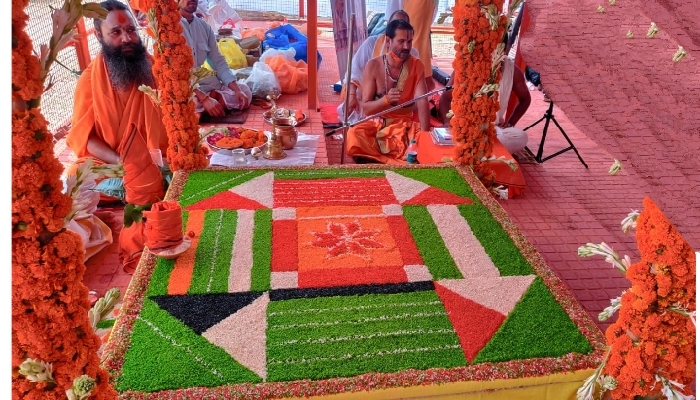
Ayodhya, Aug 4: Ramarchan puja begins at Ram Janmabhoomi site ahead of the foundation laying ceremony of Ram Temple in Ayodhya.
Ramarchan Puja is a prayer to invite all major gods and goddesses ahead of Lord Ram's arrival.

Mahesh Bhagchandka, one of the trustees of Ashok Singhal foundation as Yajman in the puja said, "This is being conducted at the temporary seat of Ramlalla. The pooja will be conducted in four phases."

Speaking about the third and fourth phases, he said: "In the third phase, Dashrath, father of Lord Ram with his wives will be worshipped and then all three brothers of Lord Ram - Laxman, Bharat and Shatrughan with their wives. Lord Hanuman ji will too be worshipped. Whereas in the fourth phase, Lord Ram will be worshipped."
Meanwhile, security has been heightened in Ayodhya ahead of the foundation laying ceremony.

Temples across the city is decorated with lights, diyas and flowers ahead of the grand event. Patna's Mahavir Mandir Trust is preparing over 1.25 lakh 'Raghupati Laddoos' for the occasion. Thes laddoos will be distributed as 'prasad' to devotees.

Uttar Pradesh Chief Minister Yogi Adityanath on Monday offered prayers at the Hanuman Garhi temple during his visit to Ayodhya to take stock of the preparations for the 'bhoomi pujan'.
He along with officials also visited 'Ram ki Paudi' to inspect the arrangements ahead of the foundation stone laying ceremony.

Prime Minister Narendra Modi is scheduled to lay the foundation stone of the Ram Temple in Ayodhya on August 5. 

Comments

Add new comment

  • Coastaldigest.com reserves the right to delete or block any comments.
  • Coastaldigset.com is not responsible for its readers’ comments.
  • Comments that are abusive, incendiary or irrelevant are strictly prohibited.
  • Please use a genuine email ID and provide your name to avoid reject.
Agencies
January 12,2020

Mumbai, Jan 12: Thousands of citizens on Sunday congregated in Mumbai's suburban Jogeshwari to oppose the new citizenship law, the proposed NRC and NPR.

They also condemned last Sunday's violence on the JNU campus in Delhi, where masked men ran riot and attacked students. Leftist organisations had claimed RSS-affiliated ABVP's role in the attack, a charge denied by the students' body.

Former Tata Institute of Social Science (TISS) general secretary Fahad Ahmed told PTI that they assembled under the aegis of 'Hum Bharat Ke Log' in Millat Nagar area.

"Prime minister Narendra Modi should call 56 students from across the country to debate on the CAA, NRC and NPR," Ahmed said in an apparent jibe at Modi's "56 inch chest" remark, which the latter had made ahead of the 2014 Lok Sabha polls.

"Why the PM is not talking to us? Why is he not communicating? Even the Britishers used to talk to Indians whom they ruled, but our PM is not talking to poor people," he alleged.

Bollywood actor Sushasht Singh also spoke on the occasion.

"We are people of this country and such acts (CAA) are tarnishing the image of our country," he said.

At the gathering, people waved banners with slogans like "I Am From Gujarat, My Documents Burned in 2002", "No CAA, Boycott NRC, Stop Dividing India, Don't Divide us", "Save Constitution", written on them.

A large number of police personnel were present at the venue.

The Citizenship Amendment Act (CAA), which was notified on January 10, grants Indian citizenship to non-Muslim minorities migrated to India from Afghanistan, Pakistan and Bangladesh till December 31, 2014, following persecution over their faith.

Massive protests were witnessed against the CAA, mainly by the student community, since its passage by Parliament in December last year.

Opposition parties have been dubbing the CAA an "anti-Muslim" legislation, a charge being debunked by the government.

The Congress and other parties like the TMC have also opposed the proposed National Register of Citizens (NRC) and the National Population Register (NPR).

Union home minister Amit Shah has said that the government won't rest until persecuted refugees are granted Indian citizenship.

Comments

Add new comment

  • Coastaldigest.com reserves the right to delete or block any comments.
  • Coastaldigset.com is not responsible for its readers’ comments.
  • Comments that are abusive, incendiary or irrelevant are strictly prohibited.
  • Please use a genuine email ID and provide your name to avoid reject.
News Network
June 15,2020

Sitamarhi, Jun 15: Eyewitness accounts from locals in Bihar's Sitamarhi district recount the brutality and intimidation by Nepal's security personnel who on June 12 had resorted to unprovoked firing on a group of people at the international border, which left one Indian dead and two others injured.

"18-20 shots were fired for over one hour and everyone is in shock even now," said Nitish Kumar, a resident of Jankinagar recalling the incident that took place early on Friday morning.

Nepal's Armed Police Force (APF) opened fire at the Lalbandi-Jankinagar border in which three men - Vikesh Yadav, Umesh Ram and Uday Thakur - suffered gunshot injuries. Vikash Yadav succumbed to his injuries on Friday itself.

Another person Lagan Kishore, who was at the border with his family to meet his daughter-in-law, a Nepali national and her family, said he was detained by the APF personnel who dragged him to the other side of the border.

Lagan Kishore said that the Nepali personnel abused and hit him with rifle butts and even abused his son and later resorted to firing.

Several residents of Jankinagar, who spoke to media, termed the incident as "unfortunate and shocking".

Nitish Kumar recalled: "A family was here to meet their in-laws (Nepali nationals). The daughter-in-law was talking to her family while her husband and her father-in-law sat a little distance away. Suddenly I saw Nepali personnel abusing her husband who complained about it to his father. All of a sudden the Nepali forces started thrashing them and then opened fire. They also took the father into custody."

"We were all shocked. I could hear about 18-20 gunshots fired over a period of one hour," Kumar said.

Another local, Ajit Kumar, said he was perplexed with the behaviour of the Nepali Police.

"There used to be no problems earlier. We don't understand what happened to the Nepal Police that day. The firing is unfortunate. If this continues, how will people in the border area live?" he questioned.

Ajit Kumar stated that such an incident has taken place for the first time. "People from here go to work in fields in Nepal and their people come to work in our fields. Such a thing has happened for the first time. About 80 per cent of our people are married to Nepalis," he said.

Many people who live in the adjoining districts of Bihar, which shares over 600 kilometres of border with Nepal, have relatives on either side of the border.

Meanwhile, Nepali police have claimed that Lagan Kishore, who was taken into custody following the firing by APF and handed over to Indian Security Forces at no man's land on June 13, was detained for trying to snatch a weapon from one of their personnel during an altercation.

However, both Kishore and his family have denied the claims and said he was "dragged" across the border and was beaten.

Kishore said that during the firing he had rushed towards the Indian side but Nepalese personnel hit him with rifle butt and took him to Nepal's Sangrampur. He was also asked to confess that he was taken into custody from the Nepali side.

"We ran to return to India when they started firing, but they dragged me from the Indian side, hit me with a rifle butt and took me to Nepal's Sangrampur. They told me to confess that I was brought there from Nepal. I told them you can kill me but I was brought there from India," said Kishore.

Kishore's son also said that Nepali personnel started abusing them and hit him and his father.

Speaking to ANI, Kishore's son said, "We went to meet my brother-in-law. Security personnel started abusing me but I could not understand their language. However, my brother's wife asked them to not abuse. After that, they came to the Indian side and hit me. I told my father about the incident and he confronted them."

"They started beating him and called fellow personnel who started firing and dragged my father from the Indian side, hit him with a rifle butt and took him to Nepal''s Sangrampur," he said.

Relations have become strained between India and Nepal after the latter released a map showing parts of Indian Territory-Lipulekh, Kalapani and Limpiyadhura as its own.

Comments

Add new comment

  • Coastaldigest.com reserves the right to delete or block any comments.
  • Coastaldigset.com is not responsible for its readers’ comments.
  • Comments that are abusive, incendiary or irrelevant are strictly prohibited.
  • Please use a genuine email ID and provide your name to avoid reject.