


Protests intensify after Karnataka releases Cauvery water to Tamil Nadu

September 7, 2016

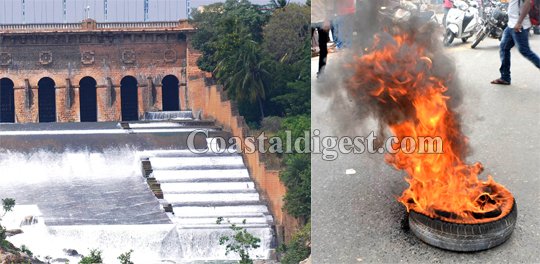
Bengaluru, Sep 7: Amid protests, Karnataka has started releasing Cauvery water to Tamil Nadu complying with the Supreme Court directive asking it to release 15,000 cusecs per day to the neighbouring state for ten days.
cavPInt

"Karnataka has started releasing Cauvery water to Tamil Nadu to obey the Supreme Court directive asking the state government to release 15,000 cusecs of water per day to Tamil Nadu for ten days," a state water resources ministry official said here.

He said the state started releasing water from midnight yesterday. Meanwhile, protesters have intensified their agitation in Mandya and other parts of the state blocking several roads and forcing schools and colleges to shut down. Complying with the Supreme Court direction, the state government yesterday decided to release water despite "severe hardships."

The court order directed an immediated backlash with agitated farmers and activists belonging to pro-Kannada outfits blocking the Bengaluru-Mysuru Highway.

Mandya district, the nucleus of Cauvery politics, saw a bandh yesterday with protesters holding road blockades and dharnas at several places, as hundreds of security personnel -- including central forces -- were deployed in the Cauvery belt to maintain law and order.

"Despite severe hardships faced by the government of Karnataka, the state will release water as directed by the Supreme Court," Chief Minister Siddaramaiah had told reporters after nearly a three-hour long all-party meeting convened by him here, yesterday.

Siddaramaiah had also said government would approach the Supreme Court with a modification petition, explaining its difficulties in implementing its order.

Noting that the 'samba' crops in Tamil Nadu would be adversely affected, an apex court bench comprising Justices Dipak Misra and U U Lalit directed Karnataka to ensure supply of water to Tamil Nadu.

Comments

fathima
 - 
Thursday, 8 Sep 2016

Stop blaming you people. Its not 'you',its 'us'. They are our people. Just like how yettinahole is crucial for mangaloreans,same goes with mandyans.As far as i know Tamilians are more proud being Tamilian than being Indian.They should see alternative ways for their problem.Always depending on Cauvery will make two states to fall in drought in coming days

Rikaz
 - 
Wednesday, 7 Sep 2016

Give them water, dont be selfish....

Priyanka
 - 
Wednesday, 7 Sep 2016

u people are protesting like anything when it comes to u, u cant give your water to anybody then how can u ask mangalore's water wasnt u ashamed of it. yethinahole always be ours.

Add new comment

  • Coastaldigest.com reserves the right to delete or block any comments.
  • Coastaldigset.com is not responsible for its readers’ comments.
  • Comments that are abusive, incendiary or irrelevant are strictly prohibited.
  • Please use a genuine email ID and provide your name to avoid reject.
coastaldigest.com news network
May 31,2020

Mangaluru, May 31:  Even as the worst locust attack on India in recent years raised concerns over its impact on crops, swarms of locusts have triggered panic in Karnataka’s Dakshina Kannada too. 

Farmers in the coastal district were taken aback when they found the swarms of locusts, which they feared as the arrival of desert locusts in the region.

According to reports, Renjalady village under the limits of Nuji Baltila Gramp Panchayats in Kadaba taluk and Shirlalu village in Belthangady taluk witnessed locust attacks in last couple of days. 

“Locust swarms were seen in many areas. We have also alerted agriculture department. Already insects have destroyed crops of many farmers,” said a farmer in Shirlalu village.  

Joint director of Dakshina Kannada district agriculture department MC Seetha confirmed that officials have received information from villagers about the locust scare and entemologists have already visited the place to collect more information.

Not Desert Locusts?

“We contacted entemologists and forwarded the pictures that farmers sent to us. Looking at the picture, entemologists have opined that it may be calotropis locust or colour grasshopper. Desert locusts usually arrive in lakhs,” said Ms Seetha. Desert locusts that are destroying crops in other parts of India may not come to Dakshina Kannada, she added.

Comments

Add new comment

  • Coastaldigest.com reserves the right to delete or block any comments.
  • Coastaldigset.com is not responsible for its readers’ comments.
  • Comments that are abusive, incendiary or irrelevant are strictly prohibited.
  • Please use a genuine email ID and provide your name to avoid reject.
News Network
April 4,2020

Mangaluru, Apr 4: The chemistry department of National Institute of Technology-Karnataka (NIT-K) here has started producing hand sanitizers in view of its shortage in the market after the coronavirus outbreak.

The social initiative led by Arun Isloor, professor and head of the department, was launched by NIT-K director K Uma Maheshwar Rao.

The raw materials needed for this product were provided by the institute.

Comments

Add new comment

  • Coastaldigest.com reserves the right to delete or block any comments.
  • Coastaldigset.com is not responsible for its readers’ comments.
  • Comments that are abusive, incendiary or irrelevant are strictly prohibited.
  • Please use a genuine email ID and provide your name to avoid reject.
News Network
June 26,2020

Bengaluru, Jun 26: The National Restaurant Association of India (NRAI) on Thursday came up with a Standard Operating Procedure (SOP) for restaurants whereby among other physical distancing norms, it has suggested a 2-metre gap between tables.

Formulated in partnership with Releski, a Bengaluru based skill-tech company, the SoP suggests that in case of back-to-back seating, people sitting with their backs towards each other will have their seats divided by 'Plexiglass' divider raised up to 2 meters from the ground.

"In a typical restaurant, the improvised seating plan should have a minimum distance of 2 metres between tables. The distance of 2 metres (6 feet) between tables should measure from one edge of the table to the other table's edge," it said.

In case of loose or free seating such as in banquet style or food court style seating, a minimum 2 meters of distance should be maintained between tables.

The guidelines noted that, to encourage physical distancing, restaurants have to sacrifice their seating capacity, to promote health and safety, and also to gain trust from their patrons.

"In order to perform this, divide your restaurants under different sectors. Pull out your restaurant's floor plan and colour code different sections red and yellow. Red sections are potential areas where maximum footfall or traffic is observed. Yellow sections are areas where the footfalls are average," it said.

All the red sections are encircled or bordered by placing barricades or Q manager and will open at specific points to access the yellow section and all the opening points will have hand sanitisers and sprays, and every guest who walks from red zones to yellow zones will sanitise himself/herself to reduce the chances of contamination.

For air conditioning, the guidelines of CPWD shall be followed which inter alia emphasises that the temperature setting of all air conditioning devices should be in the range of 24-30 degree Celsius, relative humidity should be in the range of 40- 65 per cent, intake of fresh air should be as much as possible and cross ventilation should be adequate, the guidelines suggested.

The industry body has also suggested appointment of a COVID-free Ambassador who would operate as the Chief Health Officer within the restaurant team, preferably from the management team in each shift.

The ambassador's would put the new daily work routines into practice, to monitor compliance with good practice and to lead the preventative measures, adapt to health & safety recommendations and requirements of the restaurant and oversee the implementation of the norms.

Anurag Katriar, President of NRAI and CEO & Executive Director of deGustibus Hospitality, said: "Every restaurant cutting across formats is facing the harsh reality of subdued to shut business volumes in the present and the uncertainty of business environment in the future. One thing is certain that hygiene and safety will be a key differentiator in the post-pandemic restaurant operations."

Comments

Add new comment

  • Coastaldigest.com reserves the right to delete or block any comments.
  • Coastaldigset.com is not responsible for its readers’ comments.
  • Comments that are abusive, incendiary or irrelevant are strictly prohibited.
  • Please use a genuine email ID and provide your name to avoid reject.